How to Offer a Competitive Buyer Agent Commission in Utah


A competitive buyer-agent offer isn’t about matching a “standard” percentage. It’s about making a clear, deliberate choice. If you’re weighing how to offer a competitive buyer agent commission in Utah, start here: no commission is automatic or fixed. Any seller contribution toward a buyer agent’s compensation is negotiable and is only one part of the purchase offer.
It’s understandable to wonder whether a low or unclear offer could affect buyer interest, especially as compensation practices change. Since August 17, 2024, buyer-agent compensation offers can’t be displayed on the MLS, and buyers must have a written agreement with their agent before touring homes. That makes clarity and thoughtful negotiation more important.
This guide explains how to set a compensation strategy that fits your sale goals, communicate it clearly, and weigh it alongside price and other offer terms. You’ll also see how a fixed-price MLS listing can help you control listing costs while keeping buyer-agent compensation a separate decision. The goal is to market your Utah home with confidence, protect your flexibility, and evaluate the full deal before deciding what works for you.
Key Takeaways
- Set a clear position on buyer-agent compensation that fits your sale goals, rather than assuming a standard rate.
- Compare compensation with the full offer, including price, financing, contingencies, timing, and confidence in closing.
- Use a step-by-step plan to decide on compensation and communicate your terms clearly.
- Understand how current compensation practices affect Utah sellers and why compensation offers don’t belong on the MLS.
- Separate buyer-agent compensation from listing-service costs, and consider how a fixed-price Utah MLS listing can support a cost-conscious sale strategy.
What Makes a Buyer Agent Commission Offer Competitive for a Utah Home?
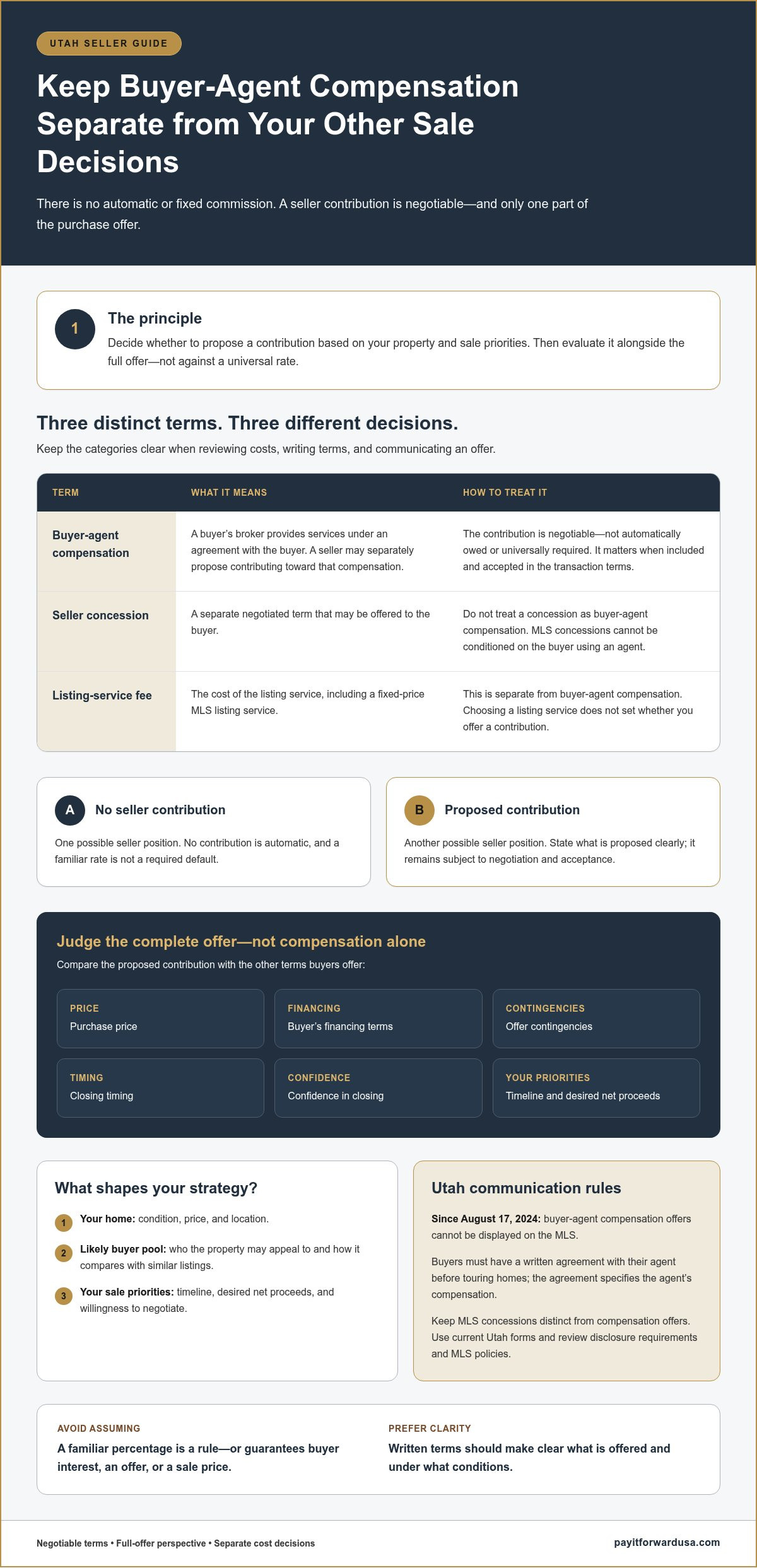
A competitive offer isn’t a magic percentage. It’s a clear proposal that fits your property, likely buyer pool, and sale priorities. One seller may decide not to contribute toward buyer-broker compensation; another may choose to include a contribution in negotiations. Neither approach is right for every home.
A competitive buyer-agent compensation offer is a clearly stated, negotiable contribution that supports your sale strategy and is evaluated alongside the full purchase offer, not against a universal rate. To decide how to offer a competitive buyer agent commission, work out what makes sense for your transaction, then assess the complete terms rather than the compensation figure alone.
What does buyer-agent compensation cover?
Buyer-agent compensation relates to services a buyer’s broker provides under an agreement with the buyer. That agreement sets out the compensation arrangement between those parties. A seller may separately propose contributing toward that compensation, but the seller’s proposal isn’t automatically owed or universally required. It matters when it is included and accepted in the transaction terms.
Keep the categories distinct. A seller concession is a separate negotiated term and shouldn’t be treated as the same thing as an offer toward buyer-broker compensation. A concession may be offered to the buyer, while compensation concerns payment for brokerage services. MLS concessions also can’t be conditioned on the buyer using an agent. Use wording and documentation that follow current forms and rules.
The seller’s listing-service fee is separate as well. Choosing a fixed-price MLS listing service is a decision about listing costs. It doesn’t set or determine whether you’ll offer anything toward a buyer’s broker compensation. Keeping these decisions separate gives you a clearer view of the costs and terms you’re choosing.
For a general overview of brokers’ roles and how commissions work across real estate transactions, see Understanding Real Estate Brokerage and Commissions. Treat broad industry context as background, not as a required rate for your Utah sale.
Why is there no one-size-fits-all commission?
Your home and priorities matter. Consider the property’s condition, price, location, and likely buyer pool. A home with features that appeal to a specific group of buyers may call for a different strategy than one competing with several similar listings. Your timeline, desired net proceeds, and willingness to negotiate also shape the decision.
Don’t mistake a familiar number for a rule. Commissions are negotiable, and no specific rate guarantees buyer interest, an offer, or a particular sale price. Decide what you can reasonably offer, if anything, and compare that choice with the other terms buyers propose, including price, financing, contingencies, and closing timing.
Utah sellers should use current transaction documents and follow applicable requirements for disclosures and communicating compensation. Buyer-agent compensation offers aren’t displayed on the MLS under current rules, so an MLS listing isn’t the right channel for sharing them. Review current Utah forms and MLS policies before communicating an offer, especially if rules or forms have changed.
How Current Compensation Practices Affect Utah Sellers
Buyer-agent compensation is a specific negotiation, not a figure sellers should assume will automatically appear with a listing. Under the practice changes that took effect on August 17, 2024, compensation offers are no longer displayed on the MLS. Buyers must have a written agreement with their agent before touring homes, and that agreement specifies the agent’s compensation. A federal appeals court made the settlement rules permanent on August 19, 2026.
A negotiated offer is a proposal to discuss; an assumed commission is a cost you may never have agreed to. You can consider a contribution as part of your sale strategy, but don’t treat a familiar rate or past practice as a default obligation.
How do buyer-broker agreements affect the offer?
A buyer and broker may agree on compensation before the buyer tours or purchases a home. That agreement shapes the buyer-side relationship. A seller’s offer may help address compensation in a transaction, but it doesn’t automatically replace or rewrite the buyer-broker agreement. The parties must consider how any contribution is proposed, documented, and accepted within the transaction.
For example, if a buyer’s written agreement sets compensation terms, a seller’s proposed contribution is a separate matter for negotiation. The buyer’s agreement and the purchase offer are not interchangeable documents. Avoid verbal assumptions or vague language. Written terms should make clear what is being offered and under what conditions.
Where and how should compensation terms be communicated?
Keep MLS information distinct from compensation discussions. Current rules don’t allow buyer-agent compensation offers to be displayed on the MLS. Sellers may offer buyer concessions through the MLS, but those concessions can’t be conditioned on the buyer using a real estate agent. These are different concepts, so don’t label a concession as an agent-compensation offer or assume one can replace the other.
How compensation may be shared outside the MLS depends on applicable rules and current policies. Before communicating terms, review current Utah forms, disclosure requirements, and MLS policies. The Utah Real Estate Regulations and Practices resource is a useful starting point for state-specific regulatory information. Confirm the current requirements that apply to your transaction.
Use precise, consistent wording in the appropriate written documents. Specify the amount or calculation method, who would receive the contribution, and any conditions, as appropriate to the current form and transaction. Avoid describing an offer as guaranteed or standard. If the purchase offer changes, review the compensation language alongside the revised terms.
To keep listing costs separate from this negotiation, a fixed-price Utah MLS listing approach lets you make the listing-service decision independently from any buyer-agent contribution.
How to Judge Whether Your Buyer-Agent Offer Is Competitive
Judge the offer by how it fits your overall sale, not by a commission-rate benchmark. A contribution toward buyer-agent compensation may be one term buyers consider, but it doesn’t determine whether an offer is strong by itself. Compare it with the price, financing, contingencies, requested concessions, closing timeline, and your likely net proceeds.
Market context can help you think through buyer demand, but it can’t predict how a particular buyer or agent will respond. The National Association of REALTORS® offers information about industry practices and changes through its real estate resources. Use broad industry guidance as context, not as proof that one compensation figure is required or will produce a specific result.
Which factors should shape the offer?
Start with your property and priorities. Consider which buyers are most likely to consider the home, how it compares with similar options, and whether your main goal is protecting net proceeds, keeping terms simple, or preserving room to negotiate. A seller who values flexibility may approach compensation differently from one who prefers to make a defined proposal upfront. There’s no universal Utah rate that settles the question.
Use this comparison to identify the trade-offs that matter to you:
| Factor | Seller priority | Potential trade-off |
|---|---|---|
| Compensation contribution | Set a limit that fits your proceeds goal | A lower or absent offer may become a negotiation point, but doesn’t require an agent or buyer to reject the home |
| Purchase price | Protect the sale price and net proceeds | A higher price may be offset by other requested terms or costs |
| Financing and contingencies | Weigh the buyer’s financing plan and conditions | Fewer or different contingencies can change the risks and certainty you’re accepting |
| Timing and concessions | Choose a timeline and terms that work for your move | A faster close or requested concession may affect convenience or proceeds |
How should compensation compare with the rest of an offer?
Calculate the likely net from the complete proposal. Consider the offered price alongside any seller-paid compensation, concessions, and other costs or terms that affect your proceeds. Then weigh the financing, contingencies, and closing schedule. A higher-priced offer isn’t automatically better if its conditions or timing concern you. A lower-priced offer may still deserve consideration if its overall terms better fit your priorities.
For example, list the terms of two offers side by side. One may offer a stronger price but request more concessions or a longer timeline. Another may include a proposed contribution toward buyer-agent compensation but have more workable terms. Don’t isolate that contribution or assume it determines the outcome. Review the written terms together and negotiate the parts you’re willing to change.
Your best choice depends on your goals and the actual terms presented. Set priorities before reviewing offers, then assess each proposal consistently. That gives you a clear basis for deciding whether compensation supports the transaction, needs adjustment, or isn’t the right fit.
How to Set and Communicate a Competitive Offer Step by Step
A sound decision starts with your sale goals, not pressure to match a number someone calls standard. Use this process to set a position you can explain, then adjust it as written offers and buyer feedback come in. That’s how to offer a competitive buyer agent commission without giving up control of your negotiation.
A practical seller decision process
- Set your net-proceeds target. Estimate the amount you want to retain after the sale, accounting for expected transaction costs. Treat any proposed buyer-agent contribution as a possible cost, not an automatic deduction.
- Choose your priorities. Decide which terms matter most: protecting proceeds, keeping negotiations flexible, or aiming for a simpler transaction. Identify in advance what you might adjust and what you’re not willing to change.
- Choose an initial position. You can make a clear compensation proposal, wait and negotiate in response to a written offer, or consider another structure permitted under current rules. Don’t feel locked into a figure just because it’s familiar or suggested by someone else.
- Reassess with new information. Buyer feedback and written offers can reveal which terms matter in your transaction. Revisit your position if circumstances change, and compare any revision with the offer’s price, financing, contingencies, concessions, and timeline.
This gives you a framework, not a promise of a particular result. A lower or absent contribution may become a negotiation point, but it doesn’t mean a buyer or agent must reject the home. Decide based on what works for your sale and the full terms on the table.
How to make terms clear in writing
Precision prevents mismatched expectations. In the appropriate transaction documents, state the proposed amount or calculation, who the contribution is intended for, and any applicable conditions. Avoid vague wording such as “standard compensation” or “commission as customary.” Those phrases can leave the amount and the parties’ intent unclear.
Before putting terms forward, confirm which current Utah forms apply, how compensation should be documented, and which communication channels are permitted under current MLS policies and other requirements. Rules and forms can change, so don’t rely on an old template or verbal summary. Use consistent language in the written offer and related communications.
Keep copies of written proposals, counteroffers, and accepted terms with your transaction records. If the buyer changes the price, asks for concessions, or revises other conditions, review the compensation language alongside those changes. The goal is a clear record of what was proposed and what the parties ultimately accepted.
If you’re planning a cost-conscious sale, explore Utah MLS listing options while keeping listing-service costs separate from your buyer-agent compensation decision.
How a Utah MLS Listing Fits Your Compensation Strategy
Your listing-service choice and any contribution toward buyer-agent compensation are separate decisions. One covers how you arrange your home’s listing; the other is a negotiable transaction term. Keeping them separate makes it easier to understand the costs, proceeds, and negotiating flexibility involved in each choice.
A fixed-price MLS listing can support a cost-conscious approach by keeping the listing-service cost distinct from a percentage-based fee structure. It doesn’t determine whether you’ll offer buyer-agent compensation or guarantee buyer interest or a particular sale result. You still set your compensation position based on your property, timeline, and sale goals. That distinction is central to offering a competitive buyer agent commission without treating any payment as automatic.
How can a seller control listing costs separately?
With a flat-fee MLS listing, the listing-service cost is structured separately from the sale price. This gives sellers another way to approach listing expenses while leaving buyer-agent compensation as a separate decision. Pay It Forward Realty LLC provides fixed-price MLS listing services for Utah sellers, with packages starting at $89. Sellers can choose the $89 Affordable Package, the $195 Affordable Plus Package, or a $29 monthly listing plan.
Keep a simple cost worksheet as you plan. Record your listing-service expense separately from any proposed buyer-agent contribution, concessions, and other transaction costs. Then estimate how each choice could affect your net proceeds. These categories may interact in a negotiated offer, but they shouldn’t be blurred together when deciding what to propose.
This separation also prevents a common assumption: choosing an MLS listing service doesn’t automatically include or require a buyer-agent compensation offer. Review the listing arrangement and any later purchase offer on their own terms. Consider how the full transaction fits your priorities before agreeing to additional costs.
What should sellers do before deciding?
Consider the whole sale plan. Your home’s features, likely buyer audience, preferred timeline, and net-proceeds target all inform the decision. A strategy that fits one property or seller may not suit another. Set priorities first, then decide whether a compensation proposal supports them or whether you’d rather keep that point open for negotiation.
- Review your listing costs separately from potential buyer-agent compensation.
- Consider the likely buyer audience and how your property fits available alternatives.
- Compare proposed compensation with price, financing, contingencies, concessions, and timing.
- Use current Utah transaction documents and verify applicable requirements for communicating compensation.
Keep your plan flexible enough to respond to written offers, but don’t let outside pressure replace your own priorities. If the terms change, revisit the full net-proceeds picture and make sure the written documents clearly reflect what you’re willing to accept.
Ready to consider a cost-conscious listing structure alongside your compensation strategy? Explore Pay It Forward Realty LLC’s Utah listing service.
Make Your Next Move With Confidence
Your compensation decision should serve your sale plan, not someone else’s expectations. Before you commit, write down your priorities: the proceeds you want to protect, the terms you’re open to negotiating, and the transaction details that matter most. That can keep the conversation grounded when an offer arrives.
Knowing how to offer a competitive buyer agent commission means staying deliberate while evaluating each buyer’s complete proposal. You don’t have to decide listing costs and buyer-agent compensation as one package. Pay It Forward Realty LLC’s Utah listing approach keeps those decisions distinct. For buyers, the brokerage also offers a separate rebate of up to $5,000. The brokerage is owned and operated by Principal Broker Kurt Mathewson.
Take the next step by reviewing a listing structure that fits your priorities. Explore Pay It Forward Realty LLC’s Utah MLS listing options and move forward with a plan that keeps your choices clear. You’re in control of the terms you’re willing to negotiate.
Frequently Asked Questions
Is a buyer-agent commission required by law in Utah?
No. Utah law doesn’t require a seller to pay buyer-agent compensation or set a universal commission rate. Compensation is negotiable, and a seller can decide whether to propose a contribution as part of a sale. A buyer may have a separate written compensation agreement with their broker. Review the purchase documents and current requirements before deciding how any seller contribution fits the transaction.
How much should I offer a buyer’s agent?
There’s no set amount you must offer. To decide how to offer a competitive buyer agent commission, start with your net-proceeds goal and weigh the offer against your property, likely buyer audience, and other terms you’re prepared to negotiate. This applies whether you’re selling in Saratoga Springs, Lehi, Eagle Mountain, South Jordan, Herriman, Orem, Provo, Alpine, Draper, Sandy, Bluffdale, American Fork, Highland, Cedar Hills, Lindon, West Jordan, West Valley, Salt Lake, Bountiful, South Salt Lake, or Murray. Don’t treat another home’s terms as a required benchmark.
Can a buyer-agent compensation offer be negotiated after a buyer submits an offer?
Yes. The parties can negotiate compensation as part of the offer and counteroffer process, subject to current rules and applicable documents. For example, you might respond to a buyer’s offer by proposing a different seller contribution alongside a price or closing-date counter. Put any agreed change in the appropriate written paperwork. Don’t rely on a verbal discussion as proof that the purchase terms or compensation arrangement changed.
What happens if the buyer-agent compensation agreement is higher than the seller’s offer?
The gap doesn’t automatically require you to increase your offer. The buyer’s agreement with their broker and the seller’s proposed contribution are separate arrangements. What the buyer may owe depends on the terms of their agreement and the transaction documents. The buyer and seller can negotiate whether to revise the seller contribution, adjust other terms, or proceed as proposed. Make sure the final written terms clearly state what the seller has agreed to contribute.
Can I change my buyer-agent compensation offer after listing my Utah home?
Generally, you can revise a proposed offer before it’s accepted, but don’t assume an accepted written agreement can be changed unilaterally. If you want to adjust terms after listing, determine whether a buyer has already relied on or accepted a written proposal, then document any agreed revision properly. Also follow current rules for communicating compensation. An MLS listing isn’t a place to publish buyer-agent compensation offers.
Does offering buyer-agent compensation guarantee more showings or a faster sale?
No. A compensation offer can be one factor in a buyer’s overall decision, but it can’t guarantee showings, an offer, a particular sale price, or a faster closing. Buyers also consider the home, price, location, financing, and purchase conditions. Track actual responses to your listing and compare written offers on their full terms. If interest is limited, review the complete sale strategy rather than assuming compensation alone explains the outcome.
Can buyer-agent compensation be handled differently for different offers?
Yes. You can evaluate and negotiate proposed compensation separately for each offer, as long as the terms are handled and documented under current requirements. One buyer’s offer might request a contribution while another doesn’t. Compare both alongside price, financing, contingencies, concessions, and timing. Keep your response clear and consistent within each transaction, and don’t communicate compensation through the MLS. Follow the applicable forms and rules before finalizing different terms.