What you don’t get with a flat fee listing: Includes and leaves out


~What you don’t get with a flat fee listing~
A lower listing fee can still leave you with more of the sale to manage. With a flat-fee MLS listing, what you don’t get may include hands-on help with pricing, showings, offer negotiations, and transaction details. The exact support depends on the package.
That trade-off does not make the model wrong. A flat fee is a fixed amount rather than a percentage of the sale price, and it can put a home on the MLS without bundling every service that a commission-based arrangement may provide. The key is to understand which work is covered before choosing.
This guide explains what a flat-fee MLS listing typically includes, where support may stop, and how buyer-agent compensation is separate from the listing fee. You’ll also learn how to weigh potential savings against the time, decisions, and transaction coordination that may remain yours, so you can choose an arrangement that fits how involved you want to be.
Key Takeaways
~What you don’t get with a flat fee listing~
- Separate MLS exposure from hands-on representation so you can see what the listing fee actually covers.
- Identify who will manage inquiries, showings, offers, and deadlines if the package provides limited support.
- Compare package details such as listing changes, photos, signage, and transaction assistance before choosing.
- Assess the fixed listing fee alongside any separately negotiated compensation and the services you want throughout the sale.
- What you don’t get with a flat fee listing
What is a flat fee MLS listing?
~What you don’t get with a flat fee listing~
A flat-fee MLS listing uses a fixed fee to place a home in the Multiple Listing Service (MLS), rather than charging a percentage of its sale price. Only a licensed real estate agent can enter a property into the MLS, so a broker or agent handles that step.
After the listing goes live, support may be limited while the seller manages much of the sale. The listing agreement defines the broker’s role: it may cover MLS entry alone or include help with pricing, inquiries, and offers. The practical answer to what you don’t get with a flat fee listing depends on the broker’s written duties.
Provider Support for Seller-Managed Pricing and Negotiations
Pricing and negotiation support depend on the services in the listing agreement, while sellers often make the final decisions. Some packages provide pricing guidance or help with offers; an entry-only flat-fee MLS service may simply publish the listing and forward buyer leads. Knowing what you don’t get with a flat fee listing helps you decide whether you can manage the remaining work.
For example, a seller may receive an offer but still need to assess its price, financing, and requested conditions. If the package does not include negotiation assistance, the seller handles the response and coordinates the transaction. A realtor’s involvement does not automatically mean full-service representation.
Showings and Basic-Package Support
~What you don’t get with a flat fee listing~
With a basic package, a broker may forward showing requests or buyer inquiries to the seller, who then schedules appointments and manages access. This can affect the seller’s availability and workload, especially when several buyers request tours. MLS visibility does not necessarily mean the broker manages each showing.
The seller may also answer questions, gather feedback, and follow up after visits. The listing agreement explains whether the broker handles any of these tasks or whether they remain the seller’s responsibility. Clear roles matter: a missed inquiry or delayed reply can interrupt communication with a potential buyer.
Broker responsiveness is part of practical support, but it does not replace clearly defined services. The agreement should explain how requests reach the broker and what assistance is available after the listing goes live. In a limited-service arrangement, the broker handles the contracted MLS work; the seller typically manages the remaining steps, from showings to offer decisions and closing coordination.
Flat-fee MLS listing services and typical service limitations
~What you don’t get with a flat fee listing~
A flat-fee agreement defines the broker’s duties, which may stop at MLS entry or include additional help. The service level affects both the seller’s workload and the costs to consider.
Service Trade-Offs and Sale Outcomes
With limited service, the seller takes on tasks that a full-service real estate agent may handle. That trade-off matters because sellers may manage inquiries, disclosures, and transaction coordination when those duties are not included in the agreement.
A local MLS listing can reach agents and home-search sites such as Realtor.com, Public Wasatch Front MLS, and Zillow, but visibility does not guarantee a sale or determine its terms. Buyers’ needs, property details, pricing, and how promptly sellers respond can all shape what happens next.
Costs and Results Compared
Compare total costs by adding the listing fee, any separately agreed buyer-agent compensation, and other sale expenses. Full-service agents may bundle more support, while a flat-fee arrangement may leave sellers to coordinate more of the transaction.
Neither structure guarantees a particular sale price or outcome. Because real estate commissions are negotiable, compare the services and terms in each written agreement, not just the payment method.
Flat-fee plans commonly cover MLS entry and syndication, while photos, signage, contract review, and negotiation assistance can vary. Some services provide customer support or tools for contacting buyers; others offer limited broker involvement. The broker’s role depends on the listing agreement, so the word “broker” alone does not tell you how much help is included.
Written duties are especially important with limited-service representation. The agreement should explain which tasks the broker handles and which remain with the seller. Sellers may be responsible for accurate property information and completing disclosures. Incomplete information or a missed transaction deadline can lead to disputes; having a broker enter the listing does not remove the seller’s responsibilities.
Since August 17, 2024, the National Association of Realtors settlement prohibits publishing offers of compensation to buyer agents in the MLS. Buyer-agent compensation is agreed between the buyer’s agent and that agent’s buyer; a seller may separately offer a concession toward closing costs. For a listing with limited support, flat-fee MLS listing options can be a relevant next step.
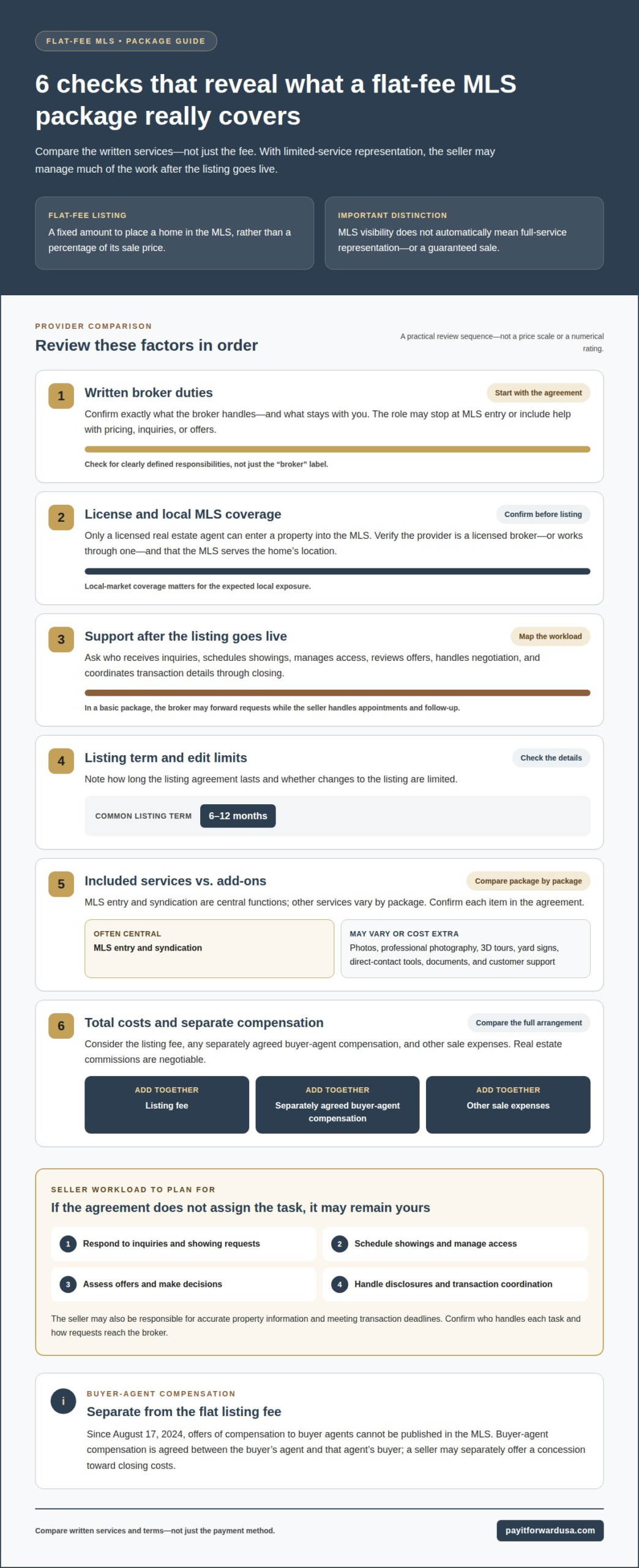
Evaluating flat fee MLS providers and package inclusions
~What you don’t get with a flat fee listing~
Compare each listing service by its written scope, local MLS coverage, and support through closing. The package label alone will not show what the broker handles or what remains the seller’s responsibility.
Start with the listing agreement. Confirm that the provider is a licensed broker or works through one, and that the property will enter the MLS serving its location. Coverage matters: an MLS service that doesn’t serve the home’s local market won’t provide the expected local exposure. Also note the listing term, commonly 6-12 months, and whether changes to the listing have limits.
Next, separate core listing functions from add-ons. MLS entry and syndication are central; photos may be included, while professional photography and 3D tours are often upgrades. A yard sign, direct-contact tools, downloadable documents, and customer support can also vary by package. For example, a seller who expects a photographer or help answering buyers’ inquiries should identify that service in the agreement, rather than assume it comes with syndication to home-search websites.
Compare the full arrangement, not just the advertised listing fee. Look for closing or transaction charges, cancellation terms, and whether broker support includes contract review or negotiation help. A percentage-based charge at closing changes the total-cost calculation, as can separately agreed buyer-agent compensation. These terms affect both what the seller pays and what help is available during the sale.
Finally, consider how to get help and how quickly the service responds. The agreement should explain how sellers submit listing changes, report an error, or request assistance with an inquiry. For example, if a buyer spots an incorrect room detail before a showing, knowing who handles the correction and how to reach them is more useful than a general promise of support. Clear responsibilities make it easier to compare services, access, and costs.
How flat-fee listings differ from commission-based arrangements
~What you don’t get with a flat fee listing~
A flat-fee service charges a fixed listing amount, while a commission-based arrangement usually calculates the listing agent’s charge as a percentage of the sale price. This changes how the listing cost relates to the final sale amount. The flat fee is generally owed whether the home sells or not; with a percentage-based charge, the amount depends on the agreed rate and sale price.
The payment model does not tell you the full service level. A commission-based package may include pricing support, marketing, offer negotiations, and transaction coordination. A flat-fee package may focus on MLS entry and leave sellers to manage some later steps. Compare the written duties, not just how the listing agent is paid. The MLS method itself does not determine whether buyers’ agents show a home; they consider whether it fits their clients’ needs.
Flat-fee MLS listings can involve buyer-agent compensation, but offers of compensation can’t be published in the MLS under the National Association of Realtors settlement, effective August 17, 2024. Compensation is negotiated outside the MLS between the buyer’s agent and that agent’s buyer. A seller may separately agree to pay compensation or offer a concession toward the buyer’s closing costs.
Buyer agents may set out compensation in a written agreement with their clients before showing a home. That agreement is between the buyer and their agent; it doesn’t automatically make the seller responsible for paying the amount. Sellers can assess any proposed payment as part of the offer terms, alongside price, contingencies, and other contract details.
The practical takeaway: compare the fixed listing charge, any negotiated buyer-agent compensation, and the support each package provides. A fixed fee can make the listing charge easier to separate from the sale price, but the seller may still manage responsibilities beyond listing. Explore flat-fee MLS listing options to see how a fixed-fee approach fits your selling plans.
Pay It Forward Realty LLC offers Utah homeowners a flat-fee MLS listing option through its Monthly Listing Plan. It may suit sellers who prefer a monthly plan and are prepared to manage responsibilities beyond the listing. The right fit depends on the support you want and the work you are ready to handle.
Other listing options include the Affordable Package and Affordable Plus Package. Each offers a different way to approach a flat-fee listing, so consider which package aligns with your selling plans and desired level of involvement. A flat-fee MLS arrangement is not the same as full-service representation, so understand the agreed responsibilities before moving forward.
If you’re weighing a flat-fee MLS listing for your Utah home, contact Pay It Forward Realty LLC to discuss your options.
Choose the level of support that fits your sale
~What you don’t get with a flat fee listing~
The best listing arrangement is the one whose responsibilities match your available time, confidence, and need for professional guidance. Before moving forward, decide which parts of selling you want to manage and where you want broker support. That clarity helps you choose based on fit, not just how the fee is structured.
Understanding what you don’t get with a flat fee listing can help you set expectations and plan for the work ahead. For Utah homeowners considering a flat-fee MLS listing, Pay It Forward Realty LLC offers the Monthly Listing Plan, Affordable Package, and Affordable Plus Package. Compare the options with the level of support you want throughout the transaction.
Ready to discuss which option fits your plans? Contact Pay It Forward Realty LLC and take your next step with a clearer picture of the arrangement.
Frequently Asked Questions
~What you don’t get with a flat fee listing~
What is a flat fee in real estate?
A flat fee is a set dollar charge for an agreed real estate service, rather than a charge calculated as a percentage of the home’s sale price. For example, the listing charge remains fixed even if the final accepted offer differs from the seller’s initial asking price. The listing agreement spells out what that fixed payment covers.
Is a flat fee better than a commission?
Neither payment model is automatically better; the right fit depends on the services you need and the work you can manage. A seller comfortable coordinating appointments and reviewing offers may value a fixed listing charge. Someone who wants ongoing help with marketing, negotiation, and transaction details may prefer broader representation. Compare the full scope and expected responsibilities before deciding.
What you don’t get with a flat fee listing?
Excluded services vary by agreement, but a limited package may leave sellers to arrange photography, set the asking price, respond to buyers, and coordinate inspections or closing details. For example, MLS placement alone does not mean a photographer will prepare listing images or a broker will negotiate an inspection request. Treat a service as included only when the agreement assigns it. Pay It Forward Realty, LLC bridges the gap by offering full service options that you want or need but only charge small flat fees for these services. (i.e.-negotiating, completing contracts, addendums, and proper disclosures is only $695. To set up and/or communicate with Title, Appraisers, Inspectors, Lenders, and Buyer’s Agent Pay It Forward Realty will do this for only $375. For under $1,100 you can have a professional Realtor help you finish your transaction. Sure beats paying a Realtor 3% commission ($15,000 on a sale price of $500,000. commission!
What services do full-service real estate agents provide that flat-fee brokers may not?
~What you don’t get with a flat fee listing~
Full-service agents may provide ongoing guidance on pricing, marketing, offer evaluation, negotiation, and transaction coordination. A limited flat-fee broker may handle only specific contracted tasks, such as MLS entry. When responding to an inspection request, for example, the key difference is whether an agent helps assess the request and shape a response, or the seller handles it independently.
Who handles buyer inquiries and showing requests with a flat-fee listing?
~What you don’t get with a flat fee listing~
The listing agreement determines who receives inquiries, and sellers often handle follow-up and showing logistics in limited-service arrangements. For example, a buyer may ask about access before scheduling a tour. If the broker forwards the message, the seller needs to reply and coordinate the appointment. A defined contact process helps prevent inquiries from being overlooked.
Does a flat-fee listing include pricing advice, negotiation, or contract support?
~What you don’t get with a flat fee listing~
Those services are not automatic; the package and listing agreement determine whether broker assistance covers them. A seller considering an offer with a short response deadline, for example, needs to know whether contract guidance or negotiation help is included. Review the specific duties in the agreement to understand who answers questions and manages each decision.
~What you don’t get with a flat fee listing~