Pros and Cons of Flat Fee Real Estate Services for Sellers


~Pros and Cons of Flat Fee Real Estate Services~
A fixed listing fee changes more than the bill: it can also change how much of the sale you manage. The pros and cons of flat fee real estate services come down to that trade-off: a set charge for listing help, but potentially less hands-on support with pricing, showings, negotiations, and paperwork. This option may suit sellers who want predictable costs and are ready to handle more of the process themselves.
Keeping selling costs in check is a sensible goal, but the fee alone doesn’t tell you what help you’ll receive or which tasks remain yours. Some packages focus on an MLS listing, while others include more support, so compare the service scope as carefully as the price.
This guide explains how flat-fee services work, where they may save money, and what their limitations can mean in practice. You’ll learn how the options compare and how to decide whether a flat-fee service fits your sale.
Key Takeaways
~Pros and Cons of Flat Fee Real Estate Services~
- Match the fee structure to the level of support you want and the tasks you’re prepared to manage.
- Look beyond the headline fee to understand possible add-ons and how the compensation arrangement affects your total costs.
- Plan for your role in pricing, showings, negotiations, and paperwork before choosing a limited-service option.
- Use the decision guide to identify whether a flat-fee listing fits your sale and which listing option best aligns with your needs.
When should you use a flat-fee agent?
~Pros and Cons of Flat Fee Real Estate Services~
Use one when you want a defined listing cost and can take on some selling tasks. In the United States, traditional listing commissions commonly run around 2.5% to 3% of the sale price; full-service discount brokers typically charge 1% to 2%, compared with a traditional listing fee of 2.76%. A fee MLS listing can suit sellers who want MLS exposure without the same level of agent support.
Flat-fee models differ in both price and service. Before choosing one, compare what the listing service covers, what triggers extra charges, and who handles buyer inquiries and showings. Read the service agreement for included tasks, add-ons, and cancellation terms, then decide how much hands-on guidance you need.
| Option | Listing compensation | Typical support focus |
|---|---|---|
| Traditional agent | Usually 2.5% to 3% | Broader listing and sale support |
| Full-service discount broker | Typically 1% to 2% | Full-service model at a lower listing rate |
| Flat-fee MLS listing | Set fee structure | MLS placement, with scope varying by package |
Buyer-agent compensation is a separate budget consideration. Sellers may still be responsible for buyer-agent compensation, which usually ranges from 2% to 3% of the sale price. Treat it as a separate negotiation and cost when estimating proceeds; a flat listing fee does not automatically cover it.
State and MLS requirements depend on where the property is listed. They may cover listing documentation, disclosures, and how listing information is submitted or updated. A flat fee doesn’t remove those responsibilities.
Choose a structure that fits your available time, transaction experience, and preferred level of support. If you’re comfortable handling pricing decisions and showings, a limited listing service may fit. If you want broader guidance, compare services by the work they include, not the compensation structure alone.
What are the Pros and Cons of Flat Fee Real Estate Brokers?
~Pros and Cons of Flat Fee Real Estate Services~
The pros and cons of flat fee real estate services come down to cost, included support, and seller workload. A fixed listing charge can make that expense more predictable, but your total transaction costs matter more than one line item.
Potential Savings from Fixed Fees
A fixed fee doesn’t rise with the home’s sale price, unlike percentage-based listing compensation. That can appeal to sellers who want a predictable listing expense. But the fee alone doesn’t determine your savings. Include add-ons and any separately negotiated buyer-agent compensation, then compare the expected total costs with the services provided. This will help you assess whether the fee fits your budget and selling plan.
Savings on High-Value Home Sales
~Pros and Cons of Flat Fee Real Estate Services~
On a higher-value sale, percentage-based compensation increases with the price, while a flat listing fee stays fixed. That difference may create more room for savings if the package covers the work you need. Still, a lower listing expense doesn’t guarantee higher net proceeds. The result also depends on the sale price, negotiated terms, extra services, and other transaction costs.
Additional Fees and Lower Sale Prices
~Pros and Cons of Flat Fee Real Estate Services~
Some flat-fee MLS services charge separately for listing changes, photography, or open houses. Add those costs to your estimate before deciding whether the fee structure saves money. A limited package may also leave you to manage pricing and negotiations, which takes time and affects how you handle the sale.
In the United States in 2024, FSBO homes sold for a median of $380,000, compared with $435,000 for agent-assisted sales. These figures compare different sale approaches; they don’t show that a flat-fee listing causes a lower price. Weighing the pros and cons of flat fee real estate services means considering both likely proceeds and the support needed to manage the sale.
List the included services, possible add-ons, and any compensation you may negotiate with a buyer’s agent. Sellers considering a defined-fee listing can explore flat-fee listing options as part of that comparison.
Limited help and seller responsibilities
~Pros and Cons of Flat Fee Real Estate Services~
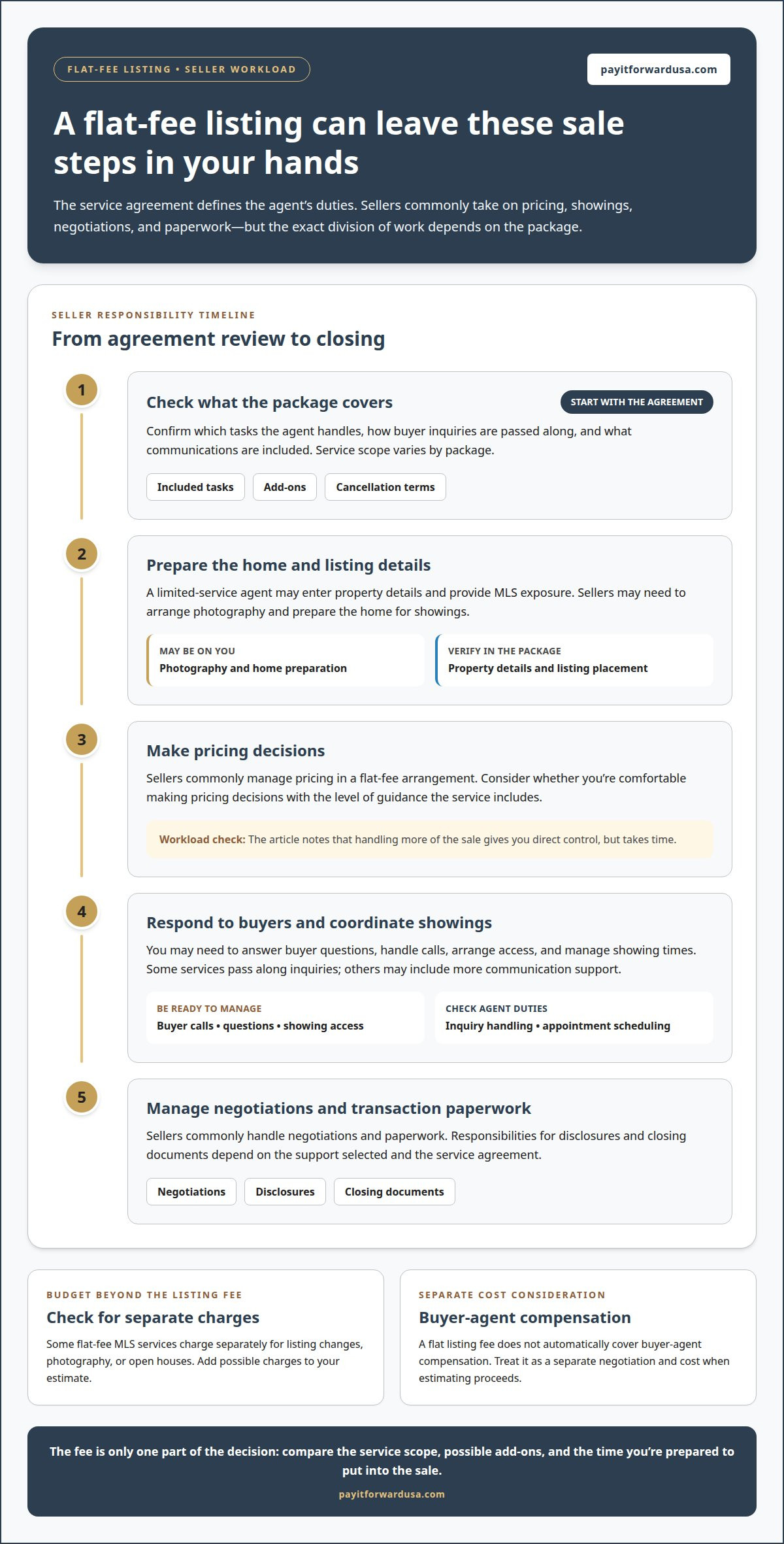
In a flat-fee arrangement, the agreement defines the agent’s duties. Sellers commonly manage pricing, showings, negotiations, and paperwork. Their role in disclosures and closing documents depends on the support they select.
Limited Agent Help
Limited support often focuses on listing exposure rather than managing every transaction step. A flat-fee agent may enter property details and pass along buyer inquiries, while sellers arrange photography and prepare the home for showings. Some services leave clients to handle calls and paperwork, so responsibilities can extend well beyond the initial listing. Review the agreement to see which tasks and communications the agent handles.
For example, if buyers ask about a feature or request a showing, you may need to respond and coordinate access. That can work well if your schedule is flexible and you’re comfortable talking with buyers. If you expect an agent to field inquiries, schedule appointments, and guide negotiations, check whether those tasks are included in the package.
Seller Control and Workload
~Pros and Cons of Flat Fee Real Estate Services~
Handling more tasks gives you direct control over key decisions. You can set a pricing approach, choose photography, manage showing times, and respond to buyer feedback without waiting for an agent. That control takes time, too. Organizing photos, preparing the home, tracking inquiries, and moving paperwork forward can become a substantial workload during an active sale.
Assess the fit by mapping the tasks against your weekly schedule. For example, consider who can answer buyer calls during work hours and accommodate a showing request. If those jobs fall to you, factor in the time and any separate service charges, not just the dollars saved on representation.
Handling the Sale Process
~Pros and Cons of Flat Fee Real Estate Services~
Pricing, showings, negotiations, disclosures, and closing all require attention, but the agent’s role can vary by agreement. Sellers may set the asking price, host or coordinate showings, and respond to offers. They also manage disclosure information and closing paperwork, with agent assistance depending on the selected service.
Before listing, write down who handles each step and how buyers’ questions reach you. Confirm the process for reviewing offers, communicating changes, and completing documents. Clear task ownership helps you avoid missed messages and last-minute paperwork scrambles while retaining control over the decisions that matter to you.
How flat-fee real estate services work
~Pros and Cons of Flat Fee Real Estate Services~
A flat fee is a set charge for a defined real estate service, regardless of its duration or complexity. Unlike percentage-based compensation, it doesn’t rise with the final sale price. The term can describe different service levels, from an MLS listing to broader assistance. The agreement, not the phrase “flat fee,” explains what the agent will do.
An MLS listing generally places the property in the database agents use to find homes for buyers. A basic package may cover listing placement, while other packages add support. The transaction then moves through several stages, and the service agreement determines how the agent and seller divide the tasks.
- Choose the service scope. Compare listing placement with any additional help, and identify tasks not included.
- Provide property details. The listing relies on accurate home information and seller-provided decisions about presentation and pricing.
- Publish and manage the listing. The MLS entry shares the home with agents searching that database; changes may follow the service’s process.
- Continue through the sale. Buyers’ inquiries, offers, negotiations, and closing steps follow the responsibilities set out in the agreement.
Some MLS packages may keep a listing active for 6-12 months. That duration describes a possible package term, not a promise that a home will sell within that window. The seller should understand what happens if details change, the listing needs updates, or a sale takes longer. A realtor’s role can be narrower than in a percentage-based arrangement, so the agreement is central.
For real estate brokers, the key difference is how compensation relates to the service and final sale price. A fixed charge stays the same, while percentage-based compensation changes with the sale price. Neither structure defines the support on its own. Read the service scope, identify who is responsible for each transaction step, and account for any separately negotiated buyer-agent compensation.
To see how a fixed-fee MLS listing can fit your sale, explore flat-fee listing options.
Pay It Forward Realty
~Pros and Cons of Flat Fee Real Estate Services~
Pay It Forward Realty LLC helps Utah homeowners compare flat-fee MLS listing options with the support and responsibilities they want. Options include the Affordable Package, Affordable Plus Package, and Monthly Listing Plan. Consider a flat-fee listing if you want MLS exposure through a defined-fee arrangement and are prepared to manage some parts of the sale yourself. The right fit depends on the support you need and the tasks you prefer to handle.
If you’re weighing these trade-offs for a Utah sale, contact Pay It Forward Realty LLC to discuss your listing options.
Choose a Selling Plan That Fits You
~Pros and Cons of Flat Fee Real Estate Services~
Turn your preferred level of control into a practical selling plan. Before choosing a service, set priorities for timing, decision-making, and the assistance you value most. A clear plan lets you compare each option with how you want to manage the sale, rather than letting a familiar compensation model make the decision for you.
A thoughtful assessment of the pros and cons of flat fee real estate services can help you choose with your goals in view. Consider what you want to handle personally, where you want professional support, and how much time you can commit as the sale progresses. These priorities can also make your conversations about the listing process more focused and useful.
When you’re ready to explore a Utah listing arrangement, contact Pay It Forward Realty LLC about your sale. Take the next step with a plan that reflects your priorities and puts you in charge of the decisions ahead.
Frequently Asked Questions
~Pros and Cons of Flat Fee Real Estate Services~
What is the difference between a flat fee Realtor and a flat fee MLS?
A flat-fee Realtor is compensated through a fixed-fee arrangement, while a flat-fee MLS service focuses on placing a property in the Multiple Listing Service. The terms can overlap, but they don’t guarantee the same level of representation. One arrangement may include guidance through offers, while another may focus on the listing itself. The service agreement defines the actual scope.
Flat Fee vs Commission – Smarter Real Estate Model?
Neither model is automatically better. The right fit depends on your priorities and the services you need. Percentage-based compensation changes with the final sale price, while a flat fee is a set charge for defined work. If you’re comfortable managing parts of the sale, you may value predictable costs. If you want more transaction guidance, prioritize the agent’s responsibilities over the payment model.
What is a reasonable realtor fee?
A reasonable fee reflects the work performed, the support included, and your priorities. Compare the agreement’s specific duties with the help you expect, such as managing buyer communications or guiding offer decisions. Consider whether additional services carry separate charges, too. The most useful comparison weighs total compensation against the actual scope, rather than judging the fee alone.
Which real estate saves more money?
~Pros and Cons of Flat Fee Real Estate Services~
A flat-fee listing can reduce listing expenses if you need limited assistance and can manage more tasks. A commission-based arrangement may offer better value if you want broader hands-on support. To compare potential savings, consider all negotiated compensation, add-on services, and expected sale proceeds. The lowest listing charge alone doesn’t determine which option leaves you with more after closing.
What services are typically included in a flat-fee real estate listing package?
Packages vary, but a basic listing service may focus on entering a property into the MLS. Other arrangements may offer additional help with listing details or transaction tasks. Distinguish MLS placement from assistance with buyer inquiries or offer reviews. The written package terms identify what the agent handles, what you manage, and whether extra services are available.
How much do flat-fee real estate services cost in the U.S.?
~Pros and Cons of Flat Fee Real Estate Services~
There’s no single nationwide price because flat-fee services differ in scope, listing terms, and optional additions. An MLS-only listing and a package with broader agent support are different services, so comparing their prices without comparing coverage can mislead. For a useful estimate, identify the included tasks, possible extra charges, and any separate compensation you may negotiate during the transaction.