How to Write a Real Estate Listing Description That Sells Your Utah Home Fast

Why hand over $15,000 of your hard-earned equity just because you’re worried about a blinking cursor? Most Utah sellers feel paralyzed when they sit down to figure out how to write a real estate listing description. It’s tough to be objective about the space where you’ve built your life. You might feel anxious about hitting strict WFRMLS character limits or accidentally skipping a mandatory legal disclosure. We get it. Writer’s block is a heavy burden when thousands of dollars in commission savings are on the line!
Mastering your property description doesn’t require a marketing degree; it just requires a proven strategy. You’re about to learn the art of the high-conversion listing. This guide shows you how to grab immediate attention on the MLS and make your $89 investment pay off. Professional results without the professional price tag! We’ll break down the exact formula for selling a lifestyle instead of just square footage. We’ll cover character count hacks, local Utah trends, and the legal essentials that keep you safe. Get ready to slash your time-on-market and keep that 3% commission in your own pocket where it belongs.
Key Takeaways
- Learn how to write a real estate listing description that moves beyond simple feature-dumping to sell the specific lifestyle Utah buyers crave.
- Master a four-part formula to create high-impact headlines and narrative leads that hook interest within the critical first 200 characters.
- Leverage local advantages like “Mountain View” premiums and proximity to Silicon Slopes to maximize your home’s perceived value and ROI.
- Navigate strict WFRMLS character limits and avoid common “Fair Housing” traps that can lead to legal headaches or listing delays.
- Discover the proofreading secrets that maintain your credibility and help your $89 flat-fee listing compete with high-priced traditional brokerages.
The Psychology of a High-Conversion Listing Description
Your home isn’t just a house; it’s a solution to someone’s problem. On sites like Zillow or the local MLS, you have about three seconds to capture a buyer’s attention. This is why the first 200 characters of your real estate listing are the most important digital real estate you’ll ever own. If those first two sentences don’t “stop the scroll,” the rest of your hard work remains invisible. Learning how to write a real estate listing description that actually converts is the fastest way to protect your equity and justify your $89 flat-fee investment.
In a crowded market like Salt Lake City, where dozens of new listings might pop up in a single afternoon, your text needs to work harder than a traditional agent. You aren’t just listing facts; you’re guiding an emotional journey. This journey starts on a glowing phone screen and ends with a buyer standing at your front door. To win, you must understand what makes a buyer click “Schedule a Tour” instead of swiping left.
Features vs. Benefits: The Seller’s Secret Weapon
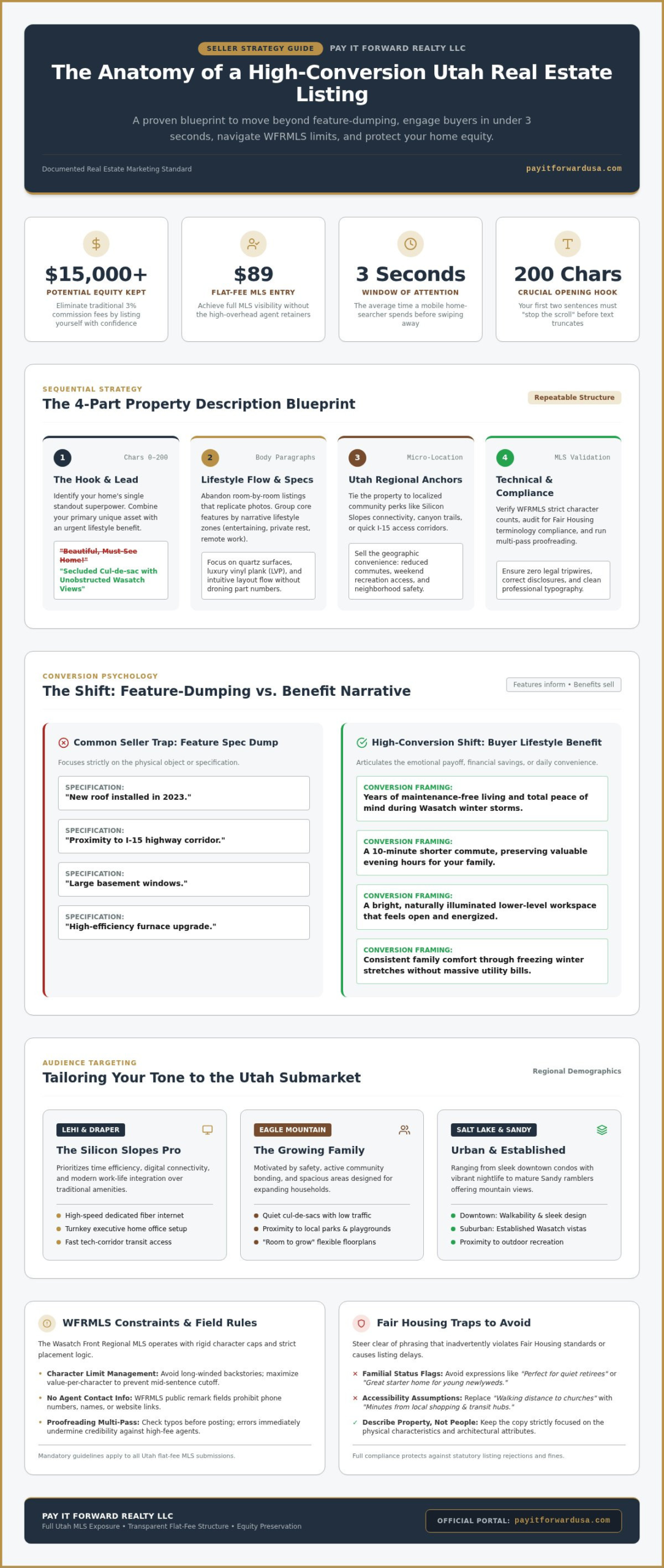
Most sellers fall into the trap of “feature-dumping.” They list the granite countertops, the three-car garage, and the new water heater. While these facts matter, they don’t sell houses. Benefits sell houses. A feature is what something is; a benefit is what it does for the buyer. Transforming your list of specs into a narrative of a better life is the key to a professional-grade description. Consider these shifts:
- Feature: New roof installed in 2023. Benefit: Years of maintenance-free living and total peace of mind during winter storms.
- Feature: Proximity to I-15. Benefit: A 10-minute shorter commute so you can spend more time with your family.
- Feature: Large basement windows. Benefit: A bright, inviting workspace that doesn’t feel like a dungeon.
Installing a high-efficiency furnace isn’t just a tech upgrade; it’s the guarantee that your family stays warm during a Wasatch Front winter without a massive utility bill.
Know Your Audience: The Silicon Slopes Buyer
If you’re selling in Lehi or Draper, you aren’t just selling a house. You’re selling a lifestyle to a Silicon Slopes professional who values their time and connectivity. Mentioning high-speed fiber internet or a dedicated home office can be more persuasive than a fancy backsplash. Meanwhile, young families looking in Eagle Mountain are searching for safety and community. They want to hear about cul-de-sacs, nearby parks, and “room to grow.” Tailor your tone to the neighborhood vibe. A downtown Salt Lake condo needs a sleek, urban energy, while a rambler in Sandy should feel warm and established. When you know exactly who is reading, how to write a real estate listing description becomes a simple matter of speaking their language.
The 4-Part Formula for a Perfect Property Description
Stop guessing and start using a script. Every high-performing listing follows a specific hierarchy. This ensures you don’t miss key details while keeping the reader engaged from start to finish. Understanding home buyer search behavior research reveals that buyers scan for value before they commit to reading long blocks of text. If you want to know how to write a real estate listing description that moves the needle, you need a repeatable blueprint that works every time.
Step 1: The Hook and the Lead
Your headline is your home’s “Superpower.” Don’t waste it on “Beautiful Home!” or “Must See!” Everyone says that. It’s white noise that buyers filter out automatically. Instead, lead with the one thing no one else has. “Secluded Cul-de-sac with Unobstructed Wasatch Views” beats “Great House” every time. Use this lead formula: combine your most unique asset with a primary lifestyle benefit and an urgent opportunity. This structure forces you to identify why your home is a winner in the first five words. It’s about grabbing the buyer by the collar before they can scroll to the next listing.
Step 2: The Core Body and Bulleted Features
Move beyond the standard room-by-room tour. Buyers have eyes; they can see the kitchen is next to the dining room in your professional photos. Focus on a “Lifestyle Flow” instead. Group your assets so they are easy to scan for busy families or tech workers. This keeps the energy high and the information digestible.
- Highlight upgrades like quartz counters or LVP flooring without listing specific model numbers or sounding like a hardware store catalog.
- Mention the “unseen” value that saves money. Energy-efficient spray foam insulation or a pre-wired smart home hub adds tangible financial worth that photos can’t capture.
- Connect every major feature to a specific feeling. A “chef’s kitchen” is nice, but “a kitchen designed for hosting massive holiday gatherings” tells a story they can see themselves in.
If you’re feeling stuck on these details, our Affordable Plus Package includes professional-grade tools to help you polish your listing for maximum impact on the WFRMLS.
Step 3: The Closing and CTA
Never end a description without a clear instruction. What exactly should the buyer do next? “Showings begin Friday at 10 AM” creates immediate urgency and a fear of missing out. “Text the owner for a private tour link” provides a low-friction entry point for savvy buyers. Be transparent about Buyer Agent Commissions here too. It builds instant trust with the brokerage community and shows you’re serious about a professional transaction. A strong closing turns a casual browser into a scheduled showing before the weekend is over.
Utah-Specific Hooks: Localizing Your Listing for Success
Utah buyers don’t just buy a house; they buy a piece of the Wasatch Front. If you want to know how to write a real estate listing description that stands out, you have to speak the local language. A “Mountain View” isn’t just a feature. It’s a premium that adds thousands in perceived value. If your back deck overlooks Mount Timpanogos or the Oquirrhs, lead with that. It’s the ultimate Utah hook. Highlighting these natural assets makes your $89 flat-fee listing feel like a luxury offering.
Proximity to the Silicon Slopes is another massive ROI driver. Tech professionals in Lehi or Draper are looking for a shorter commute to the Adobe or Xactware campuses. Mentioning you’re “5 minutes from the tech corridor” can be the difference between a showing and a skip. Don’t forget the lifestyle. If you’re in Saratoga Springs or American Fork, mention the trail systems. If you’re in the Alpine or Jordan school districts, say so. These are high-demand areas where the neighborhood name does half the selling for you.
While you’re highlighting these perks, stay honest. Following FTC guidelines on truthful advertising isn’t just a legal requirement; it’s how you build trust with buyers. If the mountain view is only visible from the upstairs bathroom, don’t claim it’s “unobstructed from every room.” Accuracy sells faster than exaggeration. Using a professional approach in your description ensures you look like a seasoned pro while keeping your equity.
Selling the Utah County Lifestyle
Utah County is booming, and your copy should reflect that energy. Why does “minutes from Utah Lake” drive interest in Provo and Lindon? Because it promises a weekend lifestyle without the travel. If you’re selling in Eagle Mountain or Herriman, leverage the growth. Buyers in these areas are often looking for “new-build” quality without the year-long wait. Mentioning local landmarks like Thanksgiving Point or the District in South Jordan builds geographic authority. It shows you aren’t just a seller; you’re a neighbor who knows the value of the land.
Seasonal Selling: Summer vs. Winter Descriptions
Utah’s weather is extreme, so your description must adapt. Describing a yard in Bountiful when it’s buried under three feet of snow requires a bit of imagination. Focus on the “mudroom” as a sanctuary for snowy boots or the “heated garage” as a winter luxury. In the summer, pivot. Highlight “covered patios” and “low-maintenance xeriscaping” that survives a July heatwave. Adjusting your hooks based on the current season shows buyers that the home is ready for whatever the Wasatch Front throws at it.
Navigating MLS Constraints and Technical Pitfalls
Your masterpiece description won’t matter if the MLS cuts off your closing sentence mid-word. Every digital platform has strict boundaries. In Utah, the Wasatch Front Regional MLS (WFRMLS) acts as the gatekeeper for your home’s data. Understanding how to write a real estate listing description that fits these digital containers is essential for a smooth sale. Don’t let technical glitches or character limits slow down your $89 listing’s momentum. You’ve worked too hard on your equity to let a text box defeat you.
Giant blocks of text are where listings go to die. Buyers scan; they don’t read every word. If your description looks like a dense legal contract, buyers will swipe past it before they finish the first sentence. Use capitalization sparingly and avoid “yelling” at your audience in all caps. Bullet points are your best friend for readability. Keep it airy. Keep it fast. The goal is to move the buyer from the text to the showing request as quickly as possible.
Professionalism matters when it comes to abbreviations. While “BR” for bedroom and “BA” for bathroom are industry standard, overusing shorthand like “HWD” for hardwood or “SS” for stainless steel can confuse potential buyers. When in doubt, spell it out. Clarity beats brevity every time. If you have to choose between a confusing abbreviation and cutting an unnecessary adjective, cut the adjective. Let your professional photos handle the visual fluff while your text delivers the facts.
WFRMLS Technical Requirements
WFRMLS has specific character limits that dictate how much you can say. While the system allows for detailed entries, syndication sites like Zillow or Redfin often truncate descriptions that are too long. Aim for a “Public Remarks” section that is punchy and under 1,000 characters for maximum visibility across all platforms. Remember that the “Agent Remarks” section is for internal instructions to other brokers, not for your sales pitch. If you’re feeling overwhelmed by the technical setup, check out our guide on Utah MLS listing services to see how the pros handle the heavy lifting for you.
Legal Red Flags and Fair Housing
Fair Housing laws are non-negotiable. One wrong word can trigger a legal headache or get your listing flagged and removed. The golden rule is simple: describe the property, not the person who should live there. Avoid phrases like “perfect for families,” “bachelor pad,” or even “walking distance,” which can be interpreted as discriminatory against certain protected classes. Use “spacious floor plan” or “close to transit” instead. You’re selling a structure and a lifestyle, not a demographic profile. Staying compliant protects your transaction and ensures your home stays visible to every qualified buyer in the market.
Mastering the character count is a balancing act. If you’re over the limit, cut the fluff first. Adjectives like “stunning” or “incredible” take up valuable space without adding concrete value. Focus your text on the “unseen” benefits we discussed earlier, like energy-efficient upgrades or smart home tech. Often, shorter sentences actually increase buyer engagement by making the information more digestible. Want to ensure your description is legally compliant and formatted for maximum clicks? Our listing experts are ready to help you navigate the fine print and get your home live with confidence.
Putting it All Together: From Draft to MLS Live
You’ve done the heavy lifting. You’ve mastered how to write a real estate listing description that sells a lifestyle rather than just a floor plan. Now it’s time to bridge the gap between your draft and a live, high-traffic listing. Consistency is everything. A typo in your first paragraph signals a lack of attention to detail that can make buyers nervous about the hidden condition of the home itself. Your final polish is what protects your professional image and justifies your decision to skip the traditional commission model.
The Final Review Process
Read your listing out loud. This is the fastest way to check for flow and rhythm. If you stumble over a sentence or find yourself running out of breath, a buyer will likely lose interest at that exact same spot. Apply the “So What?” test to every single line. If you mention a “large backyard,” ask yourself “so what?” and answer it: “so you have plenty of room for a private garden or a weekend play area.” If a sentence doesn’t highlight a specific benefit or solve a buyer’s pain point, it’s just filler that needs to be cut.
While digital grammar tools are great for catching basic typos, they can’t replace the human touch of a local expert. A computer doesn’t understand the nuances of the Utah market or why a Sandy rambler is valued differently than a Daybreak townhome. Ensure your tone remains confident and inviting from the very first word to the final call to action. You want to sound like a savvy, transparent owner who knows exactly what makes their property a winner.
Your description is the script; your photos are the movie. They must be perfectly synced for a professional result. If you rave about “unobstructed mountain views” in your text, that should be one of your first five photos. Use the thousands you’re saving on commissions to hire a professional photographer. High-quality images paired with your conversion-optimized text create a 1-2 punch that traditional listings often struggle to match. This synergy is what stops the scroll and gets people to actually schedule a showing.
The first seven days on the market are your most valuable. Watch the feedback closely. If you’re getting plenty of digital “saves” on Zillow but zero showing requests, your description might be missing a critical hook or failing to address a common local concern. Don’t be afraid to update your text based on market reality. A quick tweak to highlight a newly discovered benefit or a price-per-square-foot advantage can reignite interest and drive a faster sale.
Launch Your Listing for Just $89
Ready to put your hard work to the test? Pay It Forward Realty LLC makes the transition from draft to live listing simple and transparent. We put your professional description directly onto the WFRMLS so it syndicates to Zillow, Redfin, and every major real estate site. You keep total control of your equity while getting the same exposure as the high-priced status quo brokerages. It’s about working smarter, not harder.
- Affordable Package ($89): The perfect entry point for savvy DIY sellers who want professional MLS exposure.
- Affordable Plus Package ($195): Extra tools and support for those who want a professional edge in a competitive market.
Stop waiting and start saving. Your home deserves a description that works as hard as you do to protect your equity. List your home on the MLS for $89 today!
Take Control of Your Home Sale Today
You now have the exact blueprint for a listing that stops the scroll. By moving from simple feature-dumping to selling a lifestyle, you’ve mastered how to write a real estate listing description that resonates with local Utah buyers. Whether you’re highlighting a backyard view of the Wasatch Front or a short commute to the Silicon Slopes, your words are now your most powerful tool for protecting your equity. You don’t need a high-priced agent to tell your home’s story. You just need the right strategy and a platform that puts you in the driver’s seat.
It’s time to stop paying for overhead you don’t need. As Utah’s #1 Flat-Fee MLS Broker, we empower you to save the standard 3% listing commission while maintaining professional exposure. You can even access over $5,000 in potential buyer rebates to make your next move even smoother. The market is moving fast, and your equity belongs to you. Start Your $89 Utah MLS Listing Now and see how easy it is to win on your own terms. You’re ready to sell!
Frequently Asked Questions
How long should a real estate listing description be?
WFRMLS allows for a detailed narrative, but you should aim for approximately 150 to 200 words. This length ensures your text doesn’t get truncated on mobile apps or third-party sites like Zillow. Focus on a high-impact opening and a clear call to action. Keeping it concise helps you figure out how to write a real estate listing description that maintains high buyer engagement without losing their interest.
What are the best keywords to use in a Utah real estate listing?
Use high-intent local terms like “Silicon Slopes,” “Mountain Views,” and “Xeriscaped.” Mentioning specific Utah County landmarks or proximity to I-15 and Bangerter Highway adds immediate geographic authority. If you’re selling in Lehi or Eagle Mountain, include those city names to help with local search filters. These keywords help your $89 listing stand out against hundreds of generic descriptions by proving you know the local market landscape intimately.
Can I mention the school district in my listing description?
Yes, you can and should mention top-tier districts like Alpine, Jordan, or Canyons. Highlighting a specific school can be a massive ROI driver for families looking in areas like South Jordan or Herriman. Just ensure your information is accurate and current. Mentioning the school district adds tangible value to your description without violating Fair Housing laws, as long as you focus on the institution rather than the demographic.
Should I include the price and address in the description body?
Don’t waste your limited character count on the price or address. The MLS automatically displays these in dedicated fields at the top of every listing page. Every character in your description body should focus on benefits and lifestyle features that photos can’t convey. Use that extra space to talk about your high-efficiency furnace or the quiet cul-de-sac in Sandy rather than repeating data the buyer already sees.
How do I handle Fair Housing laws when writing my own listing?
Focus entirely on the physical property and the local neighborhood amenities. Avoid any language that describes a “preferred” buyer, such as “perfect for families” or “great for retirees.” Even phrases like “walking distance” can be problematic. Stick to objective descriptions like “three blocks from the park” or “spacious floor plan.” This approach keeps your listing legally compliant while ensuring it remains inclusive to every potential buyer in Salt Lake or Provo.
What is the difference between Public Remarks and Agent Remarks on the Utah MLS?
Public Remarks are the consumer-facing narrative that syndicates to sites like Redfin and Zillow. This is where you master how to write a real estate listing description that sells. Agent Remarks are private and only visible to other Realtors. Use the Agent Remarks for showing instructions, gate codes, or details about the buyer agent commission. This separation keeps your marketing pitch clean and focused on the buyer’s emotional journey.
Do I need to mention that I am selling FSBO in the description?
No, you shouldn’t mention FSBO because you aren’t technically selling by owner once you use our service. When you list with Pay It Forward Realty LLC, you are represented by a licensed Utah brokerage. Mentioning FSBO can actually confuse buyers and other agents who see a professional brokerage listing on the WFRMLS. Focus instead on the professional features of the home to build trust and credibility with every person who views your listing.
Can I update my listing description after it goes live on the MLS?
You can definitely update your listing text at any time. In fact, we recommend reviewing your description after the first seven days to see if a different hook might drive more traffic. If you’re selling in a fast-paced market like American Fork or Bluffdale, staying flexible is key. Listing packages from Pay It Forward Realty LLC allow for updates to ensure your marketing remains as effective as possible.