Sell a House Without a Realtor in Utah: Your 2026 Guide


What if selling your Utah home without a traditional listing agent didn’t mean handling every detail alone? If you’re searching “sell house without realtor utah,” the answer is yes: you can manage the sale yourself, but you’ll take on the work a listing agent might otherwise handle.
That work includes setting a competitive price, marketing the property, coordinating showings, responding to offers, and keeping disclosures, paperwork, and deadlines on track. It takes time and careful organization, especially when negotiations and closing details affect the transaction. You can choose how much listing support you want while staying involved in key decisions.
This guide explains the Utah sale process, seller responsibilities, and documents to prepare. You’ll also learn how to reach buyers, evaluate offers, and track the steps toward closing. If you want more visibility without traditional listing representation, compare selling entirely on your own with flat-fee MLS support, which can put your home on the MLS while you retain important sale responsibilities.
Key Takeaways
- To sell house without realtor utah, decide which sale tasks you’ll handle yourself and where targeted listing support could help.
- Build a document checklist, then verify current Utah forms and disclosure requirements before setting transaction deadlines.
- Compare independent selling, flat-fee MLS support, and traditional representation by workload, market exposure, and the responsibilities you keep.
- Use nearby comparable sales to inform pricing, and prepare a clear plan for marketing, showings, and evaluating offers.
- Choose your next step based on your available time, desired control, and comfort managing the sale through closing.
Can You Sell a House Without a Realtor in Utah? Start With the Real Trade-Offs
Yes. It’s legal to sell a home in Utah without hiring a listing agent. If you plan to sell house without realtor utah, you’re choosing to take on the work, not skip the transaction. The main trade-off is more direct control and the possibility of avoiding a listing-agent commission in exchange for more time, decisions, and responsibility.
For sale by owner (FSBO) describes selling property without a real estate broker representing the seller. FSBO isn’t one fixed arrangement. You can handle the sale independently or use selected support, such as a flat-fee MLS listing, while managing other parts of the process yourself.
What does selling by owner mean in Utah?
As the owner, you’ll typically set the asking price, prepare marketing, arrange showings, respond to offers, negotiate terms, and coordinate required documents and deadlines. Those tasks are distinct from the roles of other transaction participants:
- Listing representation involves representing the seller and supporting the listing process. Hiring a listing agent is optional.
- MLS exposure is a way to market a property through a multiple listing service. Flat-fee listing support can provide this exposure, but it isn’t the same as full listing representation.
- Buyer representation is separate. A buyer may have an agent representing their interests; any compensation arrangements are negotiated, not automatic.
- Title and escrow professionals coordinate title work and closing steps. Their role doesn’t replace your decisions as the seller.
The paperwork, responsibilities, and deadlines depend on the agreements involved and current Utah requirements. Using an MLS listing service doesn’t mean someone else is managing your offers, disclosures, or closing coordination.
Is FSBO a fit for your situation?
Start with your calendar and comfort level. Can you respond to buyer inquiries, make time for showings, compare offers, and track dates? Are you comfortable discussing price, contingencies, and requested repairs? Knowing the home well can help you answer questions, but you’ll still need to organize documents and follow through on each agreed step.
Managing the sale independently may suit you if you have time to stay involved and are prepared to make decisions. If marketing reach is a concern, or you want MLS exposure while retaining key responsibilities, flat-fee MLS support offers a middle path. If document review or contract questions feel unfamiliar, seek appropriate professional guidance. Choose the level of support that matches the work you’re ready to manage, without assuming any approach guarantees a particular price or timeline.
Utah FSBO Requirements: Prepare Disclosures, Documents, and Deadlines
A well-organized sale starts before you accept an offer. Gather the documents you may need, verify current requirements, and create a system for tracking signed forms and deadlines. A checklist can keep tasks visible, but it isn’t legal advice or a substitute for reviewing the documents that apply to your transaction.
Which Utah seller documents should you prepare?
Use this as a starting point, then confirm the current forms and requirements for your property and sale:
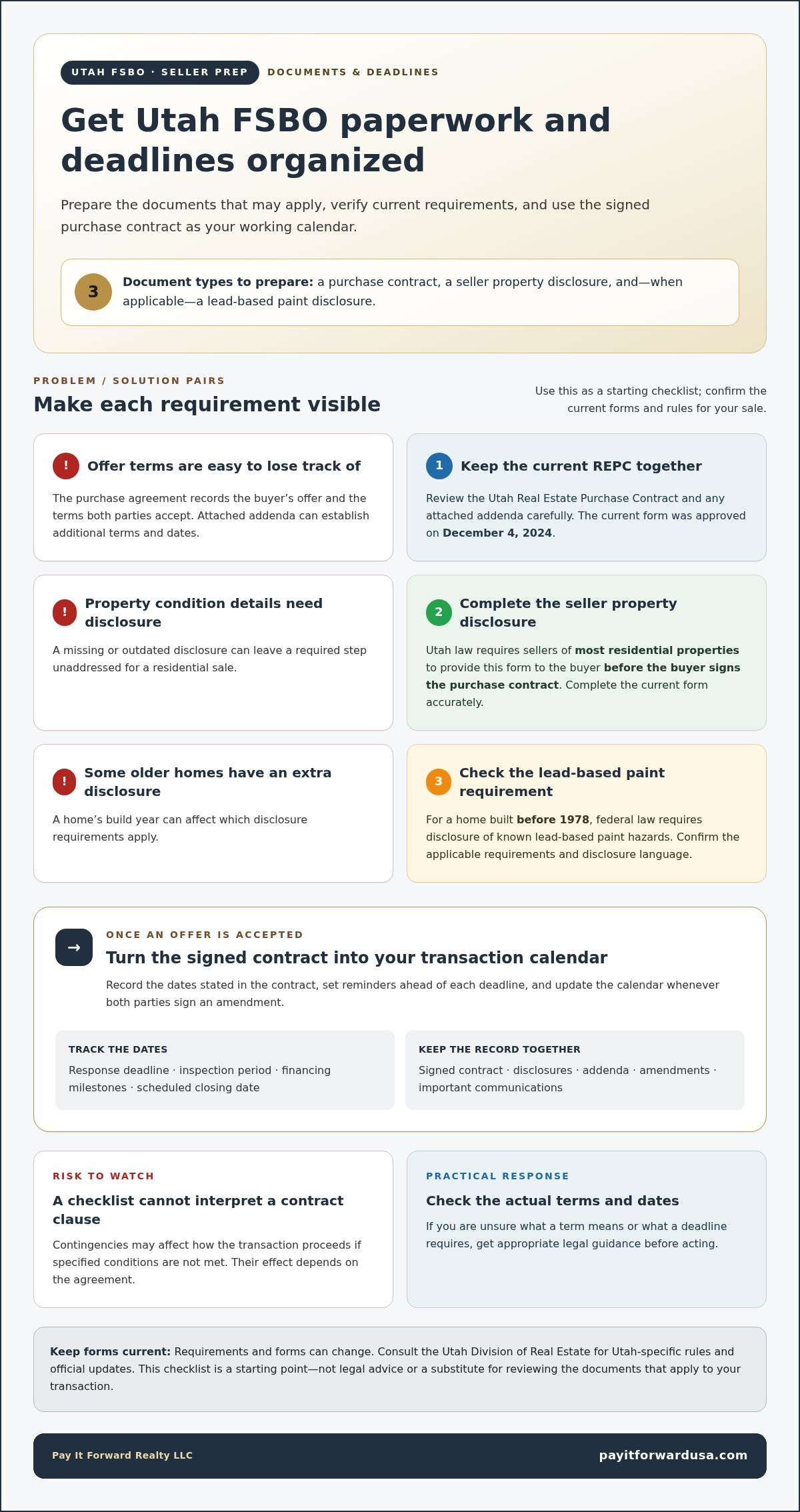
- Utah Real Estate Purchase Contract (REPC): The purchase agreement records the buyer’s offer and the terms both parties accept. The current form was approved on December 4, 2024. Read the actual contract and any attached addenda carefully, since they establish the terms and dates for that transaction.
- Seller Property Disclosure Form: Utah law requires sellers of most residential properties to provide this form to the buyer before the buyer signs the purchase contract. A Utah seller property disclosure is a form for sharing information about the property’s condition with a prospective buyer. Complete it accurately and use the current form.
- Lead-based paint disclosure: For a home built before 1978, federal law requires disclosure of known lead-based paint hazards. Confirm the applicable requirements and disclosure language for the property.
For Utah-specific rules and official updates, consult the Utah Division of Real Estate. Use current documents because forms and requirements can change. Disclosures help buyers understand what the seller reports about the property, but they don’t resolve every legal or contract question.
How can you keep contract dates and contingencies organized?
Once an offer is accepted, use the signed purchase contract as your working calendar. Note the response deadline, inspection period, financing milestones, and scheduled closing date. Set reminders ahead of each deadline, and update the calendar whenever both parties sign an amendment.
Contingencies are contract terms that may affect how the transaction proceeds if specified conditions aren’t met. Their effect depends on the agreement, so a general checklist can’t interpret a particular clause. If you’re unsure what a term means or what action a deadline requires, get appropriate legal guidance before acting.
Keep the signed contract, disclosures, addenda, amendments, and important communications together in one secure record. A dated folder makes it easier to confirm what was agreed and what comes next. Sellers planning to sell house without realtor utah can also use Utah flat-fee MLS listing support to gain listing exposure while keeping their transaction responsibilities clear.
Selling Without a Realtor vs. Flat-Fee MLS in Utah: Compare Your Options
A search for “sell house without realtor utah” often starts with one question: how much of the sale do you want to manage yourself? You can handle marketing and transaction tasks independently, use flat-fee MLS support for listing exposure, or hire traditional listing representation. Each approach changes the workload and support, but you’ll still need to make informed decisions.
| Approach | Control | Workload | MLS exposure | Support scope | What you still manage |
|---|---|---|---|---|---|
| Sell independently | Highest direct control | You handle most sale tasks | Not included unless arranged separately | You choose and coordinate any outside help | Pricing, marketing, showings, offers, paperwork, and deadlines |
| Flat-fee MLS | Substantial seller control | You remain involved in the sale | Listing may receive MLS exposure | Depends on the listing plan | Key decisions and transaction responsibilities |
| Traditional listing representation | Shared with a listing representative | More listing support, with seller decisions still required | Typically part of the listing process | Based on the representation agreement | Seller disclosures, decisions, and agreed obligations |
MLS exposure and representation aren’t the same thing. A flat-fee listing can provide a route to MLS exposure while you retain substantial control, but the services depend on the package. For a fuller explanation of how the process works, read this Utah MLS listing service guide.
What does flat-fee MLS support change for a Utah FSBO seller?
Flat-fee MLS support can change how your home is presented to the market without transferring every sale task to a listing agent. You’ll still manage important decisions and responsibilities, such as responding to interested buyers and reviewing offers. Pay It Forward Realty LLC offers an Affordable Package for $89, an Affordable Plus Package for $195, and a monthly listing plan for $29 per month. Compare the plan details to understand what listing support each includes.
Buyer-agent compensation is a separate, negotiable matter. It isn’t automatic or required simply because a buyer has an agent. Consider any proposed arrangement as part of the offer terms and decide based on the specific transaction.
Which selling approach matches your time and support needs?
Choose independent selling if you’re ready to manage marketing, communication, showings, negotiations, and transaction steps. Consider flat-fee MLS support if you want MLS exposure while keeping substantial control and seller responsibilities. Traditional representation is a more involved service model for sellers who want listing support; it doesn’t guarantee a particular price or outcome. The right fit depends on your available time, desired control, and comfort with the tasks you’ll manage.
How to Manage a Utah FSBO Sale: A Practical Seller Checklist
A self-managed sale is easier to keep on track when you move through it in order. Use this checklist from preparation to closing, and keep notes as you go.
- Collect property details. Confirm the home’s features, included items, upgrades, and known condition details. Gather records you’ll need to prepare accurate listing information and organize disclosure materials.
- Research a defensible asking price. Compare recent closed sales of similar homes in the same area, then review current competing listings. Match for property type, size, condition, and features. A Salt Lake County home and a Utah County home may face different competition, and conditions can vary by neighborhood. Use comparable properties as evidence, not as a promise of what your home will sell for.
- Prepare the presentation. Write a clear description, check facts carefully, and plan how photos will show the home’s layout and condition. Decide how buyers will request showings, how much notice you need, and how you’ll manage access.
- Publish and respond consistently. Set a routine for checking inquiries, answering questions, and confirming showing details. Record buyer feedback. If interest is limited, review the price, presentation, and marketing reach before making changes.
- Compare complete offers. Consider price alongside financing, contingencies, requested concessions, and proposed dates. The highest offer isn’t automatically the strongest fit if its terms or timing create more uncertainty. Keep offer revisions and agreed changes documented.
- Track the path to closing. After accepting an offer, use the signed agreement to monitor deadlines and milestones. Coordinate with the title or escrow professionals handling closing, respond to requests, and keep copies of signed documents and communications together. For a separate look at potential sale expenses, read the Utah FSBO cost breakdown.
Keep a simple transaction record
- Log inquiries, showing dates, and buyer follow-up.
- Save each offer, counteroffer, signed amendment, and disclosure.
- Track response dates, contingency milestones, and the scheduled closing date.
- Write down key decisions and the reason for each change, such as a price adjustment or accepted offer terms.
Local comparable sales are more useful than broad assumptions about Utah as a whole. A property’s neighborhood, condition, and type all shape its competition. If you want MLS exposure while managing the sale yourself, explore Utah MLS listing support.
Choose Your Next Step: Sell Independently or Use Utah MLS Listing Support
Your selling approach should fit your time, preferred level of control, marketing goals, and confidence managing transaction details. Selling independently gives you direct control, but you’ll also take on marketing and coordination. Traditional listing representation is a more involved service model. Flat-fee MLS support sits between the two: it can provide MLS exposure while you remain an active decision-maker and handle important parts of the sale.
If your goal is to sell house without realtor utah, remember that listing support is not the same as full-service representation. It also doesn’t replace legal advice or title and closing services. You still need to make seller decisions, understand your agreements, and keep track of transaction steps.
What should you decide before choosing listing support?
Start by listing the tasks you’re prepared to manage. You might be comfortable setting a price, answering buyer inquiries, and arranging showings, but want MLS exposure for your home. Or you may want to manage marketing yourself and choose a different level of listing support. Be specific about where assistance would make the process easier.
Then review the listing plan’s scope and terms before selecting an option. Plans can differ in what listing support includes, so focus on the details that match your priorities. Choose based on the workload you want and the marketing approach that makes sense for your property, not on an assumption that one model guarantees a particular result.
How can Utah sellers take the next step?
Gather the basics before you begin: the property address, accurate home details, available photos or plans for photography, and your preferred timing. Think through how you’ll handle inquiries, showings, offer decisions, and deadlines. That preparation helps you compare options with a clear view of the responsibilities you’ll retain.
Pay It Forward Realty LLC offers Utah-focused flat-fee MLS listing plans, including fixed-fee and monthly options. This can be a practical middle ground if you want MLS exposure without handing over every sale decision. You remain actively involved, and listing support doesn’t replace legal guidance, title services, or your responsibility to follow the transaction agreements.
Ready to choose a listing approach? Explore Utah MLS listing options and compare the available support with the tasks you plan to manage yourself.
Take the Next Step With a Sale Plan That Fits
You can sell house without realtor utah by handling the sale yourself, but you’ll need to be ready for the work: pricing, buyer communication, disclosures, offer review, and deadlines. Get organized before listing, use relevant local comparables to inform your asking price, and keep every agreement and milestone in one place.
You don’t have to treat the choice as all-or-nothing. Selling independently gives you direct control, while flat-fee MLS support can provide listing exposure and leave you actively involved in important sale decisions. Pay It Forward Realty LLC provides Utah-focused flat-fee MLS listing services and is owned and operated by Principal Broker Kurt Mathewson.
Compare the available Utah flat-fee MLS listing options at Pay It Forward Realty LLC to choose support that fits your time, marketing goals, and comfort managing the transaction.
Frequently Asked Questions
Can I sell my house without a Realtor in Utah?
Yes. You can sell your Utah home without hiring a listing agent, but you’ll take on key tasks yourself. These can include setting a price, marketing the property, arranging showings, reviewing offers, completing required documents, and tracking deadlines. You can also choose limited listing support, such as a flat-fee MLS listing, while staying involved in the sale. Decide which responsibilities you’re prepared to manage before choosing your approach.
Is it legal to sell a house by owner in Utah?
Yes. Selling a home by owner is legal in Utah; hiring a listing agent isn’t required. You still need to follow applicable disclosure and contract requirements and complete the sale documents correctly. Requirements can depend on the property and transaction, so verify current forms and rules through authoritative sources. Selling without an agent changes who manages the listing work, not the need to meet your obligations as a seller.
How do I sell my house by owner in Utah?
Start by researching comparable local sales and competing listings to inform your asking price. Prepare accurate property details, organize disclosure materials, and plan your marketing, photography, showing access, and buyer follow-up. Review each offer as a package, considering price, financing, contingencies, concessions, and timing. Once you accept an offer, track the signed agreement’s deadlines and coordinate closing steps. Flat-fee MLS support is another option if you want MLS exposure while retaining seller responsibilities.
Can I put my Utah FSBO home on the MLS?
Yes. A Utah FSBO seller can use a flat-fee MLS listing service to seek MLS exposure without hiring traditional listing representation. Pay It Forward Realty LLC provides Utah-focused listing options for sellers in Saratoga Springs, Lehi, Eagle Mountain, South Jordan, Herriman, Orem, Provo, Alpine, Draper, Sandy, Bluffdale, American Fork, Highland, Cedar Hills, Lindon, West Jordan, West Valley, Salt Lake, Bountiful, South Salt Lake, and Murray. Listing plans differ in their included support.
What disclosures do I need when selling a house in Utah?
Utah law requires sellers of most residential properties to provide a Seller Property Disclosure Form to the buyer before the buyer signs the purchase contract. For homes built before 1978, federal law requires disclosure of known lead-based paint hazards. These are key points to verify, not a complete checklist for every sale. Confirm current forms and requirements for your property, and get legal guidance if you’re unsure how to complete a disclosure.
Do I need a real estate attorney to sell my house in Utah?
A real estate attorney isn’t legally required for every Utah home sale, but professional legal guidance is recommended for FSBO sellers who need help reviewing documents or understanding their obligations. A title company is also needed to handle closing. These roles are different: listing support can help with MLS exposure, but it doesn’t replace legal advice or title and closing services. Consider getting advice before signing terms you don’t understand.
How do I handle offers and buyer-agent compensation when selling without a Realtor?
Review the full offer, not just the price. Compare financing, contingencies, requested concessions, and proposed deadlines, and keep signed offers and changes organized. Buyer-agent compensation is negotiable and isn’t automatically required simply because a buyer has an agent. If compensation is proposed, evaluate it as part of the offer and decide whether to agree based on the transaction terms. Get legal guidance if you’re uncertain about contract language or deadlines.