What Information Is Needed for an MLS Listing? A Seller’s Checklist


What if a missing detail or incorrect property fact slows your listing down before buyers even see it? If you’re wondering what information is needed for an mls listing, start with the essentials: verified property details, a seller-approved price, accurate photos, and clear showing instructions. Gathering these items can feel like a lot, especially when you’re unsure which records or listing fields apply.
A little preparation makes the process more manageable. This checklist helps you build an accurate information packet for your Utah home, catch avoidable errors, and identify details that may depend on local MLS rules. You’ll know what to organize before moving ahead with a listing.
We’ll cover property facts, features and updates, pricing, photos, disclosures, access preferences, and other transaction details to have ready. With organized information in hand, you can make informed decisions about your listing strategy, including whether a Utah flat-fee MLS option fits your plans.
Key Takeaways
- Start with verified basics, including the property address, type, ownership details, and occupancy status.
- Inventory features, updates, utilities, and included items so your description stays clear and factual.
- Gather current photos, seller-approved pricing and timing preferences, and practical showing instructions.
- Use this checklist to understand what information is needed for an mls listing and organize relevant records and disclosures.
- Put the details into a one-page packet, then follow the applicable Utah MLS process for fields and submission steps.
What Information Is Needed for a Utah MLS Listing? Start With the Property Basics
An MLS listing is a structured property record shared through a Multiple Listing Service by participating real estate professionals. It organizes the facts buyers and professionals use to understand and search for a home. For a general overview of how an Multiple Listing Service (MLS) works, see the linked background. For sellers, the practical first step is to gather property facts and separate verified details from anything that still needs checking.
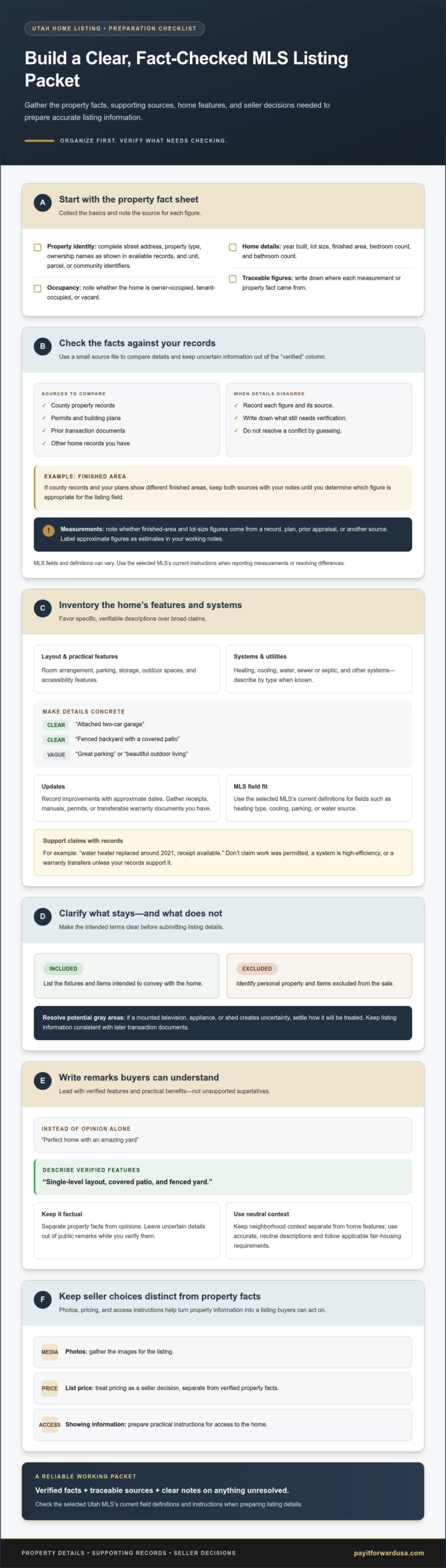
Start a property fact sheet with the complete street address, property type, ownership names as shown in available records, and whether the home is owner-occupied, tenant-occupied, or vacant. Add the year built, lot size, finished area, bedroom and bathroom counts, and any unit, parcel, or community identifiers. Note the source for each figure so you can resolve discrepancies before entering information into a listing.
Which basic property facts should sellers gather first?
Compare room counts and property characteristics with records you have and your knowledge of the home. A converted room, for example, may appear differently in older plans than it does in the current layout. Record what you can verify, and flag anything uncertain instead of treating an assumption as fact.
Take particular care with measurements. Note whether finished-area and lot-size figures come from a record, plan, prior appraisal, or another source. Label approximate figures as estimates in your working notes. MLS fields and definitions can vary, so use the selected MLS’s current instructions for reporting measurements.
How should Utah sellers check property details?
Build a small source file as you go. Compare available county property records with permits, building plans, prior transaction documents, and other home records you have. These sources may describe the property differently. A public record might show an older configuration, while your current floor plan reflects a later change.
Don’t try to reconcile conflicting figures by guessing. Write down the differences, note where each figure came from, and flag what needs verification. For instance, if county records and your plans show different finished areas, keep both sources with the fact sheet until you determine which figure is appropriate for the listing field.
So, what information is needed for an mls listing at this stage? Verified basics, traceable sources, and clear notes about unresolved details. Use the applicable Utah MLS’s current field definitions when records differ. This fact-checking step gives you a reliable foundation for the features, photos, documents, and showing details you’ll prepare next.
Describe the Home Clearly: Features, Updates, Utilities, and Included Items
Once the basic property facts are organized, inventory what makes the home function day to day. Capture the layout and useful details, such as room arrangement, parking, storage, outdoor spaces, and accessibility features. Be specific. “Attached two-car garage” tells buyers more than “great parking,” and “fenced backyard with a covered patio” is clearer than “beautiful outdoor living.”
What upgrades and systems belong in the listing information?
Record improvements with approximate dates, then gather any related receipts, manuals, permits, or transferable warranty documents you have. A working note such as “water heater replaced around 2021, receipt available” is more useful than an unsupported claim that the system is new. Describe heating, cooling, water, sewer or septic, and other systems by type when known. Don’t promise performance or imply work was permitted or remains under warranty unless you can support that statement.
Include utilities and features that help explain how the property operates, where applicable. The selected MLS may have fields for heating type, cooling, parking, or water source. Use its current field definitions rather than forcing a detail into a field that doesn’t fit.
Also make a clear list of fixtures and items intended to convey with the home, along with personal property or items excluded from the sale. If a mounted television, appliance, or shed creates uncertainty, settle how it will be treated before submitting listing details. Keeping the listing information consistent with later transaction documents helps prevent confusion.
How can sellers make listing remarks accurate and useful?
Lead with verified features that help buyers picture the layout and practical benefits. Replace vague superlatives with concrete details, and keep property facts distinct from opinions. Keep neighborhood context separate from home features; use accurate, neutral descriptions and follow applicable fair-housing requirements. Clear remarks inform buyers without promising more than the property can support.
For example, instead of “perfect home with an amazing yard,” describe the verified features: “single-level layout, covered patio, and fenced yard.” Don’t claim an upgrade is permitted, a system is high-efficiency, or a warranty transfers unless your records support it. If a detail is uncertain, leave it out of the public description while you verify it.
This feature inventory becomes useful working material for the rest of your listing preparation. Utah homeowners organizing their information for MLS exposure can learn more about flat-fee MLS listing options as they plan their next steps.
Prepare the MLS Listing Media, Price, and Showing Information
Photos, pricing, and access instructions turn property facts into a listing buyers can act on. Keep verified information separate from seller decisions. The list price is a choice, for example, while the home’s room count is a property detail that should be checked against reliable sources.
What photos and visual materials should be ready?
Prepare a current set of well-lit images that represents the home and its condition accurately. Plan views of the exterior, main living areas, bedrooms, kitchen, bathrooms, and notable features. Identify each room or feature in your working notes so captions, if used, are clear and accurate. Avoid edits that could misrepresent the property.
Before submission, note who has permission to use each image and any restrictions attached to it. Gather floor plans or virtual-tour materials if you have them. MLS rules can vary for image formats, captions, floor plans, and virtual-tour links, so follow the selected MLS’s current submission instructions.
Which pricing and showing decisions should sellers make?
Choose a seller-approved list price using relevant market information and a clear rationale. Keep the reasoning with your notes, but distinguish it from verified property facts. Decide when showings can happen, how much notice you prefer, how access should be arranged, and whether occupancy creates limits. For a tenant-occupied or otherwise occupied home, account for practical access arrangements in your instructions.
Use a simple working table to keep each detail in its proper place:
| Category | Examples to prepare | What to verify |
|---|---|---|
| Seller-supplied items | Current photos, image permissions, showing availability, access notes | Accuracy, currency, and any use restrictions |
| Seller decisions | List price, preferred timing, notice preferences, access method | Approval and consistency across seller communications |
| MLS-specific fields | Photo requirements, captions, floor-plan or tour fields, showing instructions | Current rules and field definitions for the selected MLS |
Before submission, compare the price and access instructions across the forms and communications used for the listing. A mismatch can create avoidable uncertainty. Knowing what information is needed for an mls listing means preparing both supporting materials and the decisions that shape how buyers can view the home. Utah sellers organizing these details for MLS exposure can review flat-fee MLS listing options as part of their planning.
Utah MLS Listing Documents and Details: What to Verify Before Submission
Documents can support listing details, but they serve different purposes. Some inform the property record; others are disclosures or transaction paperwork. Keep source documents organized, and don’t assume every document belongs in the public listing. The applicable MLS process and current Utah requirements determine what must be submitted, retained, and how information is handled.
Which documents and records may help complete the listing?
Gather available ownership and property records, improvement receipts, manuals, surveys, floor plans, and records for major systems. Use these materials to support details such as measurements, installation dates, or system types. If a document conflicts with your current knowledge of the home, flag the difference rather than treating either version as automatically correct.
Keep seller disclosures and supporting records separate from public-facing remarks. Utah law requires sellers of most one- and two-family residential properties to provide buyers with a Seller’s Property Condition Disclosure before a purchase contract is signed. It addresses known material defects that could adversely affect value or a buyer’s decision; sellers aren’t required to disclose issues they don’t know about. For homes built before 1978, federal law requires a lead-based paint disclosure. Use current forms and guidance for the property and transaction.
What should sellers check before approving the MLS entry?
MLS fields and submission steps can differ. Review the applicable listing agreement or authorization, required seller forms, field definitions, and submission instructions for the selected Utah MLS. A property must be listed through a licensed real estate broker or with one, so make sure the listing process includes the required broker authorization. Don’t assume a field or form used in one MLS applies unchanged to another.
Before approving the entry, compare each detail with its source or your approved instructions. Check:
- Address, measurements, room counts, and property features against available records and your knowledge.
- Price and included or excluded items against your decisions and listing paperwork.
- Remarks, photo order, showing instructions, and publication timing for accuracy and consistency.
- Any claim about an improvement, permit, warranty, or system against supporting documentation.
Correct unsupported statements and resolve discrepancies before submission. Knowing what information is needed for an mls listing includes knowing which facts are documented, which disclosures apply, and which details follow local MLS procedures. For Utah homeowners preparing a listing packet, explore Utah flat-fee MLS listing options.
Turn Your MLS Information Checklist Into a Utah Listing Plan
You’ve gathered the facts, supporting records, photos, seller decisions, and showing instructions. Bring them together in a simple packet so you can review the full picture before submission. The goal isn’t to collect paperwork for its own sake. It’s to make each listing detail easy to trace, approve, and update.
What is the quickest way to organize listing information?
Create separate folders for property facts, supporting records, photos, and seller decisions. Keep one approved version of the list price, remarks, showing instructions, and included or excluded items. Add a note beside any detail that still needs verification. That way, you’re less likely to use an old price or conflicting instruction when preparing the listing.
Finish with a quick review for missing fields, contradictions, and unsupported claims. Ask yourself: Does each property fact match its source or my knowledge? Are the photos current? Do the remarks match the features? Are the price and access instructions consistent? This final pass can catch small errors before they become part of the listing record.
How can a Utah seller move from preparation to MLS submission?
MLS fields and submission procedures can differ, so use the current process for the applicable Utah MLS. Follow its field definitions and instructions rather than assuming every system handles a detail the same way. A complete packet makes it easier to provide accurate information and identify anything that still needs attention.
For a wider view of the selling process, review a Utah home-selling cost breakdown alongside your listing plan. You can also explore a guide to listing on the MLS for $89 and a Utah MLS listing service guide to understand the next steps and available listing options. These resources complement your checklist, helping you consider both preparation and the broader transaction.
If you’re ready to move from preparation to MLS exposure, Pay It Forward Realty LLC provides flat-fee MLS listing services for Utah homeowners, with listing options starting at $89. Sellers in Saratoga Springs, Lehi, Eagle Mountain, South Jordan, Herriman, Orem, Provo, Alpine, Draper, Sandy, Bluffdale, American Fork, Highland, Cedar Hills, Lindon, West Jordan, West Valley, Salt Lake, Bountiful, South Salt Lake, and Murray can explore the available options. With your information packet in hand, you’ll be better prepared to follow the listing process and make informed decisions about how to proceed. That’s what information is needed for an mls listing in practice: organized details, clear seller choices, and a careful review before submission.
Put Your Listing Information to Work
A strong MLS listing begins with details you can stand behind. Verify property facts against available records, describe features and updates precisely, and keep seller choices such as price and showing instructions consistent. Photos and documents matter too, but local MLS fields and submission steps can vary, so follow the process that applies to your Utah listing.
Now you know what information is needed for an mls listing and how to organize it into a practical packet. That preparation can make the next step clearer, whether you’re reviewing listing paperwork or deciding how to get your home onto the MLS.
Pay It Forward Realty LLC provides Utah-focused flat-fee MLS listing services. Explore Utah flat-fee MLS listing options and choose a listing package that fits your goals.
Frequently Asked Questions
What information is required for an MLS listing?
An MLS listing generally needs accurate property identification, basic facts, features, a seller-approved price, photos, showing instructions, and applicable seller-provided documents. Exact fields and supporting materials depend on the MLS and listing arrangement. To answer what information is needed for an mls listing, start with verifiable records, mark estimates clearly, and follow current local instructions. A complete packet makes review easier and helps you catch missing details.
Do I need a survey or floor plan for an MLS listing?
Not always. A survey or floor plan can help confirm dimensions or show the home’s layout, but whether either is required depends on the property and applicable MLS rules. Gather documents you already have, and don’t present estimated measurements as verified facts. Follow current submission guidance for entering measurements and displaying supporting materials with the listing.
Do I need seller disclosures before my home goes on the MLS?
Prepare applicable disclosures as part of getting ready to sell, but the required forms and timing depend on current Utah requirements and the transaction. Utah sellers of most one- and two-family residential properties must provide a Seller’s Property Condition Disclosure to buyers before a purchase contract is signed. Homes built before 1978 also require a federal lead-based paint disclosure. Keep disclosures accurate and separate from promotional remarks.
Can I write my own MLS listing description?
You can draft remarks using accurate, specific details about the home, improvements, and practical features. Avoid unsupported claims, uncertain measurements, and language that could conflict with fair-housing requirements or local MLS policies. Make sure the final description matches verified property information and the applicable listing process. Keep a copy of the approved version so details remain consistent across listing materials and seller communications.
Are photos required for an MLS listing?
Photo requirements vary by MLS and listing arrangement, so follow the current rules that apply to your submission. Clear, well-lit, current photos help buyers understand the home, but they should represent its actual condition and features. Confirm you have permission to use each image, and follow rules for formats, captions, floor plans, or virtual tours. Avoid edits that could mislead viewers about the property.
What should I verify before my MLS listing goes live?
Review the address, property type, room counts, measurements, features, price, photos, remarks, and showing instructions. Compare listing details with reliable records and your approved information packet. Check occupancy, included and excluded items, and publication timing for consistency. Then review the applicable MLS’s current field requirements and document instructions. Correct contradictions and remove unsupported statements before approving the entry.
Can a Utah homeowner prepare MLS listing information without a traditional listing agent?
You can gather property facts, photos, records, and seller decisions before choosing a listing route, but MLS submission requires working with a licensed real estate broker. Pay It Forward Realty LLC provides Utah-focused flat-fee MLS listing services. Its local focus includes Saratoga Springs, Lehi, Eagle Mountain, South Jordan, Herriman, Orem, Provo, Alpine, Draper, Sandy, Bluffdale, American Fork, Highland, Cedar Hills, Lindon, West Jordan, West Valley, Salt Lake, Bountiful, South Salt Lake, and Murray.