Compare Buyer Rebates and Other Homebuying Cost Options in Lehi


A buyer rebate can return part of an agent’s commission to you, often as a closing credit, subject to lender approval. To get the best buyer rebate in Lehi, compare how each offer is calculated and agree on the terms before you start touring homes. The details matter as much as the advertised amount.
It’s smart to look beyond the rebate alone. Seller concessions and a lower negotiated commission can also affect your buying costs, but each works differently and may have different limits. This guide explains how rebates work, whether they’re available in Utah, and how to compare your options. You’ll also learn what to put in writing and how lender approval can shape the rebate’s use, so you can focus on the savings that fit your purchase.
Key Takeaways
- Learn how a buyer rebate is calculated and why its value depends on the agreed terms.
- Compare a rebate with seller concessions and a lower commission to see which option best fits your purchase.
- Understand how lender approval and closing-credit limits can affect how you use rebate funds.
- Know what to agree on in writing before touring homes so the rebate terms are clear from the start.
What is a home buyer rebate?
A home buyer rebate returns part of an agent’s commission to the buyer, often as a closing credit. In Lehi, compare the rebate terms with your purchase costs, financing, and home search before deciding what offers real value.
Meaning of a Home Buyer Rebate
A home buyer rebate is money returned to you from the buyer agent’s commission after a successful purchase. It may be calculated as a percentage of the purchase price or the agent’s commission. Before a showing, ask how the rebate is calculated, when it is paid, and whether it will be applied at closing.
Lehi’s typical home price was $569,889 in August 2026. An FHA purchase at a 3.5% down payment on that price requires roughly $20,000 down before closing costs. A rebate may ease cash pressure, but it doesn’t replace the need to budget for your down payment and other closing expenses.
Potential Savings for Buyers and Investors
Use the rebate calculation to estimate potential savings. For example, a 1% rebate on a $100,000 purchase would equal $1,000 before any lender or closing restrictions. Ask how the amount is calculated and where it can be credited. A buyer focused on lower upfront costs may value a closing credit differently from an investor planning long-term expenses.
For investors, track the rebate alongside the purchase price and property records. A rebate is treated as a reduction in the home’s purchase price, not taxable income. The Internal Revenue Service sets the U.S. home sale exclusion at $250,000 for single filers and $500,000 for married couples filing jointly. Keep the settlement paperwork with your cost-basis records.
Builder Incentives and Agent Rebates
New-construction builder incentives and buyer-agent rebates work differently. A builder incentive is offered through the builder’s sale terms, while an agent rebate comes from the buyer agent’s commission. Compare the written terms, permitted uses, and effect on closing costs rather than judging by the headline amount alone.
In Lehi, ask whether an agent or brokerage offers a buyer rebate, and review the amount and conditions in your buyer agreement before a showing. The agreement should make the calculation and payment method clear. For a new build, compare the builder’s incentive with the agent rebate as separate options, then consider which better supports your purchase.
Before choosing a neighborhood, use listing photos and maps to shortlist properties, then drive by to assess the street and surrounding area. A drive-by can help you decide whether to schedule a showing, but it cannot replace an interior viewing or property inspection.
Rebates compared with seller concessions and lower commissions
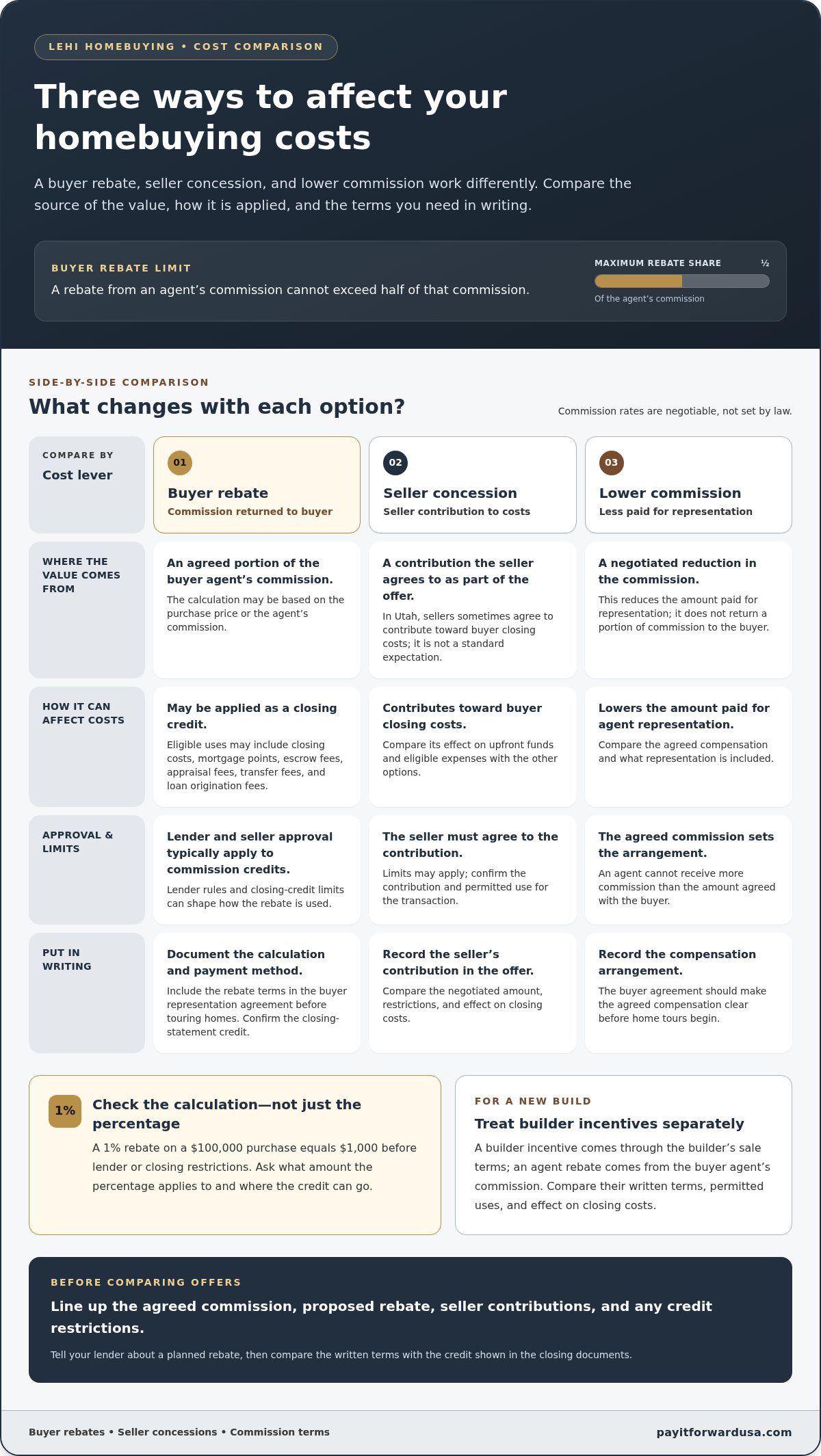
These options can affect different parts of your homebuying costs. Compare how each changes the transaction, when you receive value, and what approvals apply.
Buyer Rebate Amounts and Commission Shares
A rebate returns an agreed portion of the buyer agent’s commission.
These examples show why the percentage alone doesn’t tell the full story. Compare the commission amount, the rebate share, and the calculation in your buyer agreement. Commission rates are negotiable, not set by law. A lower commission reduces the amount paid for representation; a rebate returns an agreed portion to the buyer.
Commission Sharing and Rebate Mechanics
In a real estate transaction, the buyer agent’s commission may be shared with the buyer as a rebate. Put the arrangement in the buyer representation agreement before you begin touring. The contract should state how the rebate is calculated and delivered. A rebate from an agent’s commission cannot exceed half of that commission.
Commission credits typically need approval from both the lender and the seller. Eligible uses may include closing costs, mortgage points, escrow fees, appraisal fees, transfer fees, and loan origination fees. Ask how the credit will appear on the closing statement and whether your loan permits the intended expense.
A seller concession works differently: the seller agrees to contribute toward buyer closing costs as part of the offer. In Utah, sellers sometimes agree to these contributions, but they aren’t a standard expectation. Compare the negotiated contribution with a rebate and a lower commission, including their effects on upfront funds and eligible expenses.
To compare the options, line up the agreed commission, proposed rebate, seller contributions, and any credit restrictions.
How a buyer rebate works
A buyer rebate returns an agreed portion of the buyer agent’s commission after a completed home purchase. The payment depends on the agreement, commission earned, and lender rules for applying the credit. Getting the best buyer rebate in Lehi starts with treating it as a written transaction term, not an informal promise made during a listing tour.
Use this sequence to keep the calculation and payment clear:
- Agree before touring. Sign a buyer representation agreement before viewing homes. State the agent’s compensation and rebate method in that agreement.
- Define the calculation. Specify whether the rebate is fixed or calculated as a portion of commission. For example, a 1% rebate on a $100,000 purchase equals $1,000.
- Confirm the credit route. Tell your lender about the planned rebate. Lender approval and closing rules determine whether it can reduce eligible costs or appear another way.
- Review the settlement statement. Before closing, compare the written rebate terms with the actual credit shown in the transaction documents.
The National Association of Realtors settlement changes took effect on August 17, 2024. Buyer-agent compensation was decoupled from the MLS, so an MLS listing no longer sets the buyer agent’s payment. The buyer agreement records the compensation arrangement. An agent cannot receive more commission than the amount agreed with the buyer.
Keep the paperwork aligned. If the agreement promises a rebate but closing documents show no corresponding credit, resolve the mismatch before signing. Compare the calculation, commission earned, and lender-approved use. This creates a clear record of what was offered and how the payment was handled.
To get the best buyer rebate in Lehi, settle the terms before the first showing and track them through closing. Regulations and lender requirements affect payment, so put the agreed method in the transaction paperwork from the start.
What buyer rebates are available when purchasing a home in Lehi, Utah?
Lehi buyers can compare buyer-agent rebates, seller concessions, and builder incentives. These options depend on different agreements and may affect different closing costs. A rebate comes from the buyer agent’s commission, seller concessions are negotiated with the seller, and builder incentives come through the builder’s purchase terms.
Buyer rebate availability and restrictions can vary by location, so buyers should check whether a rebate arrangement is allowed where they are purchasing. Utah buyers can therefore explore rebate arrangements, then compare the written terms, calculation method, and eligible uses. Lender approval can shape whether a rebate is applied as a closing credit.
Reported Lehi buyer examples show that rebates can vary considerably. These are separate transaction examples, not a standard rebate schedule. Compare the amount and calculation in your agreement rather than assuming another buyer’s result will match yours.
Before choosing an option, use this quick comparison:
- Buyer-agent rebate: Review the agreed commission share, calculation, and closing-credit treatment.
- Seller concession: Include the requested contribution in your offer and consider its permitted use.
- Builder incentive: Compare the builder’s written incentive terms with the other available cost reductions.
Ask your lender how an approved rebate can be applied to your transaction. A credit may reduce eligible closing costs, but it doesn’t automatically become cash for any purpose. Match the rebate’s permitted use to your immediate needs, such as reducing eligible expenses at settlement. This helps you judge an offer by its practical impact, not just its advertised amount.
To compare a rebate against your Lehi purchase terms, review buyer rebate options and focus on the written amount, calculation, and closing treatment.
If a rebate fits your purchase, compare its written terms with your lender’s rules and confirm how the credit will be handled at closing. This gives you a clear next step after weighing rebates against seller concessions and commission options.
If you’re preparing to sell while buying, Pay It Forward Realty LLC offers flat-fee MLS listing options, including the Affordable Package, Affordable Plus Package, and Monthly Listing Plan. Consider a buyer rebate for your purchase and a listing package for your sale. Each addresses a different part of the transaction.
To discuss your home purchase or listing options, visit payitforwardusa.com.
Make Your Next Move With Confidence
Getting the best buyer rebate in Lehi starts with aligning your purchase plan with any sale you’re making. Map out your timeline, decide which costs matter most, and keep the rebate terms clear in your transaction paperwork. This gives you a practical basis for your next conversation.
Choose the listing option that suits your needs, while keeping your buyer rebate agreement focused on the purchase.
Ready to plan your next step? Contact Pay It Forward Realty LLC to discuss your real estate needs. Take control of the details and move forward with a plan that works for you.
Frequently Asked Questions
Are rebates worth the trade-off?
A rebate can be worthwhile when it meaningfully reduces eligible purchase costs and the representation terms still suit your needs. Compare the agent’s agreed responsibilities, compensation, and rebate calculation before signing. A larger credit may not be the best fit if the agreement’s scope doesn’t match the support you want. Judge the full arrangement, not just the rebate headline.
How much can I get back?
Your rebate amount follows the calculation in your buyer agreement and the commission earned in the transaction. Check whether the offer is a fixed amount or a share of commission, then compare it with any lender limits on credits. An advertised maximum describes a possible offer, not the amount every buyer receives. Use the written terms to estimate your own credit.
How much can you save?
Your practical savings depend on how the rebate is applied. A credit toward an expense you would otherwise pay can reduce the cash needed at closing; a credit restricted to a particular cost may have less immediate value. List your expected expenses and match each proposed credit to an eligible charge before deciding how much it helps your budget.
How do real estate agent commission rebates work in Utah?
In Utah, establish the rebate terms with the buyer agent before committing to a home search. Put the calculation and payment arrangement in your buyer agreement, then align the proposed credit with your lender’s requirements. At closing, compare the credit in the transaction paperwork with the written agreement. Clear documents make it easier to spot a mismatch before signing.
How much can a homebuyer typically save through a buyer rebate in Lehi?
There isn’t one standard savings amount for every Lehi purchase. Estimate yours by applying the agreed rebate formula to the actual commission, then account for lender-approved uses and closing expenses. If your credit covers an expense due at settlement, it may reduce the cash needed then. Compare the resulting credit with your budget rather than relying on another buyer’s outcome.
How do buyer rebate offers compare with lower agent fees or closing-cost credits?
A rebate returns an agreed portion of commission, while a lower agent fee reduces the compensation charged under the agreement. A seller’s closing-cost credit is negotiated as part of the purchase offer. Compare each option’s effect on your cash due at closing and on the specific expenses you plan to cover. Choose the structure that best fits your transaction.