How to compare price and terms when selling FSBO


The highest offer can be the easiest one to lose. If you’re deciding how to handle multiple offers on a house FSBO, compare net proceeds, buyer financing, contingencies, earnest money, and closing date, not just the headline price. A lower offer with fewer conditions and a workable timeline may be the stronger choice.
It’s natural to focus on the biggest number when buyers are competing. But the best decision depends on the full terms, not your first reaction. Weigh price against buyer finances, contingencies, and closing plans. A clear “highest and best” deadline gives buyers a fair chance to submit their strongest terms. Use the same comparison process for every offer and choose one that fits your priorities.
Key Takeaways
- Compare each offer’s likely net proceeds, contingencies, and closing timeline, not just its purchase price.
- Use lender pre-approval or proof of funds to assess whether a buyer appears prepared to complete the purchase.
- Match financing details and the proposed closing date against your priorities before choosing an offer.
- Set a fair process for reviewing offers and base your decision on written terms rather than personal preference.
1. Can I accept a lower offer if the terms are better?
Yes. A lower offer can deliver stronger net proceeds if it reduces concessions, repair costs, or closing risk. Compare the written terms, not just the purchase price. For example, a $420,000 cash offer may be more dependable than a $430,000 financed offer contingent on the buyer selling a home. The higher figure may not mean more money in your pocket.
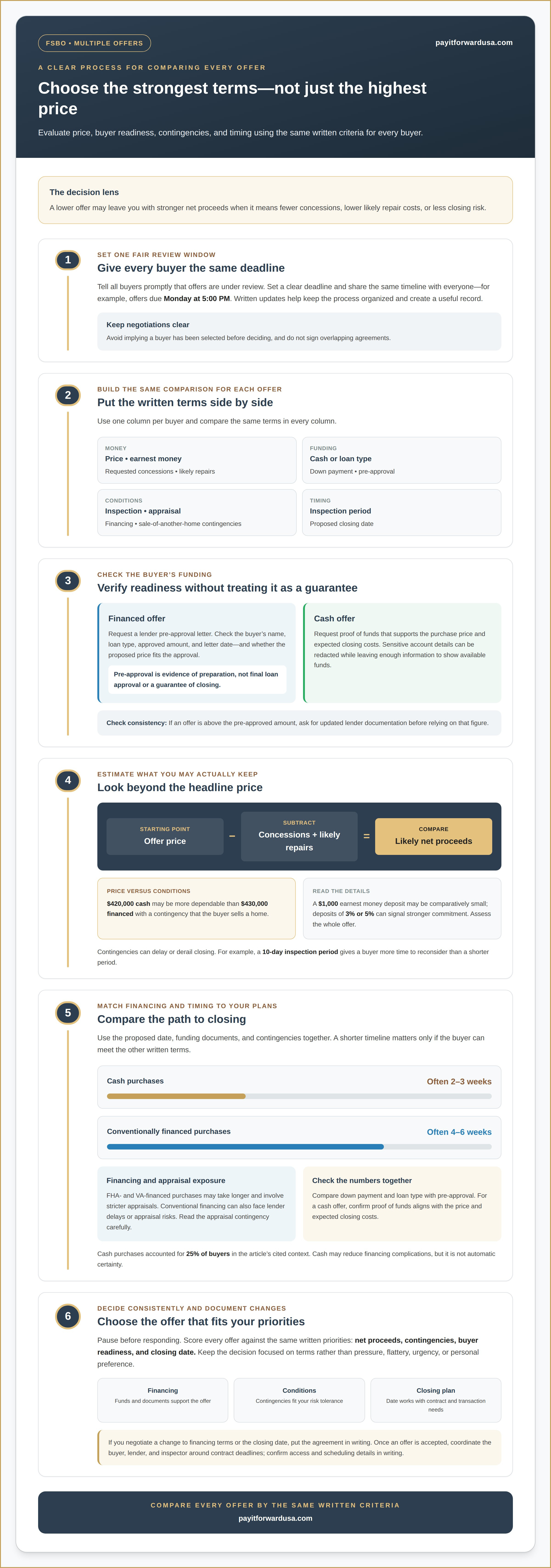
After receiving multiple offers, promptly tell all buyers you’re reviewing them. Then organize each offer’s price, financing, earnest money, contingencies, requested concessions, and closing date. A $1,000 earnest money deposit may be comparatively small; deposits of 3% or 5% can signal stronger commitment. Still, assess the whole offer. A 10-day inspection period gives the buyer more time to reconsider than a shorter period.
Create a worksheet with one column per buyer and one row per term. Estimate net proceeds by subtracting concessions and likely repair costs from the price. Note whether inspection, appraisal, financing, or sale-of-another-home contingencies could delay or derail closing. A $510,000 offer with 3.5% down and a lengthy inspection contingency may carry more uncertainty than its headline price suggests.
Compare cash and financed offers by weighing price against the buyer’s funding and conditions. Cash may involve fewer financing complications, while a financed offer can carry lender or appraisal risks. For the closing, consider how the title company handles problems, provides a direct contact, and shares updates. These details can make transaction communication clearer.
Keep the decision objective. The Fair Housing Act protects buyers from discrimination based on race, religion, and familial status; evaluate offers using consistent, written criteria rather than personal preference. According to the U.S. Environmental Protection Agency, federal law requires sellers to disclose lead-based paint hazards for homes built before 1978.
2. Verifying buyer pre-approval and proof of funds
Ask each financed buyer for a lender pre-approval letter before choosing an offer. Review the buyer’s name, loan type, approved amount, and letter date. Check whether the proposed price fits the stated approval. A pre-approval is not final loan approval, so treat it as evidence of preparation, not a guarantee of closing. For a cash offer, request proof of funds showing the buyer can cover the purchase. Buyers can redact sensitive account details while leaving enough information to show available funds.
Check that each offer is consistent with its supporting documents. If a buyer offers more than the pre-approved amount, ask for updated lender documentation before relying on that figure. For a cash offer, confirm that the documentation supports the purchase price and expected closing costs. A serious buyer should be able to explain financing questions clearly. Keep any communications with a Realtor or lender factual and focused on the written offer, deadlines, and documents.
Accepting one offer while negotiating with other buyers can create confusion and competing expectations. Avoid implying that a buyer has been selected before you’ve made a decision, and don’t sign overlapping agreements. Tell interested buyers the same review timeline. For example, state that offers are due Monday at 5:00 PM, then promptly notify every buyer after deciding. A clear deadline keeps a competitive process organized; written updates also create a useful record.
Once you accept an offer, coordinate the buyer, lender, and inspector around the contract’s deadlines. Share scheduling details promptly, confirm access arrangements in writing, and keep communication in one email thread where practical. If an agent represents the buyer, include them in relevant scheduling updates while keeping the buyer informed. These simple steps can help prevent missed appointments from disrupting the transaction timeline. For Utah sellers managing their listing, explore flat-fee MLS listing options as a separate part of the FSBO process.
3. Reviewing financing, down payment, pre-approval, and closing dates
Compare each offer’s loan type, down payment, pre-approval status, and proposed closing date. Cash purchases often close in 2-3 weeks, while conventionally financed purchases often take 4-6 weeks. Those timelines help you judge whether a buyer’s proposed date fits your plans. A shorter timeline can be valuable, but only if the buyer can meet the other written terms.
Cash can simplify financing, but don’t treat it as automatic certainty. Request proof of funds and compare it with the purchase price. An all-cash offer of $500,000 illustrates how price and available funds should align. Cash purchases accounted for 25% of buyers, so cash may appear among competing offers. Still, weigh the offer’s terms and closing plan alongside its funding.
For financed offers, compare the down payment and loan type with the lender’s pre-approval. FHA- and VA-financed purchases may take longer and involve stricter appraisals. Conventional financing can also face lender delays or appraisal risks. If the appraisal comes in below the agreed price, the contract terms determine what happens next. Read the appraisal contingency carefully before deciding how much risk you’re willing to accept.
During negotiation, consider whether the buyer can adjust the closing date or financing terms without weakening the offer. Put agreed changes in writing. Check that the proposed closing date leaves enough time for the lender, appraisal, title work, and contract deadlines. Then compare every offer using the same criteria: financing, down payment, pre-approval, appraisal exposure, and date. This keeps the decision focused on practical fit rather than a cash-versus-loan shortcut.
4. Avoiding emotional offer decisions
Receiving several offers can make the highest price feel like the obvious winner. Pause before responding, then score each offer against the same written priorities: net proceeds, contingencies, buyer readiness, and closing date. A sale by owner still needs a consistent process. It keeps a friendly buyer from receiving special treatment and helps you focus on terms instead of pressure, flattery, or urgency.
Set a firm deadline for final offers and communicate it to every interested buyer. For example, specify Monday at 5:00 PM, then give buyers the same opportunity to improve their terms. A 3-5 day offer collection period after a listing or open house can give buyers time to prepare; buyers may need 2-3 days to assemble complete offers with financing verification. Don’t change the deadline for one buyer without sharing the change fairly.
Before choosing, step away from the emails and compare offers line by line. Ask what matters most for your sale: a particular closing date, fewer conditions, or stronger net proceeds. A buyer’s personal story may be compelling, but it doesn’t show whether the financing, contingencies, or timing fit your needs. Apply the same criteria to every offer. If terms need work, put counteroffers in writing. You can counter multiple buyers rather than waiting for one response.
After deciding, promptly notify every buyer, including those whose offers you won’t accept. Keep the message brief, professional, and consistent. Once an offer is accepted, follow its written terms and deadlines; don’t treat other buyers as backup without clear communication. A steady process protects your focus through closing. For practical support with the sale-by-owner process, review your FSBO listing options.
Pay It Forward Realty
Pay It Forward Realty helps Utah homeowners list on the MLS while keeping control of their sale. If you’re preparing to review competing offers, a visible listing can help bring your property to buyers; the offer comparison process remains yours to manage. Choose from the Affordable Package, Affordable Plus Package, or Monthly Listing Plan to match your listing needs.
These options may suit sellers who want MLS exposure without handing over the entire sale process. They don’t replace careful review of buyer finances, contingencies, or closing dates. Use the worksheet and consistent criteria from this guide to weigh each offer, then choose the terms that fit your priorities. If you’re ready to discuss listing your home, contact Pay It Forward Realty.
Move forward with a clear plan
Once you’ve chosen an offer, shift from comparing terms to carrying them out. Keep the signed agreement, key dates, and communications organized in one place. Respond promptly to requests, track contractual deadlines, and record changes in writing. A steady process helps you stay focused as the sale moves toward closing.
Knowing how to handle multiple offers on a house as an FSBO seller means making a deliberate choice and following through with care. You remain in control of the decisions. If your next step is preparing or maintaining an MLS listing, Pay It Forward Realty offers flat-fee listing options for Utah homeowners. Choose a package that fits your needs, while grounding your offer decision in the terms that matter to you.
Explore your FSBO listing options with Pay It Forward Realty, and take the next step with confidence.
Frequently Asked Questions
What is a “Highest and Best” offer deadline?
A “highest and best” deadline gives buyers a cutoff to submit their strongest complete offers. It gives everyone the same chance to revise price or terms, but doesn’t commit you to accepting the highest bid. For example, if a buyer raises the price but adds a financing condition, assess the revised offer as a whole. Communicate the cutoff and any changes consistently.
Can I accept a lower offer if the terms are better?
Yes. A seller can choose a lower-priced offer if its other terms better fit the seller’s priorities. Consider what the buyer is asking you to pay or provide, when they expect to close, and which conditions could affect completion. The strongest choice is the one that fits your financial and timing needs, not automatically the one with the largest number.
Can I negotiate multiple offers myself as a FSBO seller?
Yes. FSBO sellers can negotiate directly with buyers through written counteroffers and addendums. Keep each buyer’s proposed changes separate, then make sure the written terms reflect any agreement before proceeding. You can counter more than one buyer at a time, but be clear that a counteroffer is part of negotiation, not final acceptance. Track who received each version and when.
Do I have to tell buyers I have other offers?
Tell interested buyers you’re reviewing multiple offers if you’re using a shared deadline or inviting revised bids. This sets a clear expectation without disclosing another buyer’s price, identity, or private terms. Give every buyer the same information about the process, and avoid suggesting that any offer will win. Consistent communication helps buyers decide whether to submit or revise an offer.
How to Handle Multiple Offers When Selling FSBO (Without Losing the Best Deal)?
Keep a clear record of every offer, counteroffer, and response so no term gets lost in a busy inbox. Before choosing, confirm that the version you’re considering includes the buyer’s latest agreed terms. If a key point is unresolved, ask for it in writing rather than relying on a phone conversation. This keeps your decision tied to the actual offer, not a remembered summary.
What deadlines work best for reviewing competitive bids?
Choose a cutoff that gives buyers a reasonable opportunity to prepare complete offers, then state the exact date, time, and method for delivery. A 3-5 day offer collection period can give buyers room to prepare; buyers may need 2-3 days to assemble offers with financing verification. Avoid shifting the deadline for one buyer without sharing the change with others.