Utah Home Buyer Rebate Program: What Buyers Should Know in 2026


Could a Utah homebuyer benefit be a deferred loan, a brokerage rebate, or both? The phrase “utah home buyer rebate program” can refer to different benefits. Confusing them could leave you counting on money that does not fit your purchase.
It’s reasonable to look for help with upfront costs. As of March 2026, Utah’s First-Time Homebuyer Assistance Program offers eligible buyers an interest-free, deferred loan of up to $20,000 for a newly constructed home priced at $450,000 or less. Applicants must have lived in Utah for at least a year, and repayment is due when the home is sold or refinanced. Funding, eligible uses, and current terms matter too, so check the current rules before including the loan in your plans.
This guide explains the difference between state-administered assistance and a real estate brokerage rebate, what eligibility and repayment details to verify, and how Pay It Forward Realty’s buyer rebate of up to $5,000 may fit into a Utah purchase. You’ll get a practical way to assess each benefit without treating them as interchangeable or assuming they can be combined.
Key Takeaways
- The phrase “utah home buyer rebate program” can refer to different benefits. Identify whether you’re researching state assistance, a lender offer, or a brokerage rebate before planning around the funds.
- Check current official program guidance for eligibility, funding, eligible uses, and repayment terms before relying on state assistance.
- Compare each benefit by provider, purpose, eligibility, and repayment to understand how it may fit your purchase.
- Keep state-assistance requirements and brokerage-rebate terms separate in your offer planning. Don’t assume the benefits can be combined.
- Pay It Forward Realty offers a buyer rebate of up to $5,000 for buyers purchasing through the brokerage. Free mortgage prequalification through True North Mortgage is a separate resource.
What Is the Utah Home Buyer Rebate Program, and Which Program Do You Mean?
Confusion makes sense: “buyer assistance” and “rebate” can sound like the same pot of money, but they are not. A search for the utah home buyer rebate program may lead to state-administered assistance, a lender incentive, or a rebate offered by a real estate brokerage. Each has a different provider, eligibility rules, and transaction terms.
Quick definition: There isn’t one benefit that every buyer can claim under the name “Utah home buyer rebate program.” People often use the phrase for either government homebuyer assistance or a brokerage commission rebate. Identify the specific program before counting on its funds.
State assistance follows government program rules, while a brokerage buyer rebate is an incentive connected to a real estate transaction. Qualifying for one does not automatically qualify you for the other. The word “rebate” alone also does not tell you whether the funds must be repaid or how they can be used.
Is Utah’s homebuyer assistance the same as a buyer rebate?
No. State-administered assistance comes from a public program and may have requirements related to buyer status, property type, purchase price, residency, funding, and eligible uses. Some assistance is structured as a loan, with repayment terms set by the program. A 2023 Utah Senate announcement reported assistance of up to $20,000, but that historical announcement does not establish current 2026 availability or terms.
A brokerage rebate is different. It is a potential buyer benefit connected to a purchase through a brokerage, not a state grant or state loan. Its amount and delivery depend on the applicable brokerage and transaction terms. It is not automatically a credit on the closing statement, cash paid at closing, or a guaranteed amount. Don’t assume it can be combined with government assistance, since loan and transaction requirements may affect how benefits are handled.
What kinds of homebuying benefits might Utah buyers find?
Start by sorting potential benefits into three categories:
- Government assistance: State or local programs may offer eligible buyers help with purchase costs under program-specific rules. The assistance could involve repayment, so review the terms rather than relying on the label “assistance.”
- Lender offers: A mortgage lender may provide an incentive tied to its loan products or underwriting. The lender’s terms determine who qualifies and how the offer applies.
- Brokerage rebates: A real estate brokerage may offer a buyer a rebate connected to the brokerage’s transaction. This benefit is separate from assistance administered by the state.
When comparing a state program with a brokerage rebate, record each benefit’s provider, eligibility rules, permitted uses, repayment obligations, and timing. “Rebate” does not automatically mean a grant, a loan, or money available for any particular cost. Get the details in writing before including a benefit in your purchase budget.
Next, we’ll look at Utah’s first-time buyer assistance and the current official guidance to review before relying on it.
Utah’s First-Time Homebuyer Assistance: What to Verify for 2026
Older program pages can provide background, but they do not prove that applications are open today. For 2026, distinguish the program’s launch announcement and lender summaries from the current Utah Housing Corporation (UHC) rules. A past description may outline the benefit without answering questions about current funding, application status, or requirements.
What did the earlier Utah program information say?
A 2023 Utah Senate announcement reported assistance of up to $20,000 for eligible first-time buyers. It described possible uses including a down payment, closing costs, or an interest-rate buydown. That announcement documents what was reported at launch; it does not establish that funding remains available or that applications are still being accepted.
A Bank of Utah page has described the assistance as an interest-free, deferred loan, with repayment when the home is sold or refinanced. Treat those repayment details as that lender page’s account, not as a substitute for current program documents. Before relying on the funds, review the latest UHC guidance and confirm the program’s status and terms for your purchase.
Which current eligibility and repayment details need checking?
UHC program information available in 2026 describes the First-Time Homebuyer Assistance Program under S.B. 240 as active, with a deferred loan of up to $20,000. The reported current requirements include first-time buyer status, purchasing a newly constructed home for $450,000 or less, and at least one year of Utah residency before purchase. The loan is interest-free, with payment deferred until sale or refinance. Verify these details against current official guidance before making a decision.
Historical summaries and current program rules are not interchangeable. The 2023 Utah Senate announcement reported the assistance amount and possible uses, while the current 2026 program description sets out eligibility and repayment terms to confirm with UHC.
Review current UHC materials for:
- Application status and funding: Confirm that the program is accepting applications and funds remain available.
- Buyer qualifications: Verify how first-time buyer status is defined and what documentation proves Utah residency.
- Property and price rules: Confirm the new-construction requirement, purchase limit, and how the price is calculated.
- Permitted uses and repayment: Check eligible costs, when repayment is triggered, and whether additional conditions apply.
Don’t base an offer budget on a search snippet or an older lender page. Use current UHC guidance and confirm the terms with the program administrator or participating lender before treating assistance as part of your financing plan. You can separately review a brokerage buyer rebate. It is a different benefit with its own transaction terms.
State Assistance vs. a Brokerage Rebate: Compare the Benefits Carefully
Both benefits can affect your purchase budget, but they come from different places and follow different rules. The Utah Housing Corporation’s First-Time Homebuyer Assistance Program is state-administered. Pay It Forward Realty offers a buyer rebate when you purchase through the brokerage. Neither benefit automatically guarantees cash in hand at closing, and the terms of one do not determine the terms of the other.
How do a state assistance loan and a buyer rebate differ?
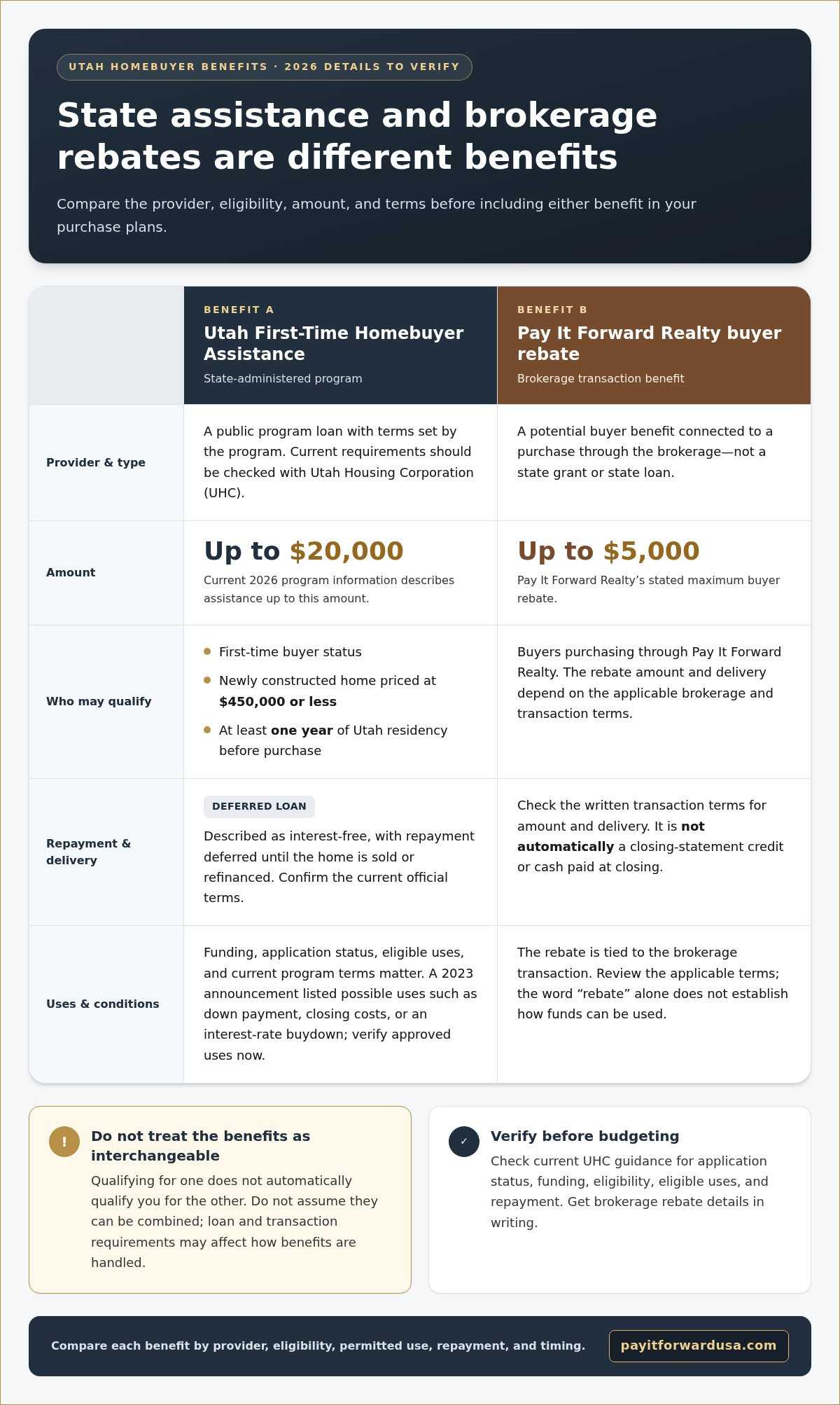
Use the comparison below to identify the details that matter. The current state program details are based on the 2026 requirements described by Utah Housing Corporation. Brokerage rebate terms are separate and depend on the transaction’s written terms.
| Factor | Utah state assistance | Pay It Forward Realty buyer rebate |
|---|---|---|
| Source | Utah Housing Corporation administers the state program. | Offered through Pay It Forward Realty when purchasing through the brokerage. |
| Purpose | Eligible buyers may use the loan for a down payment, closing costs, or a permanent interest-rate buydown. | A potential buyer benefit connected to the brokerage transaction. Don’t assume a particular use or delivery method. |
| Eligibility | Current requirements include first-time buyer status, a newly constructed home priced at $450,000 or less, and at least one year of Utah residency before purchase. | Buyers purchasing through the brokerage may receive a rebate of up to $5,000. Transaction terms apply. |
| Repayment | An interest-free, deferred loan, with repayment due when the home is sold or refinanced. | It isn’t described as a state loan. Review the brokerage’s written transaction terms rather than assuming repayment or payout details. |
The practical difference is how each benefit is qualified and controlled. The state program sets eligibility, use, and repayment rules for its loan. A brokerage rebate is a separate transaction benefit, not a state grant, and its amount or delivery should not be treated as identical to government assistance. For broader context on how brokerage compensation relates to buyer costs, see this Utah low-commission real estate guide.
Can buyers use both benefits together?
Don’t count on combining them until the applicable written rules explain how they are treated. The state program’s loan documents, lender underwriting requirements, and brokerage rebate terms may all affect a transaction. Meeting the state program’s eligibility rules, for example, does not establish whether a separate rebate can be applied to the same purchase or how it must be disclosed.
Before planning around both benefits, get the current UHC program requirements and the brokerage’s rebate terms in writing, then review how the lender will handle the proposed arrangement. Keep each benefit on a separate line in your budget so you can distinguish what is confirmed, what is conditional, and what should not yet be counted as available funds.
How Utah Buyers Can Evaluate a Rebate Before Making an Offer
A benefit helps your purchase only if you understand what it is, which conditions apply, and when it can be counted in your financing plan. Before writing an offer, separate confirmed funds from possibilities. Use this checklist to assess the utah home buyer rebate program you’re considering without building your budget around assumptions.
- Identify who provides the benefit. Write down whether you’re looking at government assistance, a lender offer, or a brokerage rebate. Each has its own administrator or provider, eligibility rules, and written terms. A general search result or the word “rebate” does not confirm which benefit is available to you.
- Confirm state-program status and eligibility. For government assistance, use current official Utah Housing Corporation materials to check whether applications are open and funding is available. Verify buyer and property requirements, purchase limits, eligible uses, and deadlines that apply to your purchase. Keep the guidance you relied on with your planning notes.
- Review the loan and repayment details. If assistance is structured as a loan, read the current program documents for repayment triggers and conditions. Consider how the obligation fits your financing plans, including what could happen if you later sell or refinance. Use current written terms rather than relying on a summary from an older page.
- Get the brokerage rebate terms in writing. Note the stated rebate amount, purchase conditions, and how the benefit is handled during the transaction. A maximum amount is not necessarily the amount you’ll receive, and a rebate is not automatically cash at closing or a guaranteed closing credit. Keep these terms separate from state-program documents.
- Map each benefit to your purchase costs. Compare possible uses with your down payment, closing costs, and financing needs. If your main pressure point is cash needed before closing, for instance, a benefit that can only be applied another way may not address that need. Confirm how the lender and transaction documents treat each source before adjusting your plan.
- Build an offer budget using confirmed funds. Track confirmed money separately from estimated or conditional benefits. Don’t increase your offer or reduce your available reserves based on assistance that has not been approved or rebate terms that are not settled. Update your budget when the relevant requirements and transaction details are clear.
Keep two separate notes: one for verified assistance eligibility and repayment terms, and another for brokerage rebate conditions and delivery. Compare both with your loan plan. For a closer look at brokerage rebate details, review this Utah home buyer rebate guide.
To explore the brokerage option as part of your purchase, learn about Pay It Forward Realty’s buyer rebate. Keep its terms distinct from any state assistance you’re evaluating.
Pay It Forward Realty’s Utah Buyer Rebate: Understand the Next Step
Once you’ve separated state assistance from lender offers and brokerage incentives, evaluate a brokerage rebate on its own terms. Pay It Forward Realty is a Utah-owned brokerage offering buyers who purchase through the brokerage a buyer rebate of up to $5,000. It is a brokerage benefit, not a state grant or a Utah Housing Corporation program.
The maximum rebate is not a promise that every buyer will receive that amount, and it should not be treated as guaranteed cash at closing. The delivery method, timing, and applicable transaction terms are separate from state-program rules. Don’t assume the rebate can be combined with other assistance; consider it alongside other funds only after the relevant terms are clear.
As you assess whether the offer fits your purchase, focus on these details:
- Purchase through the brokerage: The rebate is associated with buying through Pay It Forward Realty.
- Understand the amount: The offer is up to $5,000, so distinguish the maximum from the amount that applies to your transaction.
- Plan around written terms: Review how the rebate is handled in the purchase process. Don’t assume a particular payout method or timing.
- Keep benefits separate: Evaluate the rebate independently from government assistance and lender offers, since each may have different conditions.
The value of a potential rebate depends on how its terms align with your financing and closing plan. Keep it out of your confirmed-funds column until you understand how it applies to your transaction. This lets you compare the offer with your expected costs without counting on money that may not be available in the way you expect.
Pay It Forward Realty also describes free mortgage prequalification through True North Mortgage, with no cost or obligation. This is a separate financing resource, not part of the brokerage rebate or state assistance. Prequalification can help you begin assessing your financing picture, while the rebate remains subject to its own transaction terms.
The brokerage is led by Kurt Mathewson, a Utah principal broker with over 20 years of experience, recognized among Utah’s top 2-3% of Realtors. A portion of each completed transaction also supports Utah community charities.
Want to explore the brokerage offer as part of your home search? Explore Pay It Forward Realty’s Utah buyer rebate.
Make Your Next Move With Confidence
Turn what you’ve learned into a clear purchase plan. Before making an offer, write down what you need the benefit to do, which terms are confirmed, and what still depends on approval or transaction details. This helps keep a possible benefit from becoming a number you rely on too early.
Focus on fit, not just the label. The utah home buyer rebate program you’re researching should support your budget and purchase goals, with terms you understand before you commit. If a brokerage rebate is the right path to explore, review how it could fit into your home search.
Explore Pay It Forward Realty’s Utah buyer rebate and take the next step with a clear purchase plan.
Frequently Asked Questions
This guidance is relevant to buyers considering homes in Saratoga Springs, Lehi, Eagle Mountain, South Jordan, Herriman, Orem, Provo, Alpine, Draper, Sandy, Bluffdale, American Fork, Highland, Cedar Hills, Lindon, West Jordan, West Valley, Salt Lake, Bountiful, South Salt Lake, or Murray.
Is Utah’s First-Time Homebuyer Assistance Program available in 2026?
Utah Housing Corporation information describes the program as active in 2026, but that does not confirm that applications are open or funding is currently available. Program status, funding, and rules can change, so review current UHC guidance before relying on assistance in your purchase budget. The state program is separate from Pay It Forward Realty’s brokerage buyer rebate, which has its own transaction terms.
Is a Utah home buyer rebate the same as a first-time homebuyer grant?
No. The phrase “utah home buyer rebate program” can refer to different benefits. State-administered assistance follows program rules and may involve repayment, depending on its terms. Pay It Forward Realty offers a brokerage rebate of up to $5,000 for buyers purchasing through the brokerage. It is not a grant, and “up to” describes a maximum, not an amount every buyer is guaranteed.
How much can a Utah homebuyer receive through Pay It Forward Realty?
Pay It Forward Realty offers buyers purchasing through the brokerage a buyer rebate of up to $5,000. That figure is the maximum, not a guaranteed payout for every transaction. The amount and handling depend on applicable transaction terms, so don’t build a closing budget around receiving the maximum or assume the rebate will be delivered as cash at closing.
Can I combine a Utah homebuyer assistance program with a buyer rebate?
Possibly, but don’t assume the benefits can be combined. State-program rules, lender requirements, and the brokerage’s transaction terms may affect how each benefit is treated. Qualifying for assistance does not automatically mean a lender will handle a separate rebate in a particular way. Review current written program and loan terms before including both benefits in your financing plan.
What could Utah’s First-Time Homebuyer Assistance Program funds be used for?
Earlier program information reported that assistance could go toward a down payment, closing costs, or a mortgage interest-rate buydown. Those reported uses describe prior program information, not necessarily the current 2026 rules. Before assigning funds to a specific cost, check current Utah Housing Corporation guidance for eligible uses and repayment conditions. This matters if your budget depends on applying assistance to a particular expense.
Does Pay It Forward Realty offer mortgage prequalification for Utah buyers?
Pay It Forward Realty is associated with True North Mortgage, which provides mortgage prequalification at no cost or obligation. This is a financing resource, separate from the brokerage’s buyer rebate and any Utah state assistance program. Prequalification can help you begin assessing your financing, but it does not guarantee mortgage approval or establish that you qualify for a homebuyer assistance program.