Flat Fee MLS vs Realtor: Compare Costs and Included Services


A flat-fee MLS listing doesn’t automatically mean a home sells for less. The difference is how the listing service is paid: traditional U.S. listing agents typically charge 2.5-3% of the sale price on the listing side, while flat-fee MLS uses a fixed listing fee. This flat fee MLS vs full service realtor cost comparison shows why the fee gap can grow as a home’s value rises.
When comparing flat-fee MLS and full-service Realtor costs, weigh the upfront fee against the support and services included. A lower fee can leave more tasks for you to handle, while full-service representation typically involves more hands-on help. The right fit depends on the work you want to manage and the support you value.
This comparison covers cost structures, package features, and how the math changes with a home’s value. You’ll also see what a flat-fee MLS listing does and doesn’t cover, so you can decide whether the savings match your priorities, not just the headline price.
Key Takeaways
- Compare the fixed listing fee with percentage-based listing commissions to see how the cost gap can widen as your home’s value rises.
- Separate the listing-side fee from any buyer-agent compensation when estimating your total selling costs.
- Review each package’s included services and support, then weigh them against the tasks you’re prepared to handle yourself.
- Use the price-threshold comparison to judge when a flat-fee option may fit your budget and preferred level of involvement.
- Choose the selling approach based on both the likely savings and the help you want throughout the transaction.
Flat-fee MLS listing costs
A flat-fee MLS listing separates the upfront listing charge from percentage-based representation. The total depends on the package, any optional services, and costs outside the listing fee.
Seller Responsibilities and MLS Access
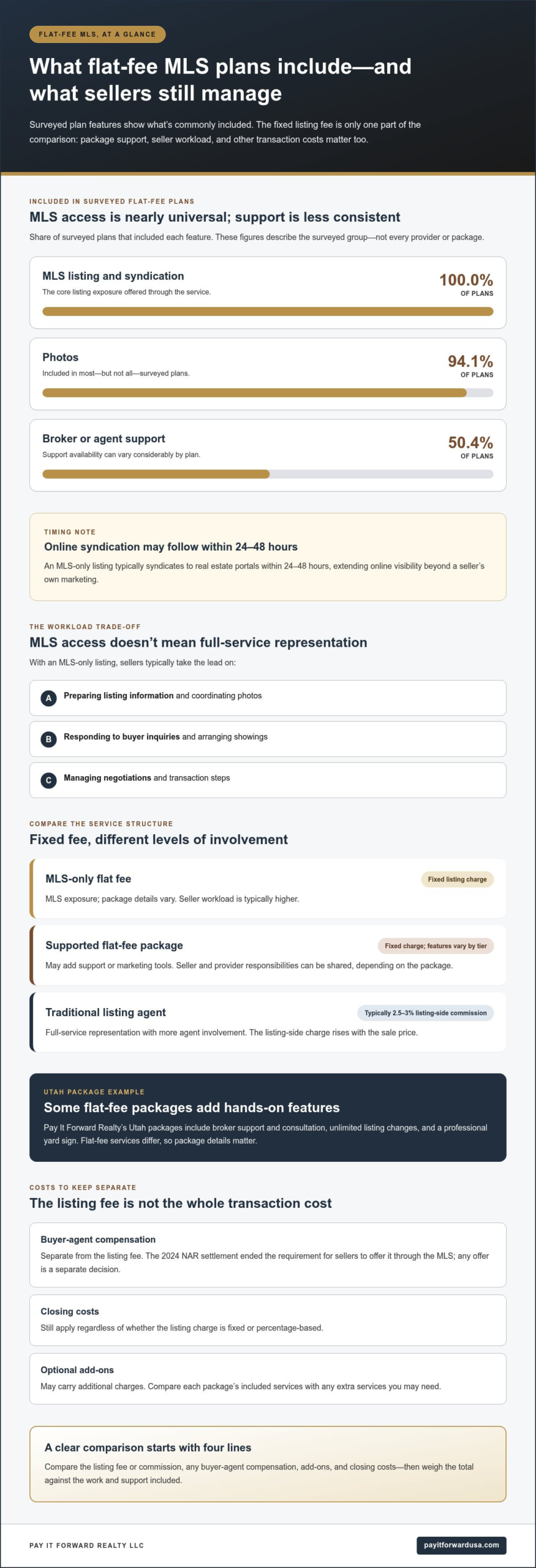
An MLS-only listing gives a seller access to the Multiple Listing Service through a broker, but doesn’t provide a full-service agent. The listing typically syndicates to real estate portals within 24-48 hours, expanding online visibility beyond a seller’s own marketing.
The trade-off is hands-on work. Sellers typically prepare listing information, coordinate photos, respond to buyer inquiries, arrange showings, and manage negotiations and transaction steps. In a surveyed group of flat-fee plans, MLS listing and syndication appeared in 100.0% of plans; photos appeared in 94.1%, while broker or agent support appeared in 50.4%.
Flat-Fee Tiers and Remaining Costs
Flat-fee packages differ in broker support and included tools, not just MLS access. Pay It Forward Realty’s Utah packages include broker support and consultation, unlimited listing changes, and a professional yard sign. Compare the specific inclusions rather than assuming every flat-fee listing covers the same work.
Costs can remain beyond the listing fee. Buyer-agent compensation is separate, closing costs still apply, and optional add-ons may carry additional charges. The 2024 NAR settlement ended the requirement for sellers to offer buyer-agent compensation through the MLS; any compensation offer is a separate decision.
A percentage-based listing commission works differently: the charge changes with the sale price. Traditional listing agents in the United States typically charge 2.5-3% on the listing side. That means a seller’s total comparison should include the listing fee or commission, any buyer-agent compensation offered, closing costs, and add-ons.
| Option | Listing cost structure | Included-service pattern | Seller workload |
|---|---|---|---|
| MLS-only flat fee | Fixed listing charge | MLS exposure; package details vary | Higher |
| Supported flat-fee package | Fixed charge, with tier-dependent features | May add support or marketing tools | Shared, depending on package |
| Traditional listing agent | Typically 2.5-3% on the listing side | Full-service representation | More agent involvement |
Use the table as a starting point, then compare the tasks and services included with each option. A fixed fee makes the listing-side charge easier to forecast, while your final expense still depends on your transaction choices.
For example, a seller comfortable managing photos, showings, and buyer communication may prefer an MLS-focused structure. A seller who wants an agent involved in more steps may value traditional representation, despite its percentage-based listing cost.
Choose the option that fits your budget priorities and the work you’re ready to handle yourself.
How much does a typical flat fee MLS service cost compared to traditional agents?
The key difference is the fee structure: a flat-fee MLS listing uses a fixed charge, while traditional listing commissions usually track the sale price. Compare the listing side separately from any buyer-agent compensation and closing costs.
Traditional Agent Commission Rates
Traditional listing agents in the United States typically charge 2.5-3% of a home’s sale price on the listing side. The commission rises with the sale price, so the same percentage means more dollars on a higher-value property.
That figure covers the listing side only, not buyer-agent compensation or closing costs. When comparing agents, identify the proposed rate, the services it covers, and which other transaction costs remain separate.
Flat-Fee and Commission-Based Compensation
A flat-fee MLS arrangement charges a fixed listing fee rather than a percentage of the sale price. The listing-side charge won’t increase just because the home sells for more, although service levels and seller responsibilities can vary by package.
The 2024 NAR settlement ended the requirement for sellers to offer buyer-agent compensation through the MLS. Buyer-agent compensation is therefore a separate negotiation, not an automatic portion of the listing fee. Sellers can compare whether to offer compensation and how that choice affects their expected proceeds.
Potential Savings on Agent Commissions
Potential savings depend on the sale price, listing fee, selected add-ons, and any compensation offered to a buyer’s agent.
For context, the reported national average total real estate commission in 2026 is 5.4% to 5.5%. Those totals cover both sides and shouldn’t be confused with the seller’s listing-side fee alone.
For a fair comparison, write down the listing fee or commission, any buyer-agent compensation, add-ons, and closing costs. Then compare the services attached to each option. Some firms charge separately for marketing, MLS placement, and showing a home to prospective buyers, according to the United States Government Accountability Office.
A lower listing expense can leave you with more proceeds, but may also mean handling more of the sale yourself. An agent’s support can matter if you want help with negotiations, buyer communication, or transaction steps. Compare the total cost with the specific work each option covers.
For a practical next step, review the available flat-fee MLS listing options and compare their scope with the tasks you’re ready to manage.
Cost comparisons at different home prices
A fixed listing fee stays the same as the sale price changes, while a percentage commission grows with it. Compare the listing-side cost separately from buyer-agent compensation and closing expenses.
Savings on a Median-Priced Home
For a median-priced Salt Lake City home, start with the expected sale price and calculate the traditional listing commission at 2.5-3%. Then compare that amount with the flat listing charge and any selected add-ons. The difference is potential listing-side savings, not a guaranteed change in net proceeds.
Use local comparable sales to estimate the price, rather than treating a Zillow estimate as the final sale amount. Consider what the package includes, such as MLS exposure and broker support. List any buyer-agent compensation separately, since it isn’t automatically part of the listing fee.
These figures describe different scopes: one combines both sides, while the other covers only the listing side.
A flat-fee MLS comparison starts with the fixed listing charge, then adds any selected services and separately considered buyer-agent compensation. The service scope matters as much as the headline savings.
Cost Examples Across Home Sales
Compare those figures with a flat-fee listing structure, keeping buyer-agent compensation and closing costs separate.
These examples show why a percentage commission can become more expensive as the sale price rises, even when the rate stays unchanged. A flat listing charge doesn’t scale with the sale price, though optional services can change the total. Consider buyer-agent compensation separately, and compare the support included with each option.
For a useful comparison, use the same sale price and service scope for each estimate. Record the listing-side charge, any buyer-agent compensation, add-ons, and closing costs. Then decide whether the traditional agent’s additional involvement is worth the cost to you. MLS access can provide exposure, but it doesn’t make an MLS-focused listing equivalent to full-service representation.
Flat-fee service packages and included features
Flat-fee packages vary in what they cover, from MLS placement to broker support. Compare the written inclusions, not just the package name.
Common flat-fee MLS packages include an MLS listing and syndication to real estate portals. Photos, marketing tools, and agent support depend on the plan.
Across surveyed plans, MLS listing and syndication appeared in 100.0% of packages, photos in 94.1%, and broker or agent support in 50.4%. Those figures show why sellers should distinguish online exposure from hands-on help.
A basic tier may focus on entering the listing in the multiple listing service and distributing it to portals. Higher tiers can add tools or support. A higher tier doesn’t automatically mean full-service representation, so match each feature to a task you need covered.
Check whether the package includes photo uploads, listing edits, and support with buyer inquiries. Pay It Forward Realty’s packages include unlimited MLS listing changes, and buyer inquiries are forwarded to you. Showing coordination and negotiation help are separate considerations, so don’t assume they come with MLS access.
Package details matter because listing the property is only one part of a real estate transaction. Sellers may handle pricing decisions, buyer communication, showings, and offer review. In a full-service model, an agent can take a larger role across those steps, while an MLS-focused plan generally leaves more work with the seller.
- MLS listing: Places the property on the local multiple listing service.
- Syndication: Distributes listing information to real estate portals.
- Photos and marketing: May be included or offered as added tools.
- Agent support: Appears in 50.4% of surveyed plans.
These features aren’t interchangeable. Online distribution can increase listing exposure, but it doesn’t itself provide someone to manage offers or coordinate the sale. Some firms charge separately for marketing and advertising, MLS listing, and showing the home to prospective buyers, according to the United States Government Accountability Office.
Full-service flat-fee brokerages provide the same range of services as commission-based brokerages, while MLS-only packages focus on listing access. That distinction helps clarify what sellers can expect: broader representation or a narrower service with more owner-managed tasks.
Before choosing, list the work you want handled, then compare each package’s included features and add-ons. If you can manage photos, showings, and buyer communication, a narrower package may fit. If you want an agent involved throughout the transaction, compare a full-service model.
Price thresholds for flat-fee services
Flat-fee MLS prices and services vary by state and local market because package scope, broker support, and local requirements differ. Utah is among the jurisdictions identified as having minimum-service mandates for flat-fee MLS services, so local rules can affect what a listing arrangement includes.
A useful price threshold is the sale price where a percentage-based listing commission exceeds the fixed listing charge. Traditional listing agents typically charge 2.5-3% of the sale price, so commission dollars rise as the price increases. A seller can compare that percentage cost with the flat fee and any add-ons, then assess the work each option covers.
Think of the comparison as two questions: what do you pay upfront, and which tasks remain yours? A sale by owner with MLS access may still involve managing showings, buyer communication, offer review, and closing steps. Broker support varies by package, so compare the specific services included.
Local market conditions also shape the value of extra services. In Salt Lake City and nearby areas such as Lehi, Orem, and Provo, sellers may prioritize listing exposure and clear photos. A property needing more explanation, specialized marketing, or careful pricing may make broker guidance more valuable. An appraisal can influence negotiations, but it’s distinct from MLS placement and listing support.
Use this three-step comparison before choosing:
- Set the sale-price estimate. Use comparable properties and account for how an appraisal could affect negotiations.
- Calculate the percentage fee. Apply the traditional 2.5-3% listing-side rate to the estimated sale price.
- Compare total scope. Add the flat listing charge and selected extras, then identify who handles showings, offers, and closing coordination.
The threshold isn’t only a dollar break-even point. It also reflects how much your time and transaction support matter. A seller comfortable coordinating showings and reviewing offers may favor a narrower listing service. Someone seeking more professional involvement may weigh the agent’s role alongside the commission.
For example, compare two options using the same sale-price estimate for a home in Saratoga Springs, South Jordan, or another nearby Utah community. One provides MLS access with seller-managed showings; the other charges a percentage and offers broader agent involvement. Write down each included task, separate cost, and person responsible. This makes the trade-off clear before you choose.
Compare Utah flat-fee listing options against the service scope and seller responsibilities that fit your sale.
Pay It Forward Realty offers Utah homeowners flat-fee MLS listing options for sellers who want MLS exposure without percentage-based listing representation. The Affordable Package, Affordable Plus Package, and Monthly Listing Plan offer different pricing structures. The Affordable Plus Package has an additional percentage charge at closing, so include that in your comparison.
Choose based on your preferred payment structure and how much of the selling process you’re prepared to manage.
Review the options and decide which fits your transaction. Visit Pay It Forward Realty to learn more.
Make Your Next Move With Confidence
A flat-fee MLS vs. full-service Realtor cost comparison is most useful when it reflects how you want to manage the sale, not just the headline fee. Before deciding, identify which transaction tasks you want to handle yourself and where professional support would make a meaningful difference. That gives you a practical way to choose an approach that fits your priorities.
Pay It Forward Realty offers Utah homeowners flat-fee listing options, including the Affordable Package, Affordable Plus Package, and Monthly Listing Plan. If you’re weighing a sale, use your preferred level of involvement to guide the next conversation. A clear starting point helps you compare options without losing sight of the work behind the transaction.
Explore your listing options with Pay It Forward Realty, then take the next step with confidence.
Frequently Asked Questions
Do Flat Fee Listings Sell for Less Than Traditional Listings?
Not simply because the seller used a flat-fee listing. The listing method affects representation and workload, not a home’s inherent market value. Buyers consider factors such as condition, location, presentation, and asking price. A well-presented home priced in line with comparable properties can compete on its merits, regardless of how the seller arranged MLS access.
Does a flat fee MLS listing hurt your sale?
A flat-fee MLS listing doesn’t automatically hurt a sale, but the seller takes on more responsibility in an MLS-focused arrangement. Delayed replies, limited showing availability, or incomplete property details can make it harder for interested buyers to move forward. Set a plan for responding to inquiries, keeping showing times current, and sharing accurate information so buyers can act on the listing.
What Is Flat Fee Real Estate, Exactly?
Flat-fee real estate means paying a fixed charge for a defined service instead of paying a listing agent a percentage of the sale price. In an MLS-focused arrangement, a broker submits the property to the Multiple Listing Service, while the seller manages much of the sale. The term doesn’t mean every package provides the same support or representation.
What are the pros and cons of a flat fee MLS listing?
The main advantage is a predictable listing-side charge that doesn’t rise with the home’s sale price. The trade-off is seller involvement: you may need to handle buyer inquiries, showing coordination, and offer decisions. Before choosing, list the tasks you can manage and compare them with the package’s services. That makes the practical trade-off clearer than focusing on the fee alone.
What does a flat-fee MLS listing cost in the United States?
Flat-fee MLS costs vary across the United States according to market, package scope, broker support, and optional services. An MLS placement and a package with added tools can have different costs. For a useful comparison, identify whether the quoted charge is one-time or recurring, then account separately for add-ons and transaction expenses.
What is the typical seller-agent commission or full-service realtor fee?
Traditional listing agents in the United States typically charge 2.5-3% of the sale price on the listing side. The calculation is the sale price multiplied by the agreed rate. Treat that as the listing-side figure, not an automatic total for both sides of the transaction. Any buyer-agent compensation is separate and should be considered independently.
How much can a home seller save with flat-fee MLS compared with a full-service realtor?
The difference depends on the home’s sale price, the fixed listing charge, selected add-ons, and services included. A flat-fee MLS versus full-service Realtor cost comparison should calculate the listing-side fee first, then account for any buyer-agent compensation and closing costs separately. Flat-fee alternatives can reduce listing-side costs by 70-90% compared with percentage-based commissions, though the seller may handle more tasks.
How do flat-fee MLS sellers handle pricing, showings, offers, negotiations, and paperwork?
Sellers generally set the asking price using comparable properties and the home’s condition, then coordinate showing requests and respond to buyers. They review offers, negotiate terms, and manage transaction paperwork through closing. A practical system helps: keep a record of inquiries, showing feedback, offer deadlines, and requested documents. Broker support varies by package, so understand which tasks your chosen service covers.