How to Verify Buyer Financing in a FSBO Sale: A Utah Seller’s Guide


What if a buyer’s preapproval letter looks solid but doesn’t tell you whether their lender is ready to fund the purchase? If you’re searching for how to verify buyer financing fsbo, start with this: a letter is a useful signal, not a guarantee. You’re right to want more clarity before relying on an offer, especially when a financing delay could put your sale at risk.
You can assess the buyer’s readiness without prying into private financial details or acting as their lender. This guide shows you how to review the letter, confirm key details with the lender respectfully, and understand what the buyer’s financing contingency and contract deadlines mean for your Utah FSBO sale.
We’ll cover the difference between prequalification and preapproval, practical questions to ask, and steps to take if financing hits a snag. You’ll also learn when a Utah real-estate or mortgage professional can help you interpret the paperwork or contract. The goal is simple: verify what you reasonably can, keep communication clear, and help the transaction stay on track.
Key Takeaways
- Learn how to verify buyer financing fsbo by reviewing the offer and financing letter, then confirming relevant details through the buyer or their representative.
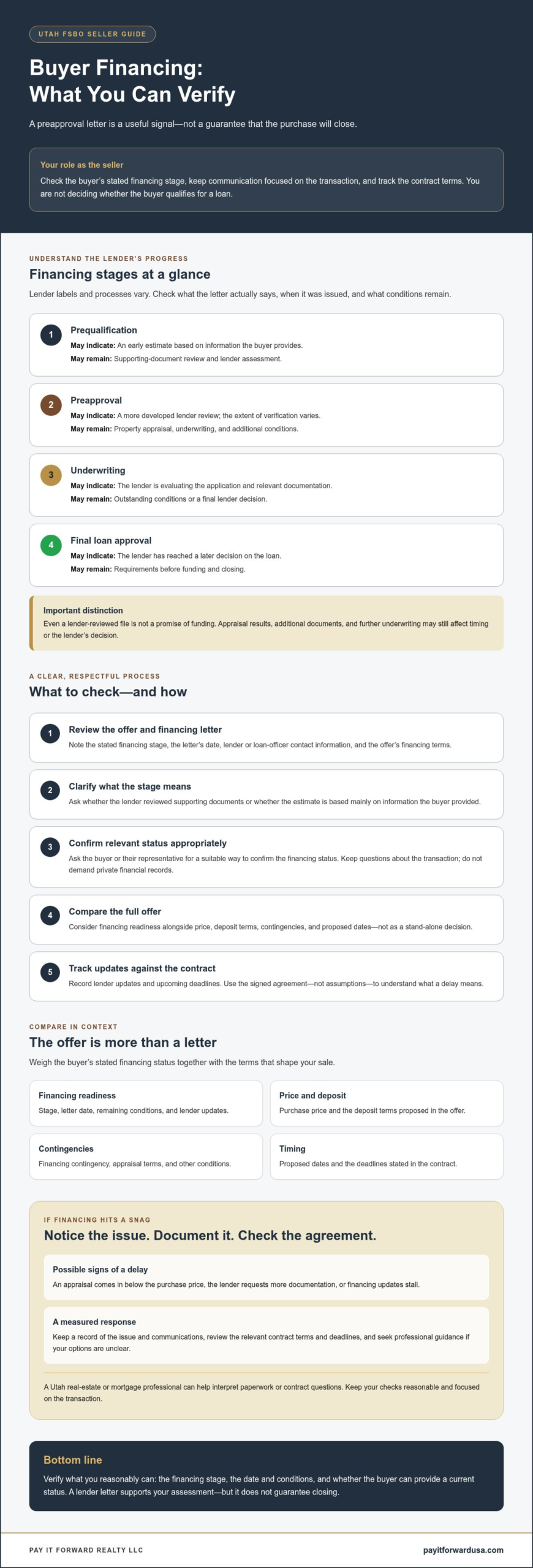
- Compare prequalification, preapproval, underwriting, and final loan approval by checking the stated stage, date, and conditions.
- Weigh financing readiness alongside price, deposit terms, contingencies, and proposed dates before deciding which offer fits your priorities.
- Track lender updates and upcoming contract deadlines so you can spot delays early and respond based on the agreement.
- If financing information stalls or contract options are unclear, document the issue and consult a Utah real-estate or mortgage professional.
Why Utah FSBO Sellers Should Verify Buyer Financing Before Moving Forward
An accepted offer isn’t the same as confirmed financing. A buyer may have a lender letter and a clear plan, but the loan still has to move through steps such as appraisal and underwriting. If a valuation comes in below the purchase price, or the lender needs more documentation, the buyer’s financing may take longer or change. That can put proposed closing plans under pressure and make contract deadlines harder to manage.
For a Utah FSBO seller, the goal isn’t to decide whether a buyer qualifies for a loan. It’s to make a reasonable check of the buyer’s stated financing status, then consider that information alongside the offer’s dates and contingencies. You can ask for relevant confirmation without demanding extensive personal financial records. Review the terms in the purchase contract, keep communication focused on the transaction, and get professional guidance if you’re unsure how a deadline or contingency applies.
What “verified financing” can and cannot mean
Verification means confirming what stage the buyer’s financing has reached, not securing a promise that the loan will fund. A prequalification may be an early estimate; a preapproval generally reflects a more developed lender review. The exact terms and process can vary, so check what the letter actually says and when it was issued. For a neutral overview of mortgage pre-approval, see how it differs from prequalification in the home-buying process.
Even a lender-reviewed file isn’t a guarantee of closing. The lender may still need documents, appraisal results, or further underwriting before making a final decision. Treat a letter as evidence of preparation and progress, not certainty. The practical question is whether the buyer can share a current, credible status and keep you informed as the transaction moves forward.
Why Utah FSBO sellers need a repeatable process
When you’re managing the sale yourself, you’re also coordinating buyer communication and keeping track of contract dates. A simple, consistent process helps you compare offers using the same kinds of information instead of relying on impressions or a confident-sounding letter. Ask each buyer for the financing stage, the date of the lender document, and an appropriate way to confirm the status through the buyer or their representative.
Then assess financing in context. A buyer’s loan status matters, but so do the proposed closing date, financing contingency, appraisal terms, and other conditions in the offer. Record updates and compare them with the signed agreement rather than making assumptions about what a delay means. For broader planning, the Utah FSBO selling-cost breakdown can help you consider financing readiness alongside the practical costs of selling.
Prequalification, Preapproval, and Loan Approval: What Utah Sellers Should Check
A lender letter can use reassuring language without showing exactly how far the buyer’s application has progressed. To understand how to verify buyer financing fsbo, focus on the stated stage, the date, and any remaining conditions. Labels vary among lenders, so treat this comparison as a guide, not a universal definition.
| Stage | What it may indicate | What may remain |
|---|---|---|
| Prequalification | An early estimate based on information the buyer provides | Review of supporting documents and lender assessment |
| Preapproval | A more developed review; the extent of verification varies by lender | Property appraisal, underwriting, and additional conditions |
| Underwriting | The lender is evaluating the application and relevant documentation | Outstanding conditions or final lender decision |
| Final loan approval | The lender has reached a later decision on the loan | Any remaining requirements before funding and closing |
What a prequalification or preapproval letter tells you
A prequalification is generally an early estimate based on details supplied by the buyer. A preapproval may involve more review, but the word alone doesn’t tell you which documents the lender checked or whether an underwriter reviewed the file. Ask a focused question: “Has the lender reviewed supporting documents, or is this estimate based mainly on information the buyer provided?” You don’t need to request tax returns, bank statements, or other sensitive records to ask about the process.
Review the letter for the buyer’s name, lender or loan officer contact information, proposed loan type, and an expiration or review date. Check that the stated financing appears consistent with the offer. A letter is useful evidence, not a guarantee. If anything is unclear, ask the buyer or their representative to clarify it with the lender, or consult a qualified mortgage professional.
What changes after an offer is accepted
Acceptance doesn’t end the lender’s work. Underwriting may continue, an appraisal may be needed, and the lender may request more information or impose conditions before the loan can proceed. A change in the buyer’s circumstances or the property’s appraisal can also affect the financing path.
Compare updates with the signed offer’s financing-contingency language and deadlines. Don’t assume what a missed date permits or requires: Utah contract wording and current practices should be reviewed with a qualified local real-estate professional. Clear expectations matter. If you’re also weighing your sale approach, you can explore Utah listing support while keeping the buyer’s loan questions separate from your listing decisions.
How to Check a Buyer’s Financing Without Overstepping
A practical way to learn how to verify buyer financing fsbo is to follow the same limited checks for every offer. Start with the paperwork and terms in front of you. Then ask the buyer or their representative for any clarification, keeping requests focused on the transaction rather than personal finances.
A practical financing-verification checklist
- 1. Review the offer and financing letter. Check that the buyer named in the offer matches the name on the letter, and that the financing described appears consistent with the proposed purchase. If the letter doesn’t identify the property, don’t assume it’s property-specific.
- 2. Note the loan details and dates. Look for the loan type, stated financing stage, issue date, expiration or review date, and any visible conditions. A mismatch, such as different names or an outdated date, is a reason to ask for clarification, not to jump to conclusions.
- 3. Ask what remains outstanding. You might say, “Can you share the lender’s current status and what milestones are still ahead?” Ask whether documents, appraisal, or other lender conditions remain. Don’t request account numbers, full bank statements, tax returns, or a complete loan file.
- 4. Request a suitable lender contact. Ask the buyer or their representative to provide the loan officer’s contact details and arrange permission for a limited status conversation. The lender may require the buyer’s authorization before discussing the application.
- 5. Record the update and follow-up. Note when the information was received, what was confirmed, and when the next update is expected. Keep records and documents in an appropriate, secure place, and track the agreed follow-up against the contract dates.
How to speak with the buyer’s lender
Get the buyer’s permission before contacting the lender. If you do speak, keep the call narrow and professional. You can confirm the lender’s identity and ask whether the letter is current, what general stage the file has reached, and whether key milestones remain. Don’t ask for confidential details such as income, credit scores, account balances, or loan-file documents. The lender may decline to discuss specifics, even when you have a reasonable transaction question.
Use contact information provided by the buyer or representative, and, when appropriate, verify it independently through the lender’s official website or another trusted source. If a name, loan type, or date doesn’t line up, ask the buyer to explain or provide an updated letter. A clear follow-up is usually more useful than treating a discrepancy as proof of a problem.
Compare Financing Offers by Readiness, Contingencies, and Timing
A financing letter is one part of an offer, not the whole decision. Compare the buyer’s stated loan progress with the price, deposit terms, contract contingencies, and proposed dates. A higher offer may come with terms or timing that don’t fit your priorities; a more advanced financing review doesn’t automatically make another offer the better choice.
Use the same comparison points for each offer. This keeps your review grounded in the documents rather than assumptions about a buyer or a particular loan type.
| What to compare | Questions to ask |
|---|---|
| Financing readiness | What stage does the lender letter state? Has the lender reviewed supporting buyer information, and when was the letter issued? |
| Price and deposit terms | How does the purchase price compare with your goals? What deposit terms does the written offer propose? |
| Contingencies | What do the financing, appraisal, and inspection terms say? What actions or deadlines do they specify? |
| Timing and communication | What closing date is proposed? Are extensions requested, and how will the buyer share financing updates? |
Questions to compare across offers
Read each offer as written. Note the financing stage and any confirmation the buyer has shared, then compare the exact contingency language, proposed dates, and communication expectations. Don’t assume that a buyer has fewer protections or a faster path to closing based only on a loan label. Utah forms and contract language can change, so have a qualified local professional review the current documents and deadlines before you accept an offer or agree to revised terms.
A simple side-by-side record can help: list each offer’s price, deposit terms, financing evidence, contingencies, key dates, and unresolved questions. That makes tradeoffs visible without pretending that one factor decides everything.
When financing uncertainty needs a professional review
Pause for guidance if details conflict, the lender can’t confirm even a general status, or you can’t tell what a deadline requires. A Utah real-estate attorney, licensed broker, or qualified transaction professional can help you understand the documents and identify questions to resolve. If you’re also weighing how to market a FSBO property, review Utah flat-fee MLS listing options as a separate part of your sale plan.
Keep a Utah FSBO Sale on Track After Financing Checks
Financing checks give you a snapshot, not a reason to stop tracking the transaction. Keep the next steps visible. A simple follow-up routine helps you connect lender updates and buyer communications to the dates in your signed agreement, without treating a status update as a promise of closing.
A simple follow-up routine from offer to closing
- At acceptance: Save the signed agreement and note its financing-related dates, the buyer’s preferred communication channel, and any follow-up date you’ve agreed on.
- As a milestone approaches: Contact the buyer or their representative through that channel and ask for a concise update. Record when you asked, what they reported, and any next step or date discussed.
- If an update is delayed: Document the missed communication and ask the buyer for a revised status. Before agreeing to an extension or changing any timeline, compare the request with the signed agreement and get guidance from a qualified professional.
- As closing nears: Keep tracking the contract dates and any remaining lender milestones. Share only the information needed for the transaction, and store buyer documents securely rather than forwarding sensitive files unnecessarily.
One organized, secure record is enough: dates, communications, agreed follow-ups, and relevant documents. Avoid collecting or circulating private financial material you don’t need. If a deadline’s meaning is unclear, don’t guess. Ask a Utah real-estate attorney, licensed broker, or other qualified transaction professional to help you understand your options.
Where Utah FSBO sellers can get help
Listing support and financing verification are different. A listing provider can help with the listing side of a sale, but that doesn’t mean it makes lending decisions, gives legal advice, or provides representation for every transaction issue. Pay It Forward Realty LLC offers Utah flat-fee MLS listing options. Its association with True North Mortgage may provide buyers a prequalification starting point, but that is not approval or independent verification of a specific buyer’s loan.
You’ve done the practical work of keeping financing updates connected to your contract timeline. If you’re considering listing support for a Utah FSBO sale, explore Utah FSBO listing support and review what fits your needs.
Move Forward With Clear Checks and a Plan
Buyer financing doesn’t have to be a mystery, and it doesn’t have to become your responsibility to underwrite a loan. The practical approach to how to verify buyer financing fsbo is to review what the buyer shares, confirm relevant status with permission, and keep updates tied to the signed agreement.
Remember two things: a lender letter shows a stage of progress, not a promise that funds will be available at closing. And financing evidence is only one part of the offer, alongside its price, contingencies, and timing. If documents conflict or a deadline is unclear, pause and get guidance from a qualified Utah real-estate or mortgage professional before changing terms.
Pay It Forward Realty LLC offers Utah flat-fee MLS listing options for homeowners selling independently. Its association with True North Mortgage may give buyers a prequalification starting point, but prequalification isn’t loan approval or verification of a particular buyer’s financing.
Ready to consider your listing options? Explore Utah FSBO listing support. Stay organized, ask proportionate questions, and move ahead with confidence.
Frequently Asked Questions
Is a mortgage preapproval letter enough to verify a buyer’s financing?
No. A preapproval letter is useful evidence of lender review, but it doesn’t guarantee the loan will fund. Check that the buyer’s name, loan type, and letter date make sense for the offer, and ask what conditions remain. For sellers considering how to verify buyer financing fsbo, a current status update from the buyer or their authorized lender contact can add context without treating the letter as final approval.
Can a home seller contact a buyer’s lender directly?
Yes, if the buyer authorizes a limited conversation, though the lender may still restrict what it can share. Ask the buyer or their representative to arrange permission and provide the right contact. Keep questions focused on general progress, the financing stage, and outstanding milestones. Don’t seek private details such as income, credit scores, or account balances. If the lender can’t discuss the file, request an update through the buyer.
What documents should a FSBO seller request from a financed buyer?
Start with the purchase offer and a current lender letter that identifies the buyer and describes the loan type and financing stage. You can ask whether the lender has reviewed supporting information and what milestones remain. Avoid requesting a full loan application, tax returns, bank statements, or account numbers. If a document is unclear or inconsistent with the offer, ask the buyer to clarify it rather than collecting more personal records.
How can I verify proof of funds for a buyer’s down payment or closing funds?
Ask the buyer to provide reasonable confirmation, such as a current financial institution letter or a redacted statement showing sufficient available funds. They should be able to conceal account numbers, unrelated transactions, and other sensitive information. Don’t assume a screenshot or document proves funds will remain available through closing. If you’re unsure what evidence is appropriate, ask a qualified real-estate professional, and handle any financial documents securely.
What happens if a buyer’s financing is delayed after I accept their offer?
A delay doesn’t automatically tell you whether the buyer can proceed or what action you can take. Record the update, ask the buyer for a revised status and expected next milestone, then compare the situation with the signed agreement’s contingency language and deadlines. Don’t agree to change dates based on assumptions. Have a Utah real-estate attorney, licensed broker, or qualified transaction professional explain your options before you respond.
Does prequalification mean a buyer’s home loan is approved?
No. Prequalification is generally an early estimate based on information supplied by the buyer. It doesn’t establish final loan approval, and lender processes differ. A preapproval may involve additional review, but it also isn’t a guarantee of funding. Ask what information the lender has reviewed and what conditions remain. True North Mortgage, associated with Pay It Forward Realty LLC, offers buyer prequalification as a starting point, not approval or seller-side verification.
Should I accept a cash offer instead of a financed offer?
Not automatically. Compare the full written offers: price, deposit terms, contingencies, proposed dates, and credible evidence of available funds or lender progress. A cash offer still deserves careful review, and a financed offer may fit your priorities better depending on its terms. Sellers in Saratoga Springs, Lehi, Eagle Mountain, South Jordan, Herriman, Orem, Provo, Alpine, Draper, Sandy, Bluffdale, American Fork, Highland, Cedar Hills, Lindon, West Jordan, West Valley, Salt Lake, Bountiful, South Salt Lake, and Murray should weigh each offer on its own details.