Salt lake county new home rebate


Buyer commission rebates are legal in Utah. A Salt Lake County new-home rebate can return part of the buyer-agent commission to the buyer, and Utah law requires the rebate to come from the brokerage, not the individual agent. The key is how the rebate is structured and applied to the purchase.
It’s reasonable to ask whether a rebate can work with a new build, your loan, or your tax situation. The answer depends on the type of rebate: a buyer-agent commission rebate is different from an energy-efficiency rebate or homebuyer grant, and each has its own eligibility and use rules.
Learn which home and financing situations may qualify, how Utah’s new-construction incentives fit in, and how the IRS treats a buyer rebate for tax purposes. You’ll also see practical limits that can affect the value you receive, helping you plan your purchase with fewer surprises.
Key Takeaways
- Buyer-agent commission rebates are legal in Utah, but the brokerage must issue the rebate rather than the individual agent.
- Separate buyer-agent rebates from energy rebates and grants: home type, income, and the program’s rules can affect eligibility.
- Learn how a buyer rebate may be treated for federal taxes and why its use can depend on your loan and closing details.
Existing-home and new-construction eligibility
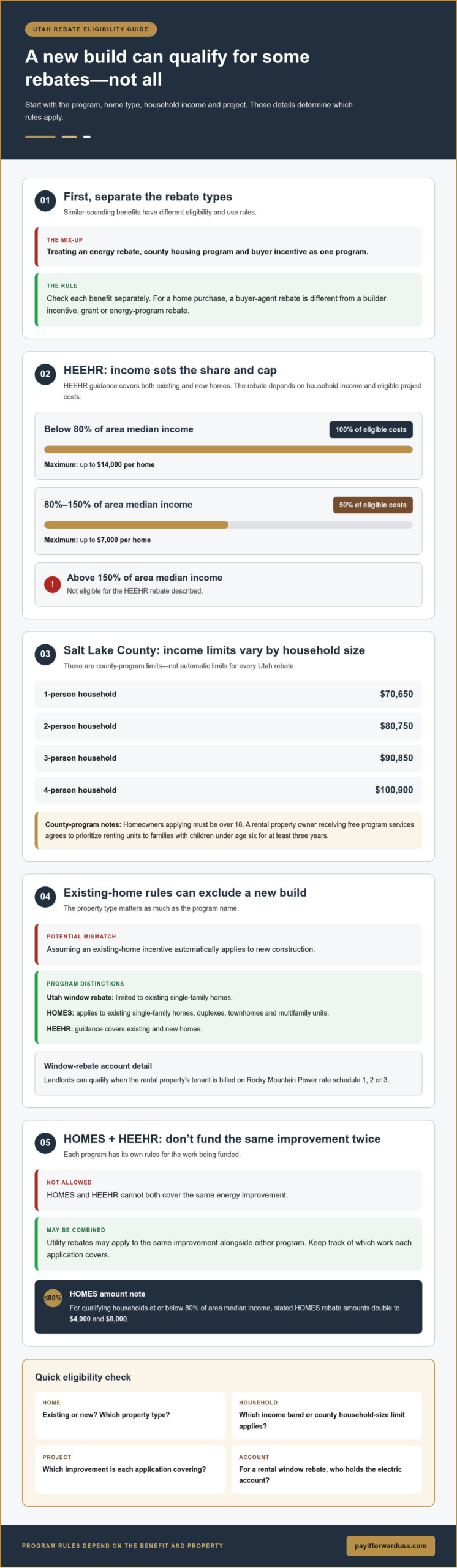
First identify which program you mean: an energy rebate, a county housing program, or a buyer incentive. Utah’s window rebate and HOMES rebates apply to existing homes, while HEEHR guidance covers both existing and new homes. This distinction matters for a newly built property: it may fall outside one program’s rules but qualify under another.
Salt Lake County’s stated income limits are household-size specific. According to Salt Lake County, the maximum income for a one-person household is $70,650. For a two-person household, the limit is $80,750, according to Salt Lake County. For a three-person household, it is $90,850, according to Salt Lake County. The four-person household limit is $100,900, according to Salt Lake County. These county figures apply to the county program’s eligibility criteria, not automatically to every Utah rebate.
Renters may benefit when a landlord applies for eligible home improvements. A Salt Lake County rental property owner receiving free program services agrees to prioritize renting the units to families with children under age six for at least three years. That commitment affects the owner’s rental choices after the work. Homeowners applying for the county program must be over 18 years old.
HEEHR eligibility also depends on household income and eligible project costs. Households below 80% of area median income may receive 100% of eligible costs, up to $14,000 per home. Households from 80% to 150% of area median income may receive 50% of eligible costs, up to $7,000 per home. Households above 150% of area median income aren’t eligible for the HEEHR rebate described. HOMES rebates apply to existing single-family homes, duplexes, townhomes, and multifamily units. For qualifying households at or below 80% of area median income, stated HOMES rebate amounts double to $4,000 and $8,000.
For Utah’s window rebate, the tenant’s electric account can matter. Landlords can qualify when the rental property’s tenant is billed on Rocky Mountain Power rate schedule 1, 2, or 3. Before applying, identify the property type, program, household income, and account holder. Those details help distinguish an eligible existing-home project from a new-construction purchase incentive.
Are rebates taxable income?
Tax treatment depends on what the payment represents and when it reaches you. Distinguish buyer cash-back rebates from builder incentives and energy-program rebates before reviewing the paperwork.
Cash-Back Rewards for Buyers
A cash-back reward connected to a home purchase can reduce your net purchase cost. The IRS treatment described for buyer rebates paid at or after closing is a purchase-price adjustment, rather than taxable income. The rebate also does not need to be reported on Form 1099-MISC.
Keep closing paperwork that shows the rebate and when it is applied. Compare the settlement statement with the written rebate terms to confirm the amount and treatment. For a Salt Lake County new-home rebate, first determine whether it’s buyer-agent cash back, a grant, or a builder incentive. These labels describe different benefits, not interchangeable payments.
Rebates on New Construction
A new build can involve a buyer-agent rebate, a builder incentive, or both. A builder incentive may reduce the purchase price or help cover eligible financing costs, such as a rate buydown. Read the written terms for restrictions, including any preferred-lender requirement, and check how the incentive appears in your closing documents.
Cash back tied to buyer representation is different from a builder credit. Before submitting documents or finalizing the purchase, identify who funds each benefit, when it is paid, and how it is recorded. This paper trail helps distinguish a purchase-price adjustment from other assistance.
“New-construction exclusion” does not mean every rebate excludes newly built homes. Utah’s window rebate is limited to existing single-family homes, while HEEHR guidance includes new homes. Treat each program separately: energy rebates follow program eligibility, while buyer cash-back rewards relate to the purchase transaction.
For the tax treatment described here, timing matters: the buyer rebate must be paid at or after closing to count as a purchase-price adjustment. Keep the closing disclosure and rebate agreement with your tax records. For a purchase-focused explanation of buyer rebate options, review the relevant terms before deciding how a reward fits your closing plan.
Utah legality and federal tax treatment of rebates
Homebuyer assistance may be combined with builder incentives, mortgage credits, or other grants when each program’s terms and lender treatment allow it. HOMES and HEEHR rebates cannot cover the same energy improvement, although utility rebates may apply to that improvement.
Buyer commission rebates are legal in Utah. State law requires the brokerage, not the individual agent, to issue the rebate. A buyer rebate paid at or after closing is treated as a purchase-price adjustment rather than taxable income. It does not need to be reported on Form 1099-MISC. Keep the rebate terms and closing paperwork together, so the payment’s purpose and timing are clear. These buyer rebates differ from energy incentives, which follow program eligibility and application rules.
HOMES and HEEHR cover eligible home improvements, but they cannot both fund the same improvement. Utility rebates may be used alongside either program for that work. Separate improvements are assessed under their respective program rules, so identify which work each application covers.
Window rebates and tax credits are separate incentives. As of 2026, no active federal or Utah state residential window-replacement tax credit is available. The residential window-replacement tax credit expired at the end of 2025. Each qualifying window needs a U-factor of 0.22 or lower.
Before accepting incentives, list each benefit by source: buyer rebate, builder credit, grant, mortgage credit, or energy rebate. Match each benefit to its intended use and the relevant closing or project documents. For energy work, keep separate records for each improvement and application. This makes restrictions easier to spot when multiple incentives relate to one new-home purchase.
Rebates with conventional, FHA, VA, and cash purchases
A buyer rebate can interact differently with conventional, FHA, VA, and cash purchases. The key question is whether a lender classifies the rebate as a seller or interested-party contribution and what the loan allows. Put the rebate terms in writing early, then ensure the amount and intended use are accurately reflected in the transaction documents.
For FHA financing, guidelines allow interested-party contributions up to 6% of the sale price. That limit is not permission to use a buyer rebate for every purpose: Utah and federal lending guidelines do not allow a buyer rebate to fund the down payment. A conventional loan has its own contribution rules, so the rebate’s source, structure, and use matter. Don’t assume an FHA allowance automatically applies to a conventional purchase.
VA financing also requires the rebate to follow the loan’s applicable rules. Consider who funds it, whether it reduces eligible closing costs, and how it appears in the closing paperwork. With a cash purchase, there’s no mortgage program to approve how the rebate is used. Still, document the payment and closing adjustment clearly, especially if the rebate is paid at or after closing.
Keep loan-related credits separate from energy incentives. An 80% area-median-income threshold may affect eligibility for certain home-energy rebates, but it isn’t a loan contribution limit. Track each benefit by source and purpose, then compare the rebate agreement with the purchase and settlement documents before signing.
Utah buyers must sign a written representation agreement before privately touring homes with an agent, following the 2024 NAR settlement. Include rebate terms in the representation paperwork and clarify how the payment will be processed.
Pay It Forward Realty: Affordable Package
Pay It Forward Realty can be a next step if you’re buying a Utah home and want a buyer rebate, or selling and want a flat-fee MLS listing option. Review the rebate terms alongside your purchase and closing documents to understand how it fits your transaction.
For sellers, Pay It Forward Realty offers the Affordable Package, Affordable Plus Package, and Monthly Listing Plan. Choose based on the listing support you want and how you prefer to manage the sale. These services meet different needs: a buyer rebate relates to a purchase, while listing packages are for homeowners selling a property.
Contact Pay It Forward Realty to discuss which option fits your next real estate move.
Make your next move with a clear plan
A Salt Lake County new-home rebate is one part of a larger purchase decision. Before moving forward, write down what you want the benefit to accomplish, then organize your purchase documents around that goal. A clear record can make conversations about closing, financing, and paperwork more focused.
If you’re selling, Pay It Forward Realty’s flat-fee MLS listing options offer another way to approach your next move. The right path depends on whether you’re preparing a home for sale or working toward a purchase.
For listing options, pricing depends on the case and is provided after a quote request. Factors include the selected listing plan and the needs of the transaction. Keep the decision practical: understand the terms, identify your priority, and choose the next step that fits.
Contact Pay It Forward Realty to discuss your real estate plans and take your next step with confidence.
Frequently Asked Questions
Are buyer commission rebates legal in Utah?
Yes. Utah permits buyer commission rebates, and the brokerage must issue the rebate rather than the individual agent. Before making an offer, make sure your written buyer representation terms explain how the rebate is calculated and handled. This gives you a clear record to compare with the final closing paperwork and helps distinguish a brokerage rebate from a separate builder incentive.
Does new construction qualify?
A new build can qualify for a buyer-agent commission rebate, which is separate from energy-program eligibility. Treat the builder’s incentive and the brokerage’s rebate as distinct transaction benefits, even if both affect your purchase costs. Before committing, identify each benefit’s source, terms, and intended use. For example, a builder rate buydown isn’t the same as buyer cash back.
How Does It Work?
A buyer and brokerage agree in writing on representation and rebate terms, then document the arrangement through the purchase. Utah buyers must sign a written representation agreement before privately touring homes with an agent, following the 2024 NAR settlement. Keep the rebate terms alongside your purchase paperwork, and ensure the lender and closing documents reflect how the benefit will be applied.
How long does it take to receive the rebate?
The written rebate terms and transaction paperwork determine when the buyer receives the funds. A rebate may appear as a purchase adjustment at closing or be paid afterward. Submit required paperwork promptly, ensure the closing documents show the agreed treatment, and retain the final settlement statement with your rebate agreement.