Utah Home Selling Checklist for a Confident 2026 Sale


A Utah home sale can get complicated long before the first offer arrives. The right tasks, records, and decisions in the right order can help you avoid preventable surprises. This utah home selling checklist gives you a clear place to start.
It’s normal to wonder what to fix before listing, which paperwork to gather, and who’s responsible for each step. A practical plan can help you prepare with confidence and choose a selling approach that fits your needs and the level of support you want.
Use this guide to get your home and records ready, compare selling options, and follow key decisions from listing through closing. You’ll also see where Utah-specific details, including seller disclosures, fit into the process. Keep deadlines visible and take one step at a time.
Key Takeaways
- Use the utah home selling checklist to organize the sale into clear stages, from getting ready to closing.
- Gather homeownership and maintenance records, then prioritize practical repairs and presentation before listing.
- Compare agent-led, flat-fee MLS, and seller-managed approaches by weighing responsibilities, support, and control.
- Review offer terms, contingencies, and deadlines carefully, and be ready for possible inspection and appraisal steps.
- Track the next task at each stage, and direct unanswered legal, tax, title, or inspection questions to the appropriate professional.
Utah home selling checklist: map the sale from first decision to closing
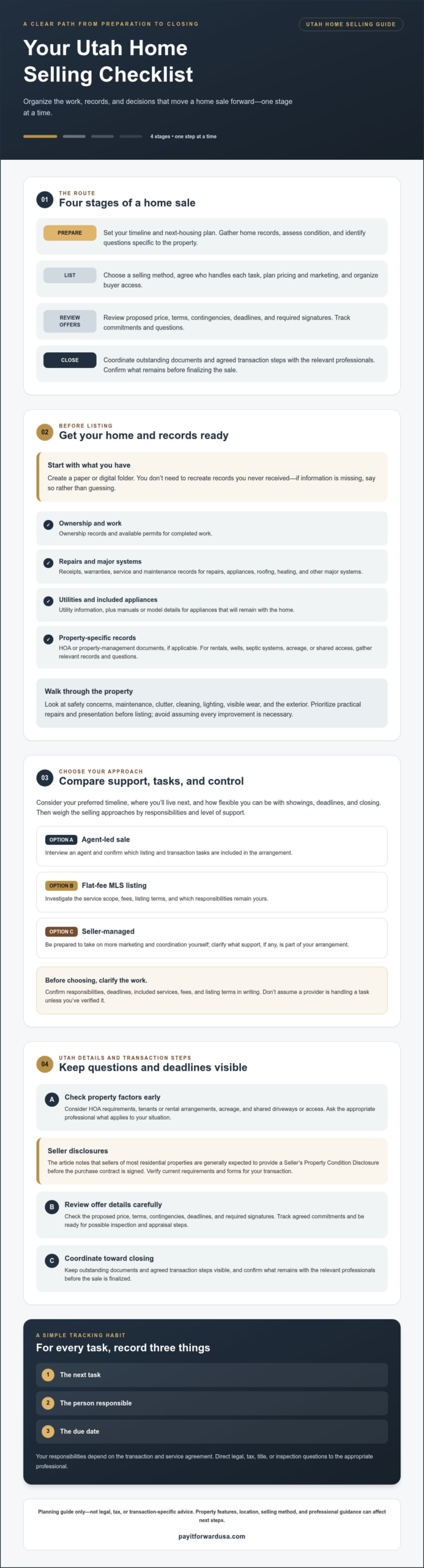
A home sale is easier to manage when you can see the path ahead. Decide when and how you want to sell, prepare the property and records, choose a marketing approach, review offers, and coordinate the steps leading to closing. This Utah home selling checklist is a planning aid, not legal, tax, or transaction-specific advice. Your next steps can depend on the property, location, selling method, and guidance from qualified professionals.
What should Utah sellers decide before starting?
Set your preferred timeline and think through where you’ll live next. Consider how flexible you can be with showings, deadlines after accepting an offer, and the closing date. Then compare your options: interview an agent, investigate a flat-fee MLS listing, or take on more marketing and coordination yourself. Utah-focused flat-fee MLS listing services, such as those offered by Pay It Forward Realty LLC, are one option to explore. Confirm the service scope, fees, and listing terms before choosing.
Property details can affect your plan. Check for HOA requirements, tenants or other rental arrangements, acreage, and shared driveways or access. Identify these factors early, then ask the appropriate professional what applies to your situation.
Master checklist: from preparation to closing
- Preparation: Set your timeline and next-housing plan. Gather ownership and home records, assess the condition, and identify property-specific questions.
- Listing: Choose your selling method, confirm who handles each task, set a pricing and marketing plan, and organize buyer access.
- Offer: Review the proposed price, terms, contingencies, deadlines, and required signatures. Track commitments and direct questions to the right professional.
- Closing: Coordinate outstanding documents and agreed transaction steps with the relevant professionals. Confirm what remains before the sale is finalized.
Who handles each part of a home sale?
You remain responsible for decisions about your property, sharing accurate information, and completing tasks you agree to handle. Depending on your arrangement, an agent or listing provider may handle specified listing tasks, while a title professional, lender, or inspector may address work within their role. The profession of selling real estate can involve different participants, but the division of work depends on the transaction and service agreement.
Don’t assume a provider is handling a task unless you’ve confirmed it. Ask for responsibilities, deadlines, and included services in writing. Keep a tracker with each task, the person responsible, and the due date. This checklist helps you stay organized, but it can’t guarantee a sale, a particular price, or a smooth closing. For legal, tax, title, or inspection questions, seek advice from the appropriate professional.
Utah home selling checklist before listing: records, repairs, and readiness
Before your home goes on the market, make it easier to answer buyer questions and identify tasks that could slow preparation. Gather the records you have, walk through the property with fresh eyes, and verify which disclosure forms or property-specific documents may apply. Not every item below is required for every sale. Your home’s features, location, and selling arrangement matter.
Which home documents should sellers gather?
Start a digital or paper folder for documents that explain the home’s history and systems. Useful records may include:
- Ownership records and available permits for completed work.
- Receipts, warranties, and service or maintenance records for repairs, appliances, roofing, heating, or other major systems.
- Utility information and manuals or model details for appliances that will remain with the home.
- HOA or property-management documents, if applicable. Ask about governing documents, fees, transfer steps, and timing.
- For a rental, well, septic system, acreage, or shared access, records and questions specific to that arrangement.
You don’t need to create a record you never received. If something is missing, say so rather than guessing about the work or system. For Utah-specific disclosure expectations and current transaction resources, check the Utah Division of Real Estate and consult a qualified professional. The research brief notes that sellers of most residential properties are generally expected to provide a Seller’s Property Condition Disclosure before the purchase contract is signed. Verify current requirements and forms for your transaction.
How can you prepare the property without over-improving?
Walk through every room and note safety concerns, maintenance issues, clutter, cleaning, lighting, and visible wear. Check the exterior, too. An overgrown path or sticking gate may be more practical to address than a major renovation with uncertain payoff. Prioritize issues that affect safe use, basic function, or a buyer’s first impression.
- Address first: Safety-sensitive concerns and repairs that affect everyday function. Get qualified advice rather than attempting work beyond your expertise.
- Prepare next: Deep cleaning, decluttering, simple lighting improvements, and manageable curb-appeal tasks.
- Schedule last: Final touch-ups and photography after repair work and cleaning are complete.
Build a task order around contractor availability, household routines, and your hoped-for listing date. For HOA properties, rentals, wells, or septic systems, ask the relevant association, manager, or qualified specialist which records and details to verify. Don’t assume one checklist fits every property.
Considering a flat-fee MLS route after assessing the home? Review Utah flat-fee MLS listing options and confirm the listing terms and responsibilities before deciding.
Utah home selling checklist for pricing, marketing, and buyer access
Pricing and marketing shape how buyers encounter your home, but no listing method guarantees a particular level of exposure or sale price. Use this part of your utah home selling checklist to compare responsibilities, support, and control before signing an agreement or publishing a listing.
How should Utah sellers prepare a pricing conversation?
Gather recent comparable sales in your neighborhood and note differences that could affect a comparison, including location, condition, size, lot, and features. Ask how those differences inform a suggested asking price and what local evidence supports the recommendation. A nearby sale can be useful, but it may not be a close match.
Keep three figures distinct: your asking price, the price a buyer offers, and your eventual proceeds after agreed transaction costs and other applicable expenses. An asking price is a strategy, not a promise of what the home will sell for. Check current neighborhood evidence with a qualified real estate professional, and ask how the pricing plan might change if buyer response is slower or different than expected.
What should sellers confirm before choosing an MLS route?
Compare the work you’ll handle with the support included in each arrangement. A flat-fee MLS listing can be an option for sellers seeking MLS exposure without traditional percentage-based listing representation. Pay It Forward Realty LLC provides Utah-focused listing services, with options that include the $89 Affordable Package, the $195 Affordable Plus Package, and a $29 monthly listing plan. Confirm current package inclusions and listing terms directly. For a closer look at questions to ask, read the Utah MLS listing service guide.
| Selling approach | Questions to clarify |
|---|---|
| Agent-led listing | Which listing, marketing, inquiry, showing, and offer-review tasks are included in the agreement? What support is available, and what are the fees and terms? |
| Flat-fee MLS | Who creates and updates the listing? What MLS distribution and support are included? Who responds to inquiries, arranges showings, and helps with offers? |
| Seller-managed marketing | Are you prepared to create and manage marketing, handle buyer inquiries, coordinate access, and keep track of transaction communications? |
Before choosing, get clear answers in writing. Confirm how listing changes are handled, how showings are requested and scheduled, and who communicates with prospective buyers. Exposure, included services, fees, and showing arrangements depend on the provider and agreement. Check the exact scope rather than assuming one approach includes every task. A listing provider’s role may be limited to listing services, so plan separately for work not covered by the agreement.
Utah home selling checklist for offers, inspections, and closing
An offer is more than a number. It starts a sequence of decisions, written terms, and deadlines that can carry through to closing. Add each date and document request to your utah home selling checklist, and confirm who is responsible for tracking it. Contract terms and Utah procedures can vary, so verify transaction-specific questions with the professionals involved.
What should sellers compare when reviewing an offer?
Read the full written offer before deciding whether to accept, counter, or decline. Compare the proposed price with the rest of the terms, including:
- Financing and contingencies: Understand the conditions the buyer has included and what they may mean for the transaction timeline.
- Dates and deadlines: Review proposed closing and other time-sensitive dates against your moving plans and ability to meet requests.
- Included items: Check what the offer says about appliances or other property items rather than relying on assumptions.
- Other written terms: Note requests, responsibilities, or conditions that could affect your costs or next steps.
A higher offer price may not be the best fit if other terms create timing or certainty concerns for you. Ask questions before signing, and get qualified guidance if a term is unclear. Treat verbal discussions as conversations, not substitutes for reviewing the written offer and any agreement you sign.
What belongs on the inspection-to-closing checklist?
After an agreement is signed, follow its dates and coordinate requests promptly. Depending on the contract and transaction, the buyer may arrange an inspection or the lender may require an appraisal. Neither event, nor a particular result, is guaranteed. Keep a record of updates and agreed next steps.
- Record contract deadlines and the person responsible for each response.
- Track inspection findings, written responses, and repair discussions without assuming a specific outcome.
- Ask whether an appraisal is scheduled and note any updates shared through the appropriate transaction contact.
- Keep a list of requested documents, who needs them, and the delivery deadline.
- Ask the title or closing professional which documents, identification, and funds you’ll need, and when to provide them.
Closing preparation depends on the transaction. Confirm the process and current Utah-specific requirements with your title or closing professional, and seek legal or tax advice where needed. For a separate look at potential seller expenses, read the Utah FSBO cost breakdown.
If you’re still comparing selling approaches, review Utah flat-fee MLS listing options and confirm the service scope and terms that apply.
Finish your Utah home selling checklist and choose your next step
Your checklist should fit your property and priorities, not just follow a generic sequence. Add tasks for HOA approval, tenant coordination, unique systems such as a well or septic setup, or relocation timing when they apply. Confirm local details with the relevant city or county, your HOA or property manager, and the professionals involved in your transaction. If contract terms or dates change, update your task list and confirm who owns each new deadline.
Use this final one-page version to see what still needs attention:
- Before listing: Set your timeline and next-housing plan. Organize available property records, identify repairs and presentation tasks, check property-specific questions, and choose a selling approach.
- Active listing: Confirm the listing details and service responsibilities. Set a plan for inquiries and showing requests, keep the home ready for agreed access, and track buyer feedback and listing updates.
- Accepted offer: Review the written terms and dates. Track contingencies, document requests, inspection responses, repair discussions, and any appraisal updates that arise.
- Closing: Ask the title or closing professional what documents, identification, and funds are needed, and by when. Confirm outstanding tasks and keep the final dates visible.
Where can Utah sellers learn about MLS listing options?
Compare what you’re paying for with what you’ll still handle. MLS listing access through a flat-fee arrangement is different from broader listing representation, and the exact support depends on the provider and agreement. Pay It Forward Realty LLC offers Utah-focused flat-fee MLS listing services. Confirm current inclusions and terms before deciding. The Utah flat-fee MLS savings guide can help you prepare questions about that option.
Before moving forward, write down unanswered questions and assign each to the right person. Ask a listing provider about listing tasks and service scope, a title professional about closing coordination, and qualified legal, tax, or inspection professionals about questions in their areas. That’s how your utah home selling checklist becomes a practical plan rather than a pile of reminders.
If a flat-fee MLS option may fit your preferred balance of support and control, explore Utah listing options and review the terms that apply to your sale.
Take the next step toward a confident Utah sale
A clear plan can turn a complicated sale into a series of manageable decisions. Use your utah home selling checklist to keep property records, preparation tasks, pricing, offer terms, and closing deadlines in view. Tailor it to your home, and ask the right professional whenever a question involves legal, tax, title, or inspection advice.
Your selling approach matters, too. Compare the responsibilities and support included in each option, then choose the level of control that works for you. Pay It Forward Realty LLC offers Utah-focused flat-fee MLS listing services and is owned and operated by Principal Broker Kurt Mathewson. Review current listing terms and package details before deciding whether that route fits your needs.
Ready to compare? Explore Utah listing options and take the next step at your own pace. You’re better prepared to make informed choices and move forward with confidence.
Frequently Asked Questions
When should I start preparing to sell my home in Utah?
Start as soon as you’re considering a sale, especially if you need time to organize records, handle repairs, or plan your move. Begin with a walkthrough and a list of documents you already have. Then set a preferred timeline and decide how flexible you can be with showings and closing. HOA requirements, tenant coordination, or a property with a well or septic system may add steps, so check those early.
What documents should I gather before selling a house in Utah?
Gather the records you have that could help explain ownership, improvements, and the home’s condition. These may include permits, repair receipts, warranties, service and maintenance records, utility information, and appliance details. If the property belongs to an HOA, ask about governing documents, fees, and transfer steps. For a rental or property with unique systems, collect relevant records. Don’t guess if something is missing; flag it and ask a qualified professional how to proceed.
Do I have to disclose home defects when selling in Utah?
Utah sellers of most residential properties are generally expected to provide a Seller’s Property Condition Disclosure before the purchase contract is signed. The form addresses the seller’s knowledge of the property’s condition. Selling “as-is” doesn’t mean you should hide known material defects. Requirements and forms can depend on the transaction, so verify current expectations with an authoritative Utah resource or qualified real estate professional. For legal questions, consult an attorney rather than relying on a checklist alone.
Can I sell my Utah home without a real estate agent?
Yes, you can choose to manage more of the sale yourself, but that means taking responsibility for tasks such as marketing, buyer inquiries, showing coordination, and tracking transaction deadlines. A flat-fee MLS listing is another option to compare if you want listing access while handling some responsibilities independently. Service scope varies, so confirm in writing what the provider does and what remains yours. Legal, tax, title, and inspection questions belong with the appropriate professional.
How do I decide what asking price to set for my Utah home?
Base your asking-price decision on recent comparable sales and current conditions in your immediate area. Compare homes with similar location, condition, size, lot, and features, then ask a qualified professional how differences affect the comparison. Local context matters in Saratoga Springs, Lehi, Eagle Mountain, South Jordan, Herriman, Orem, Provo, Alpine, Draper, Sandy, Bluffdale, American Fork, Highland, Cedar Hills, Lindon, West Jordan, West Valley, Salt Lake, Bountiful, South Salt Lake, and Murray. A comparison informs strategy, not a guaranteed sale price.
What happens after I accept an offer on my Utah home?
After accepting, make sure the agreement is signed and note every deadline and responsibility. Depending on the contract, the buyer may arrange an inspection, and the lender may require an appraisal. Track document requests, inspection responses, repair discussions, and updates with the professionals involved. Ask your title or closing professional what documents, identification, or funds are needed and when. The exact steps depend on the signed terms, so get guidance if anything is unclear.