Utah Real Estate Disclosure Requirements: The 2026 Seller’s Guide


Your biggest legal risk after closing isn’t a leaky roof; it’s a missing document. Most homeowners feel a wave of anxiety when they look at the mountain of forms required to meet utah real estate disclosure requirements. It’s easy to feel overwhelmed by the technical language and the constant pressure from traditional agents claiming the paperwork is too hard to handle on your own. You want to save your equity, not lose it to a lawyer because of a technicality.
We’re here to pull back the curtain. Mastering the legal side of your sale doesn’t require a law degree, just a clear roadmap. This guide is your no-nonsense resource to protecting every dollar of your equity while staying fully compliant with the law. We’ll walk you through the essential Seller’s Property Condition Disclosure (SPCD) form, federal lead-based paint mandates, and Utah’s specific laws regarding methamphetamine contamination. You’ll finish this article ready to close with total confidence and zero post-sale liability. Let’s get your home sold without the stress or the unnecessary commission check.
Key Takeaways
- Understand how Utah’s “Buyer Beware” status impacts your legal obligations and why full disclosure is your best defense against future lawsuits.
- Identify the “Big Three” non-negotiable utah real estate disclosure requirements that apply even if you are selling your property “As-Is.”
- Navigate the standard Seller’s Property Condition Disclosure form to accurately document your home’s water, electrical, and HVAC systems.
- Avoid the “active concealment” trap and the five most common paperwork blunders that trigger expensive post-sale legal battles.
- Learn how to list your home on the MLS for just $89 once your paperwork is ready to maximize your equity and skip high commissions.
Utah Real Estate Disclosure Requirements: Your Legal Shield
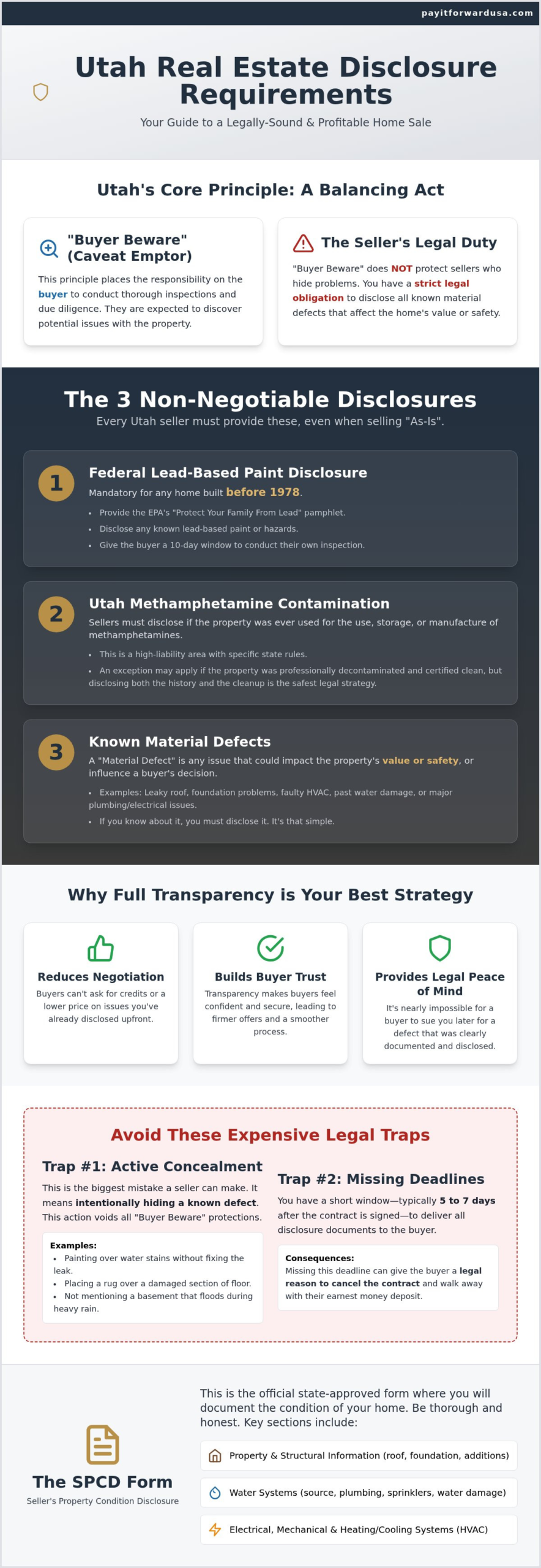
Think of your Seller disclosure statement as a legal force field. In Utah, sellers have a strict legal obligation to reveal known property defects to potential buyers before the contract is finalized. While it might feel like you’re handing over a list of reasons not to buy your home, you’re actually closing the door on future litigation. Utah real estate disclosure requirements exist to ensure a fair transaction. If you know about a problem, you have to speak up. It’s that simple.
You’ve likely heard that Utah is a “Caveat Emptor” or “Buyer Beware” state. This means the buyer is ultimately responsible for conducting their own due diligence and inspections to discover issues. But don’t let that term fool you into staying silent. Caveat emptor only protects you from things you truly didn’t know about. You cannot legally hide a leaking basement or a failing roof behind a fresh coat of paint. A material defect is any issue affecting property value or safety. Full transparency now prevents expensive lawsuits later.
Why “Over-Disclosing” Is Your Best Strategy
A ten page disclosure is infinitely safer than a two page one. Why? It’s all about the psychology of the sale. When a buyer sees a detailed list of every minor repair, they feel like you’re an honest ally. This transparency builds massive trust and often leads to firmer offers. Buyers feel safer knowing the flaws upfront because there are no surprises waiting for them after the inspection. Consider these benefits of being an open book:
- Reduced Negotiation Friction: Buyers won’t try to “re-trade” the price for issues you already disclosed.
- Faster Due Diligence: Transparency clears the path for a smoother inspection period.
- Legal Peace of Mind: It’s nearly impossible to sue a seller for a defect that was clearly documented in the paperwork.
Utah State Law vs. Federal Requirements
The Utah Division of Real Estate is the governing body that sets the rules for local transactions. They provide the standard forms you’ll use to stay compliant. However, federal laws also play a role. For any home built before 1978, federal law requires specific lead based paint disclosures. It’s also vital to remember that Utah is a “non disclosure” state regarding the final sales price. This means the public can’t see what you sold for, but that privacy doesn’t apply to the home’s condition. You must still provide the state mandated Seller’s Property Condition Disclosure to every serious buyer.
The “Big Three” Disclosures Every Utah Seller Must Provide
Selling your home “As-Is” doesn’t give you a free pass to stay silent. In fact, the term “As-Is” only means you won’t pay for repairs; it doesn’t waive utah real estate disclosure requirements. You still have a legal duty to be honest about what you’re selling. Most Utah transactions hinge on three non-negotiable disclosures that must be delivered to the buyer shortly after the Real Estate Purchase Contract (REPC) is signed. Usually, you have a tight window of five to seven days to get this paperwork into the buyer’s hands. Don’t miss this deadline. Delaying these documents can give a buyer a legal “out” to cancel the contract and take their earnest money with them.
Federal Lead-Based Paint Disclosure (Pre-1978 Homes)
If your home was built before 1978, federal law takes over. You must provide buyers with the EPA’s “Protect Your Family From Lead in Your Home” pamphlet. You also have to disclose any known lead-based paint hazards and give the buyer a 10-day window to conduct their own inspection. Federal penalties for skipping this step are steep. We’re talking thousands of dollars in fines per violation. It’s a simple form, but the consequences of ignoring it are massive.
Utah Methamphetamine Disclosure (R162-2f-401j)
Utah has very specific rules about past drug activity. According to the Utah State Code, sellers must disclose if a property has been contaminated by the use, storage, or manufacture of methamphetamines. This is a high-liability area for FSBO sellers. There is one exception: if the property has been decontaminated by a certified specialist and you have the “clean bill of health” documentation, you may not be required to disclose it. However, most savvy sellers disclose the past history and the professional cleanup anyway to eliminate any future claims of “active concealment.”
Material Defects and Structural Integrity
You must share any “Material Facts” that could change a buyer’s mind about the price or the safety of the home. This includes structural issues like foundation cracks, active roof leaks, or hidden mold. In Utah, you also need to look beyond the walls. Soil instability is a common issue in our geography, as are water rights disputes and flood zone designations. If you’ve got the right documents ready, you can list your home today and move straight to the offer stage with total peace of mind. Use this checklist to ensure you’ve covered the basics:
- Structural: Foundation, roof, and load-bearing walls.
- Systems: Electrical, HVAC, and plumbing.
- Environmental: Radon levels, soil issues, and pests.
- Legal: Boundary disputes, easements, or HOA litigation.
Navigating the Utah Seller’s Property Condition Disclosure (SPCD)
The Seller’s Property Condition Disclosure (SPCD) is the primary tool for meeting utah real estate disclosure requirements. This document, approved by the Utah Association of Realtors, acts as your official record of the home’s history. It covers everything from the age of your water heater to the last time you patched the roof. Think of it as a comprehensive health report for your property. When filling it out, you’ll encounter a “Don’t Know” checkbox. Use it only when you truly lack information. If you’ve lived in the home for a decade and claim you “don’t know” the age of the furnace, a buyer’s attorney might see that as a red flag later. If you are unsure about the specifics, how much does it cost to sell a house in Utah FSBO? Knowing your costs and legal obligations upfront keeps your equity safe.
Section-by-Section Breakdown of the SPCD
The SPCD isn’t just about leaky pipes. The Environmental section is critical in Utah, specifically regarding radon gas and asbestos. Radon is common in our soil, and if you’ve had a test, you must share the results. The Legal section requires you to disclose encroachments or boundary disputes. Did your neighbor build a fence six inches onto your lot? You need to mention it. Don’t forget neighborhood conditions. If there is a planned construction project or a persistent noise issue, transparency is your best defense. Buyers appreciate knowing about the local quirks before they sign.
HOA Disclosures and CC&Rs
If your home is part of an association, your disclosure duties increase. Utah law is specific about providing HOA meeting minutes, current budgets, and the Covenants, Conditions, and Restrictions (CC&Rs). You must also watch out for the “Transfer Fee” trap. Many HOAs charge a fee to change ownership records. If you don’t disclose this cost to the buyer, you might end up eating that expense at the closing table. The SPCD is your receipt for telling the truth. It proves you provided all the necessary data to the buyer, effectively shifting the responsibility of the “final decision” onto their shoulders. Documentation is the ultimate shield for your equity.
Common Disclosure Mistakes That Lead to Utah Lawsuits
Many sellers think they’ve done enough by handing over the keys, only to find themselves in a deposition six months later. Avoiding your utah real estate disclosure requirements is the fastest way to lose your equity to legal fees. The most dangerous mistake you can make is relying on “verbal disclosures.” If you told the buyer about the basement seep while standing in the kitchen, it didn’t happen. If it isn’t in writing, it doesn’t exist in the eyes of the law. Documentation is your only defense against a “he said, she said” scenario in court.
You also need to understand the “Active Concealment” doctrine. Painting over a water stain on the ceiling isn’t “prepping the home for sale”; it’s a crime if you’re hiding an active leak. If you take any step to physically hide a defect, you’re moving from a simple oversight into the territory of fraud. Fraudulent concealment bypasses most “Buyer Beware” protections. Check out the truth about Utah MLS listing services to see how savvy sellers manage these risks while skipping the high costs of traditional agents.
Avoid these top 5 mistakes that trigger Utah lawsuits:
- Forgetting past insurance claims: Buyers can see your “CLUE” report. If you claimed hail damage but didn’t disclose it, they’ll know.
- Ignoring soil issues: Utah’s “expansive soil” is famous for cracking foundations. If your doors stick in the summer, mention it.
- Omitting shared agreements: Shared driveways or informal fence agreements with neighbors must be documented.
- Guessing on system ages: Don’t guess the furnace is five years old if it’s actually twelve. Mark “Don’t Know” instead.
- Hiding water rights: If your property includes irrigation shares or specific water rights, failing to disclose their status is a major legal trap.
The “As-Is” Misconception
“As-is” does NOT mean “I don’t have to tell you what’s broken.” This is the most common myth in the Utah market. Selling a home “As-Is” simply means you won’t pay for repairs and the price reflects the current condition. It does not waive your legal duty to disclose every known material defect. You can use an “As-Is” addendum to set expectations, but it must be paired with a fully completed disclosure form to be legally sound. Transparency is the only way to make an “As-Is” sale stick.
Failing to Update Disclosures During the Listing
Your duty to disclose doesn’t end when you sign the initial paperwork. If a water heater breaks or a windstorm rips off shingles while the home is under contract, you must provide “Amended Disclosures.” Utah law requires you to update the buyer if new information comes to light before the closing date. Even if a buyer’s inspection reveals a problem you genuinely didn’t know about, you should formally update your disclosures to reflect that new reality. Protect your equity and list today with a partner who understands the local legal landscape.
Save Your Equity: Managing Disclosures with an $89 Utah MLS Listing
You’ve done the heavy lifting. You understand the utah real estate disclosure requirements, you’ve identified your home’s material defects, and you’re ready to protect your equity. Why hand over 3% of your hard-earned money to a listing agent now? Traditional agents often use the complexity of legal paperwork as a scare tactic to justify their high commissions. But you’ve already pulled back the curtain. With your disclosures in hand, you’re the most qualified person to sell your home. You just need the right platform to reach buyers.
That’s where the Pay It Forward Realty LLC $89 Affordable Package comes in. We provide the same MLS exposure as a high-priced brokerage for a fraction of the cost. You get your home in front of every local buyer and agent without sacrificing your profit. It’s a bold, efficient alternative to the status quo. Principal Broker Kurt Mathewson provides local oversight to ensure your listing is professional, accurate, and live on the marketplace. You’re in control, but you aren’t alone.
Why Pay It Forward Realty LLC Is the Savvy Choice
The math is simple. On a $500,000 home, a 3% listing commission eats $15,000 of your equity. Our $89 package keeps that money in your pocket. We’re a local Utah brokerage licensed under #14214237-CN00, not some distant national referral site. We offer tiered options to fit your specific needs:
- Affordable Package ($89): The ultimate budget-friendly way to get on the MLS.
- Monthly Listing Plan ($29/mo): Perfect for sellers who want flexibility without a large upfront cost.
- Affordable Plus Package ($195): Extra tools for sellers who want a more comprehensive listing experience.
By choosing a flat-fee model, you’re embracing transparency and consumer advocacy. You’re proving that you don’t need a middleman to manage your high-stakes transaction. It’s about autonomy and financial intelligence.
Taking the Next Step: List Your Home Today
The paperwork is ready. The house is prepped. The only thing standing between you and a smooth closing is the right listing. Don’t let the fear of legal jargon hold you back any longer. You have the shield of full disclosure and the power of the MLS on your side. It’s time to take action and secure your financial future. Check out our guide on how to list on MLS for $89 and start your journey toward a commission-free sale. Empower yourself, skip the 3% commission, and keep your equity where it belongs: with you.
Secure Your Equity and Close with Confidence
Mastering utah real estate disclosure requirements is the final hurdle between you and a successful, commission-free sale. You’ve learned that transparency is your greatest legal shield. By documenting the “Big Three” and accurately completing the SPCD, you’ve effectively removed the post-sale liability that keeps most sellers awake at night. You don’t need a high-priced agent to manage this process; you just need the right tools and local expertise to back you up.
Now that your paperwork is ready, it’s time to maximize your profit. You can save over $10,000 in Realtor commissions while still receiving professional, licensed Utah Broker oversight. Whether you choose our budget-friendly Affordable Package or a more comprehensive plan, we have tiered packages for every budget to ensure your listing shines on the MLS. You have the knowledge and the power to control your own transaction. Take the final step toward financial liberation and List Your Utah Home on the MLS for Just $89 today. You’ve got this!
Frequently Asked Questions
Is a property disclosure required by law in Utah?
Yes, Utah law mandates that sellers provide a written Seller’s Property Condition Disclosure (SPCD) to potential buyers before a contract is finalized. This document details your knowledge of the property’s health. While Utah is a “Buyer Beware” state, you can’t legally hide material defects that affect safety or value. Meeting these utah real estate disclosure requirements is a non-negotiable step for sellers in Saratoga Springs and Lehi who want a legal sale.
Do I have to disclose if someone died in the house in Utah?
No, you generally don’t have to disclose “stigmatized” events like a natural death, suicide, or homicide on the property. These aren’t considered physical material defects. However, if a buyer in Eagle Mountain or American Fork asks you a direct question about it, you cannot lie. Being honest is the best way to avoid a fraud claim later. If you’re unsure, it’s often safer to be an open book and maintain full transparency.
What is the Utah Methamphetamine Disclosure requirement?
Utah law specifically requires you to disclose if a home has been contaminated by the use, storage, or manufacture of methamphetamines. This is a high-stakes requirement for sellers in Orem and Provo. If the property was professionally decontaminated and you have a certified “clean bill of health,” you might be exempt from disclosing the past issue. However, most savvy sellers still provide the cleanup records to eliminate any future liability or legal disputes regarding the home’s history.
Can a buyer sue you after closing in Utah for a non-disclosure?
Yes, a buyer can absolutely sue you after closing if they prove you intentionally hid a known material defect. This is known as “active concealment” and it’s a serious legal risk. If you patched a foundation crack without disclosing it, you’re liable for the repair costs and potential damages. Following utah real estate disclosure requirements is your best insurance policy. It ensures a clean break from the property for sellers in Salt Lake and Murray.
Do I need a home inspection if I provide a full disclosure?
You still need a home inspection because your disclosure only covers what you already know. An inspection is a professional deep dive to find hidden issues you might have missed. Buyers in Sandy and Draper are responsible for their own due diligence under Utah law. Providing a full disclosure builds trust and sets a baseline, but the inspection is the buyer’s tool to verify the home’s condition before they commit to the final purchase.
How do I handle disclosures if I have never lived in the property?
If you’ve never lived in the property, such as a rental in South Jordan or an inheritance in Herriman, you still must complete the disclosure. Use the “Don’t Know” box for items you haven’t personally seen. However, you must still share any information from past inspection reports or maintenance records you have. Being an absentee owner doesn’t excuse you from sharing the known history of the property with a prospective buyer before they sign the contract.
What happens if I make a mistake on my Utah Seller Disclosure form?
If you make a mistake or a new issue pops up, you must provide an “Amended Disclosure” immediately. Utah law requires you to update the buyer if new information comes to light before the house closes. This protects you from claims that you were being dishonest. Whether you’re in West Jordan or Bountiful, keeping your paperwork current is the only way to ensure a smooth closing and avoid expensive legal battles after the sale is complete.
Does an “As-Is” sale exempt me from Utah disclosure laws?
No, an “As-Is” sale does not give you a free pass to stay silent about defects. Selling “As-Is” simply means you won’t pay for repairs and the price reflects the current state of the home. You still have a legal duty to disclose every known material defect to the buyer. If you hide a known roof leak behind an “As-Is” clause, you’ll likely lose in a Utah court if the buyer sues you for fraud.