Utah For Sale By Owner Laws: Your 2026 Legal Survival Guide


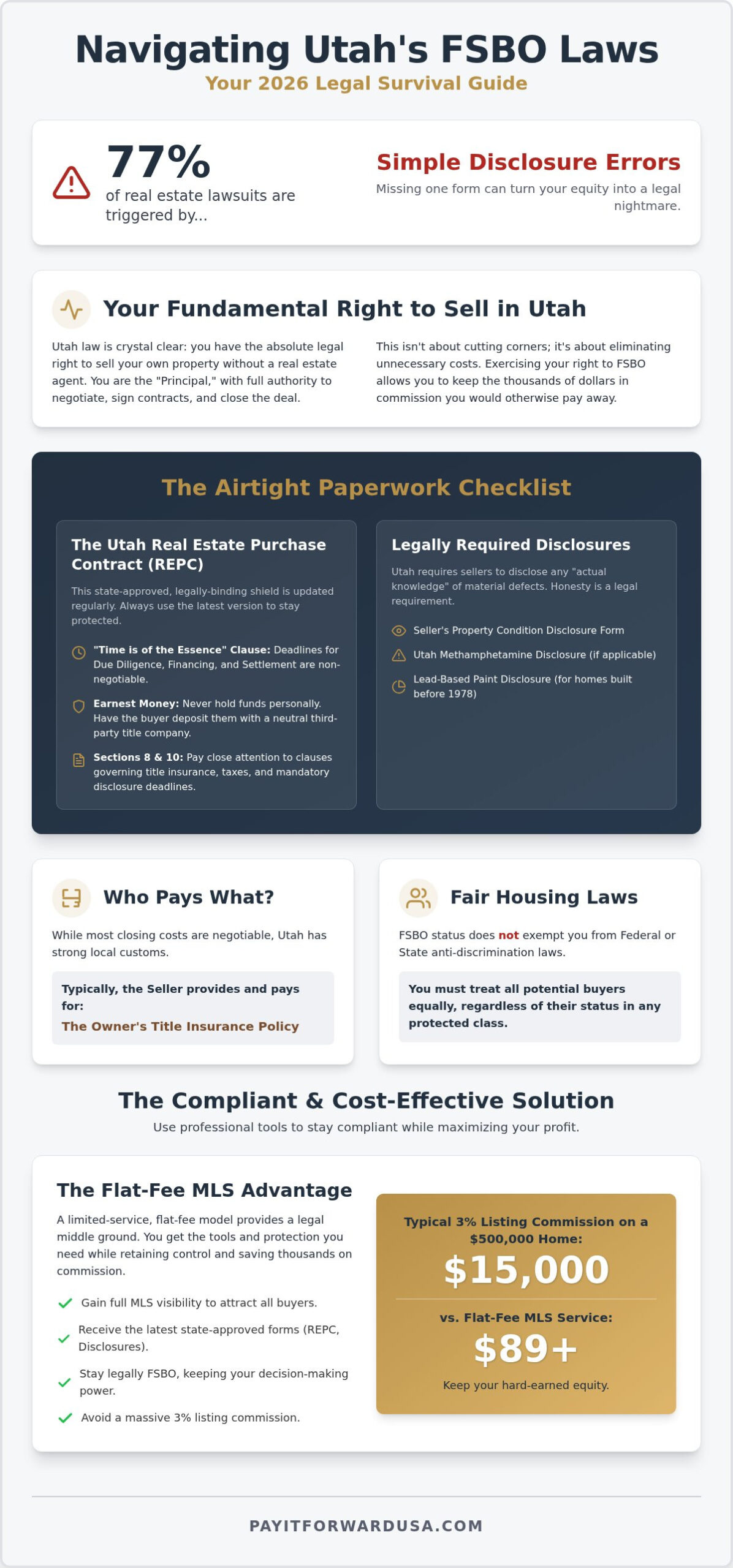
Did you know that 77% of real estate lawsuits are triggered by simple disclosure errors? It’s a staggering number that makes many sellers hand over a massive commission check just for “peace of mind.” You’re right to be cautious about utah for sale by owner laws. Missing a single update to the REPC or a mandatory disclosure can turn your hard-earned equity into a legal nightmare. But you don’t need a traditional agent to stay protected. You just need the right map.
We agree that the paperwork feels like a maze designed to keep you paying high fees. That’s why we’re pulling back the curtain. This 2026 legal survival guide promises to demystify the mandatory forms and Fair Housing requirements so you can manage your transaction autonomously. We’ll preview the essential state-approved documents, break down customary closing costs, and provide a clear checklist to ensure your sale is airtight. Stop worrying about legal loopholes and start focusing on your bottom line. You’ve got this!
Key Takeaways
- Confirm your legal right to sell. Utah law explicitly allows you to represent yourself without a Realtor or attorney when selling your primary residence.
- Master the paperwork to avoid litigation. Understanding utah for sale by owner laws helps you navigate the REPC and mandatory disclosures that often trigger legal disputes.
- Differentiate between legal requirements and local customs. Learn why Utah sellers typically provide the Owner’s Title Insurance Policy and how to manage other closing costs.
- Stay compliant with Fair Housing standards. FSBO status does not exempt you from federal or state anti-discrimination laws, making knowledge of protected classes vital.
- Utilize professional tools to simplify compliance. Flat-fee MLS services provide the state-approved forms you need to keep your transaction airtight while saving on commissions.
Understanding Your Legal Rights as a FSBO Seller in Utah
Utah law is crystal clear. You have the absolute legal right to sell your own property. You don’t need a middleman. You don’t need to pay a 3% listing commission to someone just for putting a sign in your yard. In the eyes of the law, you are the “Principal.” This means you have the full legal authority to negotiate, sign contracts, and close the deal. It’s your asset. You should be the one who decides how to trade it.
Many homeowners in fast-growing areas like Eagle Mountain and Saratoga Springs are waking up to this reality in 2026. Why give away $15,000 or $30,000 of your equity when utah for sale by owner laws are designed to support your autonomy? You aren’t just winging it. You’re exercising a statutory right. Choosing For Sale By Owner (FSBO) isn’t about cutting corners. It’s about cutting out unnecessary costs that don’t add value to your bottom line.
The Role of the Utah Division of Real Estate
The Utah Division of Real Estate exists to keep the market stable, not to force you into a brokerage contract. They provide state-approved forms like the Real Estate Purchase Contract (REPC). These aren’t just suggestions; they’re the bedrock of every residential transaction in the state. Using these standardized forms actually reduces your legal liability. They’re vetted by experts to meet current state requirements. You don’t need an attorney to draft a custom contract from scratch when the state has already done the heavy lifting for you. Stick to the approved forms, and you stay on solid ground.
Brokerage vs. FSBO: The Legal Middle Ground
You might think it’s an all-or-nothing choice. It isn’t. There’s a powerful legal middle ground called “Limited Service.” This is where you remain the seller in control but use a flat-fee MLS service to get the exposure you need. By using the $89 Affordable Package, you stay legally FSBO while gaining the same visibility as a big-box brokerage. You keep your “Seller” status and your equity. It’s a strategic move. You get the professional tools and the mandatory forms without the professional price tag. This approach keeps you compliant with utah for sale by owner laws while putting your home in front of every buyer in the state.
Mandatory Disclosures and the Utah Real Estate Purchase Contract (REPC)
The Real Estate Purchase Contract (REPC) isn’t just a piece of paper. It’s a legally binding shield. Under utah for sale by owner laws, this state-approved document dictates exactly how your home transitions to a new owner. Don’t try to reinvent the wheel with a downloaded template from a generic site. The REPC is updated regularly by the Utah Division of Real Estate to reflect current court rulings and legislative changes. It’s the gold standard for a reason. Use it to stay protected.
Deep Dive into the Utah REPC
Focus on the “Time is of the Essence” clause. Deadlines are non-negotiable. If you miss the Due Diligence, Financing and Appraisal, or Settlement dates, you could lose the deal or your earnest money. Speaking of money, FSBO sellers shouldn’t hold earnest money personally. It’s a legal trap. Always have the buyer deposit those funds directly with a neutral third-party title company. Pay close attention to Section 10. This section mandates that you provide specific disclosures by a set deadline. Fail this, and the buyer can walk away with their deposit intact. Section 8 is equally vital, as it governs how title and taxes are handled at the closing table.
The ‘Actual Knowledge’ Standard in Utah
Utah is not a ‘Buyer Beware’ state regarding known material defects. This means “As-Is” clauses won’t save you if you intentionally hide a basement flood or a mold issue. You are legally obligated to disclose any “actual knowledge” of problems that affect property value or safety. This includes latent defects, which are problems a buyer wouldn’t find during a standard walkthrough. For example, you must comply with Utah’s Methamphetamine Disclosure Law. This law requires written notice if the property has ever been contaminated and not decontaminated to state standards. Honesty isn’t just a virtue here; it’s a legal requirement that prevents future litigation.
Mastering utah for sale by owner laws means being an open book about your property’s history. You’ll use the Seller’s Property Condition Disclosure form to document everything from roof age to HOA rules. If your home was built before 1978, federal law also requires a Lead-Based Paint Disclosure and the “Protect Your Family” pamphlet. Non-compliance here carries heavy federal fines. Honest disclosure is your best defense against the 77% of real estate lawsuits that stem from disclosure issues. To get your hands on these specific forms without the high-cost broker, consider starting with an affordable flat-fee listing to ensure you have the right paperwork from day one.
Customary Costs and Closing Laws: Who Pays What in Utah?
Understanding the math behind your sale is just as vital as understanding the paperwork. While you’re saving that massive 3% listing commission, you still need to account for settlement fees. In Utah, there’s a big difference between what the law requires and what local buyers expect. If you ignore these traditions, your deal might stall before it even starts. You need to know which costs are negotiable and which ones are set in stone by utah for sale by owner laws.
Most Utah sellers can expect to pay approximately 1% of the home’s sale price in closing costs, excluding any commissions offered to a buyer’s agent. These costs aren’t just “junk fees.” They cover the essential legal work required to transfer a deed safely. In a competitive market, being transparent about these costs can actually make your listing more attractive to savvy buyers who are looking for a smooth, professional transaction.
Title Insurance and Escrow Legalities
In a standard Utah transaction, the seller typically pays for the Owner’s Title Insurance Policy. Why? Because you’re proving to the buyer that you actually own the house and it’s free of surprise liens. While the law doesn’t strictly mandate who pays, buyers from St. George to Logan will expect this as a standard concession. You’ll also deal with the Title Commitment. This is the title company’s legal promise to issue insurance once certain conditions are met at the closing table.
Don’t confuse “Settlement” with “Closing.” Settlement is the day you sit down and sign the mountain of paperwork. Closing only happens after the funds have been wired and the county recorder officially stamps the deed. It’s a distinction that matters if you’re trying to time your move-out date perfectly. For a deeper look at specific dollar amounts, check out this guide on how much does it cost to sell a house in utah fsbo to see the 2026 breakdown.
Taxes and Prorations
Taxes don’t just stop because you’re moving. Under utah for sale by owner laws, property taxes are prorated to the exact day of closing. If you’ve already paid for the year, the buyer credits you back at settlement. If you haven’t, you’ll owe your portion at the table. It’s a fair, mathematical split that ensures no one gets stuck with the other party’s bill.
Watch out for HOA transfer fees. Usually, the buyer pays these, but it’s all negotiable in the REPC. If you’re selling a rural property in Utah County, be extremely careful with Greenbelt or rollback taxes. These can be massive if the land use changes. The legal responsibility for paying them must be clearly defined in your contract to avoid a five-figure surprise that could eat your entire profit margin.
Avoiding Legal Traps: Fair Housing and Paperwork Pitfalls
Selling your own home gives you total control, but it doesn’t give you a hall pass on civil rights. Many sellers mistakenly believe that utah for sale by owner laws allow them to pick and choose buyers based on personal preference. That’s a dangerous assumption. Both the Federal Fair Housing Act and the Utah Fair Housing Act apply to you the moment you put your home on the market. One wrong comment to a prospective buyer can spark a devastating discrimination lawsuit that wipes out your equity faster than any commission ever could. It’s your house, but it’s the buyer’s right to be treated fairly.
Fair Housing Compliance for Utah FSBOs
You need to treat every inquiry with the same professional distance. Utah law protects specific classes that go beyond federal standards, including source of income, sexual orientation, and gender identity. In booming markets like Herriman or South Jordan, you might receive “love letters” from buyers trying to stand out. Don’t open them. These letters often reveal protected information about family status or religion. If you reject that buyer later, they could claim you did so because of what you learned in that letter. Stay safe. Stick to the numbers and the contract terms. Avoid “steering” by never commenting on the “type” of people who live in the neighborhood. Let the data speak for itself.
Contingency Management
The Utah REPC is a clock that starts ticking the moment you sign. The “Time is of the Essence” clause means exactly what it says. If a buyer misses their Due Diligence deadline by even one minute, their right to cancel and keep their earnest money usually evaporates. But be careful. If you try to cancel the contract without a clear legal default, you could face a “Specific Performance” lawsuit. This is where a judge forces you to sell the home to the original buyer against your will. It’s a nightmare scenario that’s easily avoided by tracking your dates religiously.
What about the earnest money? It’s the most common point of conflict in FSBO transactions. You can’t legally keep it just because a buyer’s personality annoyed you. You can only claim it if they breach the contract after all their contingencies have expired. If you find yourself in a dispute, don’t play lawyer. Use the standardized processes provided by the state. You can manage these risks easily when you have the right tools. To ensure your listing and paperwork stay on the right side of the law, list your home with a flat-fee MLS package and get immediate access to the professional forms that protect your interests.
The Legal Shortcut: Using Flat-Fee MLS to Stay Compliant
You’ve mastered the rules. Now you need the tools. Many sellers think they have to choose between a full-service broker and total isolation. They’re wrong. Using a flat-fee MLS service is the ultimate legal shortcut. It allows you to stay firmly in the “For Sale By Owner” category while gaining the professional visibility and standardized paperwork usually reserved for big-box firms. You keep your equity. You keep your autonomy. You simply stop overpaying for the privilege of being compliant with utah for sale by owner laws.
Whether you’re selling a townhome in Saratoga Springs, a tech-corridor condo in Lehi, or a historic property in Salt Lake City, the MLS is the heartbeat of the market. Listing there isn’t just about marketing. It’s a strategic legal move. It ensures your property is visible to every licensed agent in the state, creating a transparent trail of offers and interactions. This transparency is your best defense against claims of “pocket listings” or unfair housing practices. It puts you on a level playing field without the 3% entry fee.
Standardized Forms and Professional Support
Don’t risk your sale with a “free” contract found on a random internet forum. Pay It Forward Realty provides direct access to state-approved legal forms, including the most current version of the Utah REPC. Our tiered packages are designed to help you manage your paperwork like a pro. If you’re curious about how this fits into the broader market, our ultimate guide to low commission real estate in utah explains why choosing a flat-fee model is the smartest legal choice you can make in 2026. You get the right documents at the right time. By leveraging a professional utah mls listing service, you maintain total FSBO control while the system handles the technical heavy lifting.
Closing with Confidence
The journey from an accepted REPC to a recorded deed doesn’t have to be stressful. You’ve navigated utah for sale by owner laws with precision. Now, you just need to cross the finish line. Kurt Mathewson’s brokerage model acts as your legal ally, providing the framework you need to succeed without the traditional overhead. You’ve done the work. You’ve protected your equity. Now it’s time to collect your check at the closing table. Success is within reach. Ready to list? Get started with our $89 Affordable Package today!
Take Command of Your Equity Today
You’ve got the map. Now it’s time to make your move. Navigating utah for sale by owner laws isn’t a solo climb through red tape anymore. You have the statutory right to act as your own agent. By using state-approved forms like the REPC and prioritizing honest disclosures, you’ve already neutralized the biggest legal risks. You aren’t just saving on commissions; you’re taking full ownership of your financial future.
As a licensed Utah brokerage, we’re ready to be your bold ally. From our $89 entry-level option to tiered packages for every seller level, we provide the professional tools you need to stay compliant. You can even leverage a buyer rebate of up to $5,000 to make your home the most attractive listing on the block. Don’t let the fear of paperwork stand between you and your profit. It’s your home. It’s your equity. Keep it that way.
List on the MLS for just $89 and keep your equity!
You have the knowledge. You have the forms. Now, go get that “Sold” sign and celebrate your success!
Frequently Asked Questions
Is it legal to sell my own home in Utah without a Realtor?
Yes, it’s absolutely legal. Utah law grants you the right to act as the “Principal” in your own transaction. You don’t need a middleman to sign a deed or negotiate a price. This autonomy is a core part of utah for sale by owner laws, allowing you to bypass traditional commissions while maintaining full legal authority over your property.
What is the most important legal form for a Utah FSBO seller?
The Real Estate Purchase Contract (REPC) is the most critical form. It’s the state-approved document that dictates the terms of the sale, deadlines, and contingencies. Using the official version provided by the Utah Division of Real Estate ensures your contract is legally sound and recognized by title companies and lenders across the state. Don’t use generic internet templates.
Does a seller have to provide title insurance in Utah?
It isn’t a legal requirement, but it is a universal custom. In almost every Utah transaction, the seller pays for the Owner’s Title Insurance Policy. This policy protects the buyer from future claims against the property. Expecting a buyer to pay this cost is rare and could make your home much harder to sell in a competitive marketplace.
Who drafts the real estate contract in a FSBO sale in Utah?
Most often, the buyer’s agent will prepare the offer on the standard REPC form. If the buyer is also FSBO, either party can fill out the state-approved template. You aren’t required to hire an attorney to draft a contract because the state has already provided the vetted language you need to complete a residential sale safely.
What happens if I forget to disclose a problem with the house?
You risk a costly lawsuit for breach of contract or fraud. Utah requires sellers to disclose all “material defects” they actually know about. If a buyer finds a hidden issue after closing, like a cracked foundation or past flooding, they can take you to court. Honest disclosure is your cheapest and most effective legal insurance against future claims.
Can I legally list my home on the Utah MLS for a flat fee?
You can definitely list on the MLS through a flat-fee service. This is a savvy way to work within utah for sale by owner laws to get professional exposure without the 3% listing fee. You maintain your FSBO status while a licensed broker handles the technical entry into the state’s primary database for home buyers and agents.
How do I handle earnest money if I don’t have an agent?
Always use a neutral third party. Have the buyer deposit their earnest money directly with the title company you’ve chosen for the closing. This keeps the funds in a secure escrow account. It also prevents you from being accused of mishandling the money if the deal falls through or a dispute arises over the contract terms.
What are the Fair Housing laws for private sellers in Utah?
Private sellers must comply with the Federal Fair Housing Act and the Utah Fair Housing Act. You cannot discriminate based on race, religion, sex, disability, or family status. Utah also includes protections for sexual orientation and source of income. These laws apply to you the moment you advertise your home for sale, regardless of your FSBO status.